
 By
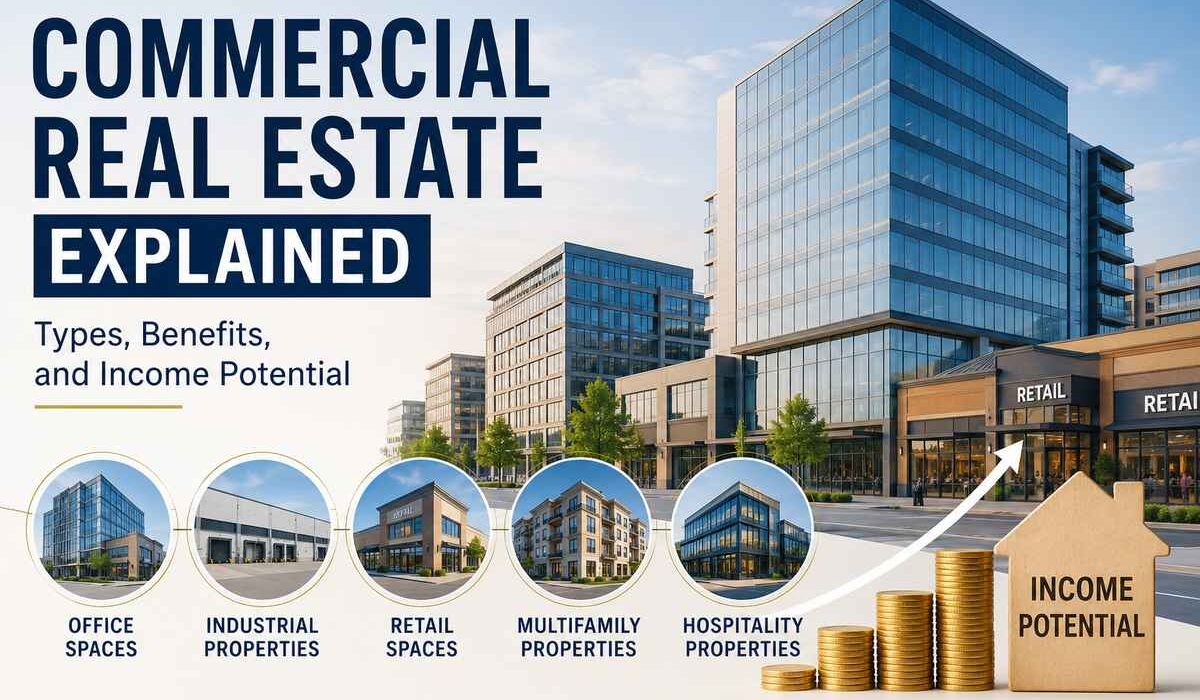
By Commercial Real Estate Explained: Types, Benefits, and Income Potential
Commercial real estate is one of the most important segments of the property market, offering businesses the space they need to operate while giving investors opportunities to generate rental income and build long-term wealth. From office buildings and retail spaces to warehouses and multifamily properties, commercial real estate covers a wide range of property types and investment strategies.
For investors, understanding how commercial real estate works is essential before purchasing a property or entering the market. Unlike residential property, where homes are primarily designed for individuals and families, commercial properties are generally used for business and income-generating purposes.
This guide explains what commercial real estate is, the different types of commercial properties, its key benefits, potential income, risks, and important factors to consider before investing.
What Is Commercial Real Estate?
Commercial real estate (CRE) refers to properties primarily used for business, commercial, or income-generating activities. These properties can be leased to companies, retailers, professionals, manufacturers, logistics operators, and other organizations.
Common examples include office buildings, shopping centers, warehouses, hotels, and industrial facilities.
The main purpose of commercial real estate investment is often to generate income through rent, although investors may also benefit from property appreciation over time.
Commercial properties can range from a small retail unit on a busy street to a large industrial warehouse or a multi-story office complex. The investment size, risk, rental structure, and potential returns can vary significantly depending on the property type and location.
Types of Commercial Real Estate
Understanding the different types of commercial real estate can help investors identify opportunities that match their financial goals and risk tolerance.
1. Office Properties
Office properties are designed for businesses and professional services. They include small office buildings, coworking spaces, business centers, and large corporate towers.
Office properties may be leased to technology companies, financial firms, law firms, consulting businesses, healthcare professionals, and other organizations.
The location, accessibility, building quality, amenities, and demand from local businesses can have a significant impact on rental income and occupancy.
2. Retail Properties
Retail real estate includes properties where businesses sell products or services directly to consumers. Examples include shopping centers, high-street retail stores, supermarkets, and neighborhood shopping complexes.
Retail properties can benefit from high foot traffic and strong consumer demand. However, their performance may depend heavily on location, local spending patterns, competition, and changing consumer behavior.
Properties located in established commercial areas with good visibility and accessibility can potentially attract strong tenants.
3. Industrial Properties
Industrial real estate is used for manufacturing, production, storage, distribution, and logistics operations.
Warehouses, distribution centers, manufacturing facilities, and logistics parks are common examples.
The growth of e-commerce and organized supply chains has increased demand for certain industrial and logistics properties in many markets. Proximity to highways, ports, airports, rail networks, and major population centers can be particularly valuable.
4. Multifamily Properties
Multifamily properties contain multiple residential units within a single investment property. Apartment buildings and large residential complexes are common examples.
Although the units are residential, multifamily properties are often classified as commercial real estate when they contain a sufficient number of units.
These properties can provide diversified rental income because revenue comes from multiple tenants rather than one occupant.
5. Hospitality Properties
Hospitality real estate includes hotels, resorts, serviced apartments, and other properties designed to accommodate travelers and guests.
Income from hospitality properties can be attractive during periods of strong tourism and business travel. However, these investments can also be more sensitive to economic conditions, seasonal demand, operating expenses, and changes in travel patterns.
6. Special-Purpose Properties
Some commercial properties are designed for specific uses and may be harder to convert to another purpose. These include hospitals, schools, theaters, religious facilities, data centers, and certain recreational properties.
Special-purpose real estate can provide unique investment opportunities, but investors need to carefully evaluate the property’s future demand and potential resale market.
Benefits of Commercial Real Estate Investment
Commercial real estate can offer several potential advantages compared with other types of investments.
Potential for Regular Rental Income
One of the biggest attractions of commercial property investment is the possibility of generating recurring rental income.
Commercial leases can sometimes be longer than typical residential leases, providing investors with greater income visibility. Depending on the lease agreement, tenants may also be responsible for some property-related expenses.
The actual income structure varies by property, tenant, lease type, and market conditions.
Long-Term Appreciation Potential
Commercial properties may increase in value over time due to improvements in infrastructure, economic growth, rising demand, limited land availability, or development in the surrounding area.
Investors can potentially benefit from both rental income and capital appreciation.
However, property values are not guaranteed to increase. Economic downturns, oversupply, poor management, changing business conditions, and unfavorable market trends can negatively affect valuations.
Diversification
Commercial real estate can add another asset class to an investment portfolio.
Instead of relying entirely on stocks, bonds, or residential property, investors may use commercial real estate to diversify their sources of income and potential returns.
Professional Tenants
Commercial properties are generally occupied by businesses rather than individual households. A successful tenant may have a strong incentive to maintain the property and remain in the location because relocating a business can be costly and disruptive.
However, tenant quality should always be evaluated carefully before making an investment.
Potential Inflation Protection
Real estate can sometimes provide a degree of protection against inflation because rents may increase over time. Some commercial leases include rent escalation clauses that allow rental rates to rise periodically.
This can help property income keep pace with increasing operating costs and general price levels.
The extent of inflation protection depends on lease terms, market demand, vacancy rates, and the property’s operating expenses.
How Does Commercial Real Estate Generate Income?
The income potential of commercial real estate comes primarily from rental payments, but investors can generate returns in several ways.
Rental Income
The most straightforward source of income is rent paid by tenants.
For example, an investor who owns a commercial building may lease space to several businesses. The combined rental payments can create a recurring revenue stream.
However, gross rent is not the same as investment profit. Owners may need to pay property taxes, insurance, maintenance, management fees, utilities, financing costs, and other expenses.
Property Appreciation
An investor may also earn a return when the property increases in value and is later sold for more than the original purchase price.
Improvements to the property, higher rents, better occupancy, infrastructure development, and increased demand can potentially contribute to appreciation.
Value-Add Opportunities
Some investors purchase properties that have the potential for improvement. Renovations, better property management, stronger tenant selection, or improved occupancy may increase the property’s income and overall value.
This strategy can potentially produce higher returns, but it usually requires additional capital, expertise, and risk management.
How Is Commercial Real Estate Income Measured?
Investors use several financial metrics to evaluate the performance of commercial properties.
Net operating income (NOI) is one of the most important measures. It generally represents the property’s income after operating expenses but before debt payments and certain other costs.
Another common metric is capitalization rate, or cap rate. It is generally calculated by dividing a property’s NOI by its value or purchase price.
For example, if a property generates $100,000 in annual NOI and is valued at $2 million, its approximate cap rate would be 5%.
Investors may also consider cash-on-cash return, which compares annual pre-tax cash flow with the amount of cash invested.
These metrics should not be considered in isolation. A property with a higher cap rate may carry greater risks, while a lower cap rate may reflect stronger demand, better location, or more stable tenants.
Factors That Affect Commercial Real Estate Income Potential
The income potential of a commercial property depends on several factors.
Location
Location is one of the most important considerations. Properties near major transportation routes, business districts, residential communities, or population centers may benefit from stronger demand.
Tenant Quality
A reliable tenant can provide greater income stability. Investors should evaluate a tenant’s business strength, lease history, industry, and ability to meet rental obligations.
Lease Terms
Lease duration, rent increases, renewal options, maintenance responsibilities, and other contractual provisions can significantly affect investment returns.
Occupancy
A property with high occupancy generally has stronger income potential than one with significant vacant space. However, investors should also consider whether current rents are sustainable.
Property Condition
Older buildings may require significant capital expenditure for repairs, upgrades, energy efficiency improvements, or compliance requirements.
Market Demand
Local employment, business formation, population growth, infrastructure investment, and economic conditions can influence demand for commercial space.
Risks of Commercial Real Estate Investment
While commercial real estate can provide attractive opportunities, it is not risk-free.
Vacancy risk is a major concern. If a tenant leaves and the property remains vacant, the owner may lose rental income while continuing to pay operating and financing expenses.
Market risk can also affect property values and rents. Economic recessions, changing consumer preferences, technological shifts, and oversupply can reduce demand.
There is also tenant concentration risk, particularly when a property depends heavily on one major tenant.
Financing creates another layer of risk. Higher interest rates or excessive debt can increase borrowing costs and reduce investment cash flow.
Investors should therefore conduct detailed due diligence before purchasing commercial real estate.
What to Consider Before Investing in Commercial Real Estate
Before making an investment, evaluate the property’s location, purchase price, expected rental income, operating expenses, occupancy, tenant quality, lease agreements, financing structure, and potential future demand.
It is also important to understand local zoning regulations, taxes, building requirements, environmental considerations, and potential development plans in the surrounding area.
A professional property inspection and financial analysis can help identify potential issues before completing a transaction.
Investors should also avoid relying solely on projected returns. Conservative assumptions about vacancies, repairs, rent growth, and expenses can provide a more realistic picture of potential performance.
Is Commercial Real Estate a Good Investment?
Commercial real estate can be a good investment for individuals and businesses seeking potential rental income, portfolio diversification, and long-term appreciation.
However, it is not automatically profitable. Success depends on purchasing the right property at an appropriate price, selecting suitable tenants, managing expenses, understanding market conditions, and maintaining the asset effectively.
Unlike some financial investments, commercial property can also require substantial upfront capital and ongoing management.
For investors who understand these requirements and conduct proper due diligence, commercial real estate can become an important part of a long-term investment strategy.
Final Thoughts
Commercial real estate includes a broad range of properties, from offices and retail spaces to warehouses, multifamily buildings, hotels, and specialized facilities. Each category has its own characteristics, risks, tenant requirements, and income potential.
The primary attractions of commercial property investment are recurring rental income, potential appreciation, diversification, and the possibility of increasing property value through effective management.
At the same time, investors need to consider vacancy, market fluctuations, tenant risk, operating expenses, financing costs, and property maintenance.
Ultimately, successful commercial real estate investing is based on research and disciplined decision-making rather than simply buying a property and expecting its value to rise. By understanding property types, analyzing income potential, evaluating risks, and studying local market conditions, investors can make more informed decisions and identify commercial real estate opportunities that align with their financial objectives.