
 By
By Below is a publication-ready, SEO-friendly article of approximately 1,900 words, incorporating current 2026 architecture and construction developments.
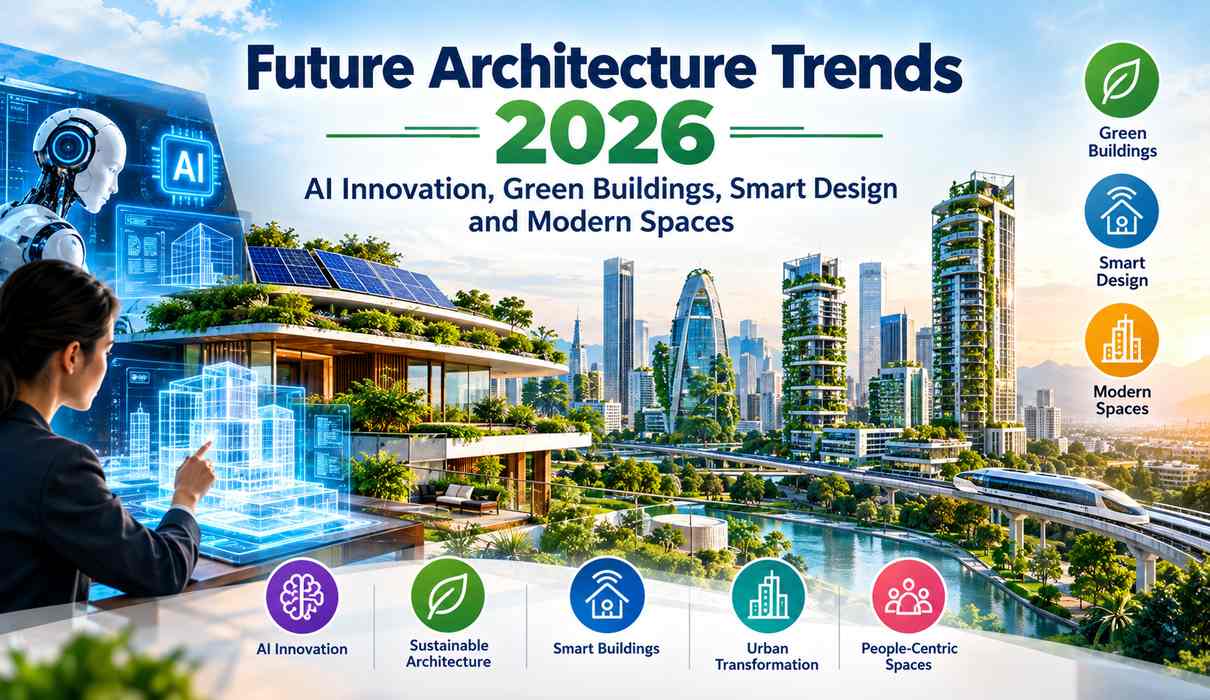
Future Architecture Trends 2026: AI Innovation, Green Buildings, Smart Design and Modern Spaces
Architecture is entering a new era in 2026, shaped by artificial intelligence, climate challenges, advanced materials, smart technology, changing lifestyles, and a growing emphasis on human-centered design. Buildings are no longer viewed simply as structures that provide shelter or workspace. Increasingly, they are expected to be energy efficient, adaptable, connected, resilient, healthy, and responsive to their surroundings.
The future architecture trends of 2026 reflect this transformation. Architects, developers, engineers, and designers are combining digital tools with sustainable strategies to create buildings that perform better while delivering attractive and comfortable spaces.
Artificial intelligence is becoming increasingly integrated into architectural workflows, while green and regenerative design are receiving greater attention. At the same time, adaptive reuse, smart buildings, biophilic design, modular construction, climate resilience, and locally inspired architecture are influencing new projects.
The American Institute of Architects has described AI as a transformative force for the profession and is developing practical resources for responsible adoption. Its 2026 initiatives also place climate, resilience, equity, and regenerative design among important professional priorities.
Here are the major architecture trends in 2026 and how they could shape the buildings and cities of the future.
1. Artificial Intelligence Is Transforming Architectural Design
Artificial intelligence is one of the biggest architectural trends of 2026. AI tools can assist architects with concept development, visualization, research, documentation, design analysis, and workflow automation.
Instead of spending hours creating multiple early-stage concepts manually, architects can use AI-assisted systems to explore different layouts, forms, materials, lighting conditions, and façade possibilities.
AI can also help analyze environmental information such as sunlight, heat gain, ventilation, energy performance, and site conditions. This allows architects to evaluate more options during the early stages of a project.
The role of AI is not simply to generate attractive images. Increasingly, the focus is shifting toward using AI as a practical design and decision-support tool. AIA’s 2026 AI Firm Toolkit encourages firms to assess their AI maturity, develop AI literacy and policies, and introduce the technology through responsible change management.
However, architects still need professional judgment. Questions surrounding authorship, data privacy, reliability, intellectual property, environmental impact, and accountability mean that AI needs to be used carefully.
2. Sustainable Architecture Becomes the New Standard
Sustainability is no longer an optional feature added to a building after the design is complete. In 2026, environmental performance is increasingly being considered from the beginning of the architectural process.
Energy efficiency, passive design, low-carbon materials, water management, renewable energy, waste reduction, and long-term adaptability are becoming central considerations.
Sustainable architecture can include features such as:
- Solar energy systems
- Natural ventilation
- Passive cooling
- High-performance insulation
- Energy-efficient glazing
- Rainwater harvesting
- Green roofs
- Recycled and renewable materials
- Efficient lighting and HVAC systems
- Low-carbon construction methods
Recent architecture discussions increasingly emphasize addressing sustainability during the design stage rather than treating it as a final addition. Circular approaches also encourage materials and components to remain useful for longer and be designed for reuse.
3. Regenerative Design Goes Beyond Sustainability
One of the more important developments in modern architecture is the movement from sustainable design toward regenerative architecture.
Sustainable design generally aims to reduce negative environmental impacts. Regenerative design goes further by asking how buildings and communities can contribute positively to ecosystems, biodiversity, resource cycles, and human well-being.
This approach can involve restoring landscapes, improving biodiversity, managing water naturally, creating healthier environments, and designing buildings that interact positively with their surroundings.
The American Institute of Architects made regenerative design a significant part of its 2026–2030 strategic direction, emphasizing climate resilience, ecosystem restoration, and community well-being.
This could make regenerative thinking one of the defining architectural philosophies of the coming decade.
4. Smart Buildings Become More Connected
Smart building technology is another major architecture trend in 2026.
Modern buildings can incorporate sensors, connected lighting, automated heating and cooling, security systems, energy monitoring, occupancy detection, and building management platforms.
These technologies allow buildings to respond to how spaces are actually being used.
For example, sensors can detect that a room is empty and automatically reduce lighting or climate control. Building management systems can monitor energy consumption and identify areas where efficiency could be improved.
Smart technology can also improve comfort and security.
The future of smart architecture is therefore not simply about adding more devices. It is about creating buildings where technology works quietly in the background to improve performance and user experience.
5. Biophilic Design Brings Nature Indoors
Biophilic architecture continues to influence residential, commercial, hospitality, healthcare, and workplace design.
The basic idea is to create stronger connections between people and nature.
Architects can achieve this through natural light, indoor plants, gardens, water features, natural materials, outdoor terraces, views of vegetation, and layouts that connect interior spaces with landscapes.
Biophilic design can also influence material selection and color palettes.
As urban populations grow and people spend significant amounts of time indoors, natural elements can help make built environments feel more comfortable and connected to their surroundings.
The trend is increasingly expanding from decorative greenery toward more integrated relationships between buildings, landscapes, water, biodiversity, and human activity.
6. Climate-Resilient Architecture Gains Importance
Extreme heat, flooding, storms, drought, wildfires, and other environmental risks are influencing architectural thinking.
Climate-resilient buildings are designed to continue functioning under challenging conditions.
Strategies may include elevated structures in flood-prone areas, improved drainage, heat-resistant materials, passive cooling, shading systems, backup power, water storage, stronger building envelopes, and landscape-based stormwater management.
Climate resilience is especially important in cities where dense development and aging infrastructure can increase vulnerability.
The goal is to create buildings that are not only energy efficient under normal conditions but also capable of responding to future environmental pressures.
7. Adaptive Reuse Gives Existing Buildings a New Life
Adaptive reuse is another major trend in architecture.
Rather than demolishing an existing structure and constructing something completely new, architects can transform an old building for a different purpose.
Factories can become offices or cultural spaces. Warehouses can become residential developments. Historic buildings can become hotels, museums, restaurants, or community facilities.
Adaptive reuse can preserve architectural character while reducing demolition waste and making use of existing structures.
It can also help revitalize neighborhoods.
In an era when construction costs, material consumption, carbon emissions, and land availability are important concerns, reusing existing buildings can be an attractive alternative to starting from scratch.
8. Circular Architecture Focuses on Reuse and Materials
Circular architecture is closely connected with sustainability and adaptive reuse.
The traditional construction model often follows a linear pattern: extract materials, manufacture products, construct a building, use it, and eventually demolish it.
Circular architecture attempts to keep materials in circulation for as long as possible.
Architects may select materials that can be repaired, reused, recycled, disassembled, or repurposed.
Buildings can also be designed with future modification in mind.
This means a structure may be easier to adapt when its occupants, technology, or purpose changes.
The result is architecture that considers not only how a building is constructed but also what happens to its components decades later.
9. Smart Materials and Innovative Building Systems
Materials are becoming increasingly important to architectural innovation.
Researchers and manufacturers are developing products designed to improve energy performance, durability, recyclability, and environmental impact.
Examples include high-performance insulation, low-carbon concrete alternatives, engineered timber, recycled materials, advanced glazing, photovoltaic surfaces, and innovative composite products.
Some materials can respond to environmental conditions or provide multiple functions.
Architects are also exploring how digital fabrication can create customized building components while reducing material waste.
The combination of material science, computation, and advanced manufacturing could significantly change how future buildings are designed and constructed.
10. Modular and Prefabricated Construction Expands
Modular construction is gaining attention as the industry looks for ways to improve efficiency, reduce waste, and manage construction schedules.
Components can be manufactured in controlled factory environments and then transported to construction sites for assembly.
This approach can potentially improve quality control and reduce some site-related delays.
Modular architecture is being explored for housing, healthcare facilities, offices, educational buildings, hospitality projects, and temporary structures.
As digital design and manufacturing technologies become more sophisticated, architects can create modular systems that are both efficient and visually distinctive.
11. Human-Centered Architecture Remains Essential
Despite the rise of AI and automation, architecture in 2026 remains fundamentally about people.
A technologically advanced building is not necessarily a successful building if it is uncomfortable, confusing, inaccessible, or disconnected from its users.
Human-centered design considers factors such as natural light, acoustics, accessibility, privacy, thermal comfort, movement, social interaction, and emotional well-being.
Workplaces are increasingly designed around flexibility and collaboration rather than rows of permanent desks.
Homes are being designed to accommodate remote work, entertainment, wellness, and changing family needs.
Healthcare architecture is focusing on calm, accessible, and patient-friendly environments.
The future therefore combines technology with empathy rather than allowing technology to dominate design.
12. AI and Human Creativity Work Together
The relationship between architects and AI is likely to become more collaborative in 2026.
AI can process large quantities of information and rapidly generate alternatives, but architects provide context, judgment, cultural understanding, technical knowledge, and ethical responsibility.
AIA’s current guidance emphasizes that professional judgment remains important as architecture responds to AI-driven change.
This suggests that the most successful practices may not be those that simply automate the most work. Instead, they may be firms that understand where AI creates genuine value while preserving human creativity and accountability.
13. Architecture Reflects Local Culture and Identity
Globalization has often produced buildings that look similar regardless of location.
A growing architectural movement is challenging this approach by combining modern technology with local identity.
Architects are revisiting traditional materials, construction techniques, climate-responsive forms, crafts, patterns, and cultural references.
AI can even assist with analyzing local environmental conditions and traditional building strategies. Recent discussions involving Indian architects, for example, have explored how AI can support the understanding of local building practices while maintaining cultural identity.
This creates an opportunity for architecture to be modern without becoming culturally generic.
14. Data Centers Become a Major Architecture Sector
The growth of artificial intelligence and cloud computing is creating new demand for data centers.
These buildings require substantial electrical infrastructure, cooling systems, security, connectivity, and specialized mechanical equipment.
According to the AIA’s July 2026 construction forecast, data centers are a standout growth category, with spending projected to increase 33% in 2026 and another 25% in 2027.
This trend is directly connected to the broader AI economy.
It also creates new architectural challenges involving energy consumption, water use, heat management, land availability, and the integration of large technical facilities into surrounding communities.
15. Flexible Spaces Become More Valuable
Buildings increasingly need to adapt to changing requirements.
A workplace may need to support collaboration today and individual work tomorrow. A residential building may need spaces that can change as families grow. Retail environments may combine shopping, entertainment, dining, and community activities.
Flexible architecture addresses these changes through movable partitions, adaptable furniture, multipurpose rooms, modular components, and infrastructure that can support future modifications.
Designing for adaptability can extend a building’s useful life and reduce the need for expensive renovations or demolition.
16. The Future of Architecture in 2026 and Beyond
The architecture industry is experiencing both technological opportunity and economic pressure.
The AIA’s 2026 construction outlook shows an uneven market, with some sectors performing strongly while others face weaker conditions. Data centers and certain institutional categories are showing resilience, while several other segments remain under pressure.
This environment makes efficiency, innovation, and adaptability especially important.
Architectural firms are likely to invest more in digital workflows, AI literacy, sustainable design expertise, building performance analysis, and multidisciplinary collaboration.
At the same time, clients are likely to expect measurable value from architectural services—not simply attractive designs.
The architects of the future will increasingly need to understand technology, climate science, materials, economics, construction, and human behavior alongside traditional design principles.
Conclusion
The Future Architecture Trends 2026 landscape is defined by the convergence of technology, sustainability, resilience, creativity, and human needs.
AI is changing how architects research, visualize, analyze, and develop projects. Green architecture is becoming more performance-driven, while regenerative design is expanding the ambition of sustainable development.
Smart buildings are becoming increasingly connected, and climate-resilient architecture is helping communities prepare for environmental challenges. Adaptive reuse and circular design are encouraging architects to rethink how existing buildings and materials can be preserved and reused.
At the same time, biophilic design, flexible spaces, modular construction, smart materials, and culturally responsive architecture are creating new possibilities for modern environments.
The future of architecture will not be defined by technology alone. The strongest buildings will combine AI innovation with human creativity, environmental responsibility with economic practicality, and modern technology with local identity.
As cities continue to grow and environmental challenges become more urgent, architecture will play an increasingly important role in creating healthier, smarter, more resilient, and more sustainable places to live and work.