
 By
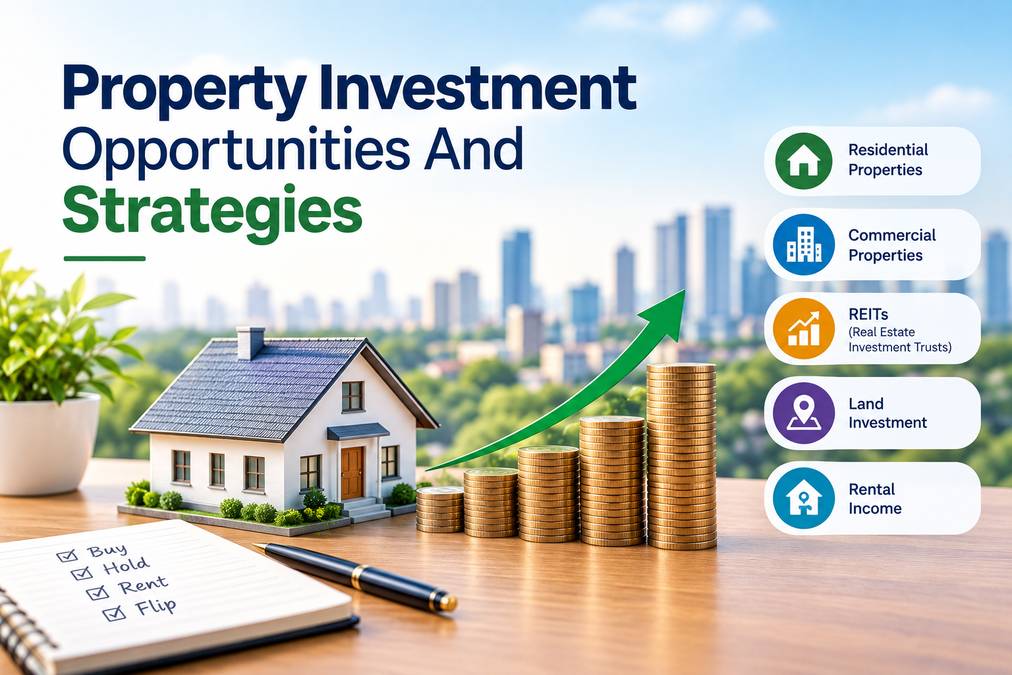
By Property Investment Opportunities And Strategies
Property investment has long been considered one of the most established ways to build and preserve wealth. From residential homes and rental apartments to commercial buildings and Real Estate Investment Trusts (REITs), investors today have more options than simply purchasing a house and waiting for its value to increase.
However, successful property investment is not just about buying an asset in a popular location. It involves understanding the market, choosing the right property type, calculating potential returns, managing risks, and selecting an investment strategy that matches your financial goals.
Whether you are a first-time investor or already have experience in real estate, understanding the available property investment opportunities and strategies can help you make more informed decisions.
What Is Property Investment?
Property investment means purchasing real estate primarily to generate income, achieve capital appreciation, or both. Unlike buying a property solely for personal use, an investment property is selected based on its potential financial performance.
Investors may earn returns through:
- Rental income
- Long-term property appreciation
- Property redevelopment or renovation
- Commercial leases
- Property development
- Real Estate Investment Trusts (REITs)
The ideal approach depends on your budget, investment horizon, risk tolerance, and how actively you want to manage the property.
A physical property can provide control and a tangible asset, but it can also require substantial capital and ongoing management. REITs, by comparison, allow investors to gain exposure to real estate without directly owning and managing a building.
Why Consider Property Investment?
Real estate can play an important role in a diversified investment portfolio. Property may generate regular rental income while also offering the possibility of long-term capital growth.
One of the biggest attractions is that investors can choose from different property sectors. Residential property may provide access to a large rental market, while commercial real estate can offer longer leases and potentially higher rental income.
Property can also provide diversification because its performance is influenced by factors such as local employment, population growth, infrastructure, rental demand, and economic development.
However, property should not be viewed as a guaranteed investment. Prices can decline, tenants may leave, maintenance costs can rise, and selling a property can take considerably longer than selling listed financial assets.
Top Property Investment Opportunities
There is no single best property investment for everyone. Different property types offer different combinations of income, growth potential, liquidity, and risk.
1. Residential Rental Property
Residential property is one of the most familiar forms of real estate investment. Investors can purchase apartments, houses, villas, or other residential units and rent them to tenants.
The primary advantage is the potential for recurring rental income combined with long-term appreciation.
Before purchasing a residential rental property, consider:
- Rental demand in the area
- Local employment opportunities
- Population growth
- Nearby schools and hospitals
- Public transport and infrastructure
- Maintenance expenses
- Property taxes and other charges
- Vacancy periods
A property that looks inexpensive may not necessarily be a good investment if rental demand is weak. Similarly, an expensive property in a high-demand location may produce stronger long-term results.
2. Commercial Property
Commercial real estate includes offices, retail spaces, warehouses, industrial properties, and other business-oriented buildings.
Commercial property can be attractive because leases may be longer and rental income can be comparatively predictable when a high-quality tenant is secured. However, commercial properties generally require more capital and can carry significant vacancy and concentration risks.
The location is especially important. Areas with strong business activity, transportation links, infrastructure, and growing employment may offer better long-term demand.
Investors should also examine the quality of tenants, lease terms, occupancy rates, operating expenses, and potential changes in the surrounding business environment.
3. Real Estate Investment Trusts (REITs)
REITs provide another way to participate in real estate without purchasing a physical property.
A REIT pools investor money and invests in income-generating real estate. In India, REITs are regulated by SEBI, and their units trade on stock exchanges. This gives investors a more accessible and liquid way to gain exposure to property compared with buying a complete building or apartment.
REITs may be suitable for investors who want:
- Lower capital requirements
- Professional property management
- Greater liquidity
- Exposure to multiple properties
- Regular distributions
However, REITs are still market-linked investments. Their prices can fluctuate, and income distributions are not the same as guaranteed rental income from a personally owned property.
4. Property Development
Property development involves acquiring land or existing buildings and improving or developing them with the goal of selling or leasing the finished asset.
This strategy can potentially generate substantial returns, but it also involves considerably greater risk than simply purchasing a completed rental property.
Development investors need to consider construction costs, permits, financing, contractor performance, market demand, project delays, and changes in property prices.
For beginners, property development is generally better approached only after gaining substantial market knowledge and professional support.
5. Value-Add Property Investment
A value-add strategy involves purchasing a property with potential for improvement and increasing its value through renovation, better management, redevelopment, or repositioning.
For example, an investor might purchase an outdated rental property, renovate it, improve its facilities, and potentially increase both its rental income and resale value.
The important point is to calculate the numbers before buying. Renovation costs, financing expenses, taxes, vacancy periods, and unexpected repairs can quickly reduce the expected return.
Key Property Investment Strategies
Once you understand the available opportunities, the next step is choosing an investment strategy.
Buy and Hold
The buy-and-hold strategy involves purchasing a property and keeping it for an extended period.
The investor may earn rental income while waiting for the property to appreciate. This approach is generally more suitable for investors who have a long-term outlook and do not need immediate liquidity.
The strategy works best when the property has strong fundamentals, such as sustainable rental demand, good infrastructure, and potential for long-term economic growth.
Rental Income Strategy
Some investors primarily focus on generating regular cash flow.
Under this approach, the investor evaluates the expected rent against all property-related expenses. It is important to calculate net rental yield, rather than simply looking at the advertised monthly rent.
A simple calculation is:
Net Rental Yield = (Annual Rental Income − Annual Property Expenses) ÷ Total Property Cost × 100
Property expenses may include maintenance, insurance, taxes, management fees, repairs, and periods of vacancy.
This calculation gives a more realistic picture of the investment’s potential income.
Capital Appreciation Strategy
Some investors are more focused on future property value than immediate rental income.
They may target areas expected to benefit from new roads, transport systems, business districts, employment growth, educational institutions, or other infrastructure improvements.
Capital appreciation is never guaranteed, however. Investors should avoid relying entirely on predictions about future development and should examine current demand and market fundamentals as well.
Fix-and-Improve Strategy
This approach focuses on properties that are undervalued because of poor condition, outdated interiors, inefficient layouts, or weak management.
After purchasing the property, the investor makes carefully planned improvements to increase its rental income or resale value.
The key is controlling renovation costs. A property can become less profitable if the renovation budget grows beyond the additional value created.
Diversification Strategy
Diversification means avoiding excessive dependence on one property, location, tenant, or real estate segment.
For example, an investor with substantial real estate exposure might diversify across residential and commercial assets or combine direct property ownership with REIT investments.
REITs can also provide diversification because they may hold multiple properties and tenants rather than exposing the investor to a single physical asset.
How to Choose the Right Property Investment
Choosing the right property requires more than comparing purchase prices.
1. Define Your Investment Goal
Start by asking what you want from the investment.
Are you looking for:
- Monthly rental income?
- Long-term capital growth?
- Portfolio diversification?
- A combination of income and appreciation?
- A relatively passive investment?
Your objective will influence which property type and strategy make sense.
2. Assess Your Budget
Calculate how much capital you can invest without placing unnecessary pressure on your finances.
Remember that the purchase price is not the only expense. Buyers may also face taxes, registration costs, legal fees, brokerage, renovation expenses, maintenance, financing costs, and other charges.
A sensible investment plan should also include an emergency reserve for unexpected expenses.
3. Research the Location
Location remains one of the most important factors in real estate.
Look beyond current property prices and investigate:
- Rental demand
- Infrastructure development
- Employment growth
- Population trends
- Accessibility
- Nearby amenities
- Competing properties
- Future development plans
A strong location can support both rental demand and long-term property values.
4. Calculate the Potential Return
Never purchase a property based solely on the belief that prices will rise.
Estimate rental income, operating expenses, financing costs, taxes, vacancy periods, and potential appreciation. Compare the expected return with alternative investments that have a similar risk profile.
For direct property investments, also consider transaction costs and the time required to sell the property.
5. Examine the Risks
Every property investment carries risk.
Common risks include:
- Property price declines
- Tenant vacancies
- Rental defaults
- Unexpected repairs
- Rising interest rates
- Regulatory changes
- Oversupply in a local market
- Poor property management
- Limited liquidity
Direct property ownership can also create concentration risk because a large amount of capital may be tied to one location or asset.
Property Investment: Direct Ownership vs REITs
Investors often compare buying a rental property with investing in REITs.
Direct property ownership offers greater control. You can choose the property, tenant, rent, improvements, and eventual selling date. However, it generally requires more capital and active involvement.
REITs offer a more passive approach. Investors can gain exposure to income-generating commercial real estate without dealing directly with tenants, repairs, or property management. They are also generally more liquid because their units trade on stock exchanges.
Neither option is automatically better.
The right choice depends on your investment amount, liquidity requirements, risk tolerance, time commitment, and financial objectives.
Common Mistakes Property Investors Should Avoid
Even promising property investments can perform poorly when investors overlook basic due diligence.
One common mistake is buying based on emotion rather than financial analysis. A beautiful property is not necessarily a profitable investment.
Another mistake is ignoring total costs. Investors sometimes calculate returns using rental income while forgetting maintenance, taxes, vacancy, financing, and transaction costs.
Overleveraging is another major concern. Borrowing too much can make an investment vulnerable to interest-rate increases or temporary rental vacancies.
Investors should also avoid assuming that past property appreciation will automatically continue. Real estate markets can change because of economic conditions, new construction, infrastructure changes, employment trends, and government policies.
How to Build a Long-Term Property Investment Strategy
A successful property investment strategy should be based on clear objectives rather than short-term market excitement.
Start small if you are new to real estate. Learn how property valuation works, understand rental markets, compare locations, and study the expenses involved in ownership.
As your knowledge and financial capacity grow, you can consider expanding into different property types or investment structures.
It is also useful to review your portfolio regularly. Changes in rental demand, property values, interest rates, and your own financial goals may require adjustments.
Most importantly, focus on the underlying economics of an investment rather than simply following market trends.
Final Thoughts
Property investment offers several opportunities for investors seeking income, capital appreciation, and diversification. Residential rentals, commercial properties, property development, value-add projects, and REITs each provide different ways to gain exposure to the real estate market.
The most effective property investment strategy is the one that matches your financial goals, available capital, risk tolerance, and preferred level of involvement.
Before investing, research the location, calculate the potential net return, understand all costs, evaluate financing, and consider the risks. If you are comparing physical property with REITs, look beyond headline returns and consider liquidity, diversification, management requirements, and your investment horizon.
Real estate can be a valuable part of a long-term financial plan, but successful investing requires patience, research, and disciplined decision-making. Rather than trying to find a universally “best” property investment, focus on finding an opportunity whose numbers and risks make sense for your individual situation.
Disclaimer: This article is for general educational purposes only and should not be considered financial, tax, or legal advice. Property markets, regulations, taxes, financing costs, and investment risks vary by location and individual circumstances. Consider consulting a qualified financial or property professional before making an investment decision.