
 By
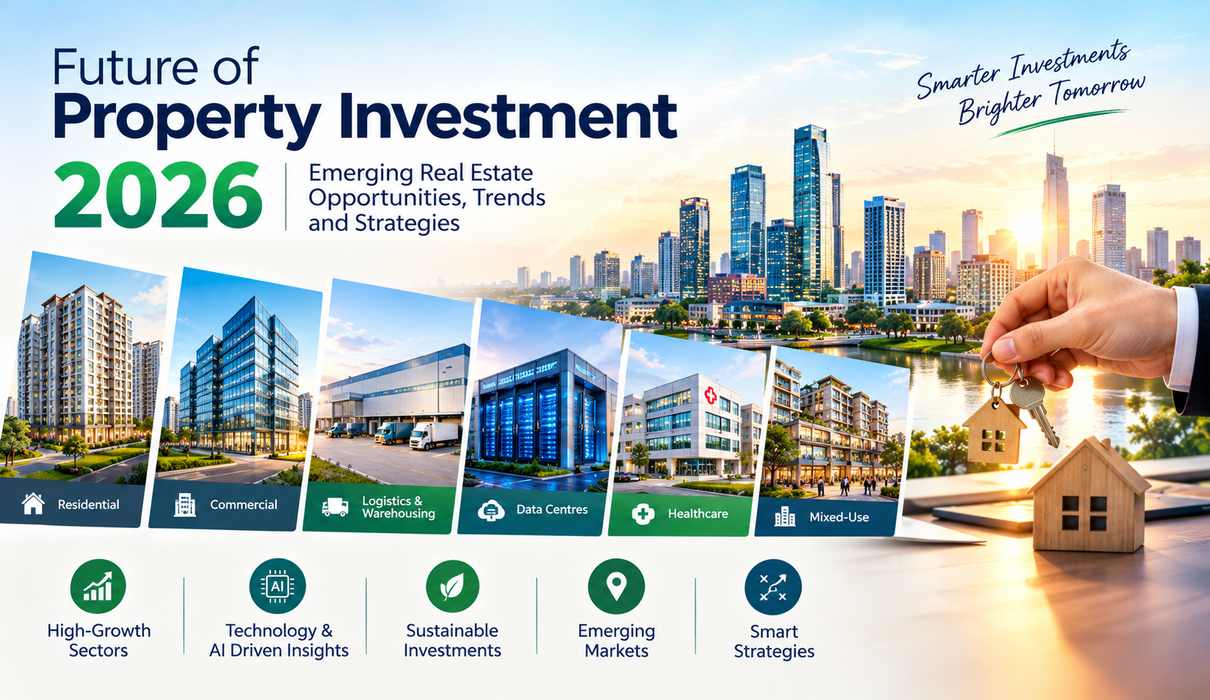
By Future of Property Investment 2026: Emerging Real Estate Opportunities, Trends and Strategies
The future of property investment in 2026 is being shaped by changing consumer preferences, technology, infrastructure development, urbanisation and the growing demand for specialised real estate. Property investors are no longer looking only at traditional residential apartments or conventional office buildings. New opportunities are emerging across data centres, logistics, warehousing, retail, rental housing, REITs, mixed-use developments and technology-enabled properties.
India’s real estate market is entering 2026 with continued investment momentum. CBRE expects sustained investment activity, with institutional investors showing a stronger preference for quality assets and strategic opportunities across office, retail, industrial and logistics real estate. (CBRE)
At the global level, data centres, logistics and specialised office properties are among the leading commercial real estate investment targets, while healthcare and other alternative assets are gaining attention. (Deloitte United Kingdom)
For investors, this means that property investment in 2026 requires a more informed and diversified approach. Understanding where demand is coming from, how technology is changing real estate and which locations have strong long-term fundamentals can make a significant difference.
What Is Changing in Property Investment in 2026?
The property market is becoming more diversified. Traditional property investment remains relevant, but investors are increasingly considering properties connected to digital infrastructure, logistics, healthcare, flexible work and changing lifestyles.
Several factors are driving this transformation:
- Rapid urbanisation
- Growth of e-commerce
- Expansion of digital infrastructure
- Demand for data centres
- Infrastructure development
- Changing workplace patterns
- Growth of organised retail
- Rising demand for quality housing
- Increasing institutional investment
- Development of emerging cities
The result is a property market where location, infrastructure, tenant quality, technology and long-term demand can be just as important as the physical building itself.
1. Data Centres Are Becoming a Major Real Estate Opportunity
One of the most interesting property investment trends for 2026 is the growth of data centre real estate.
Artificial intelligence, cloud computing, streaming services, digital payments and data-intensive applications are creating enormous demand for computing infrastructure.
This is turning data centres into an important real estate asset class. JLL estimates that the global data centre sector could grow at a 14% compound annual growth rate over the next five years, requiring significant new capacity and investment. (JLL)
India is also experiencing strong data-centre growth. Recent reporting indicates that India’s colocation capacity could expand from around 2 GW to 10 GW by 2031, supported by AI demand and data-localisation requirements. (The Financial Express)
For property investors, data centres can create opportunities involving land, specialised buildings, infrastructure and development partnerships.
However, these assets require careful due diligence because power availability, connectivity, cooling infrastructure, regulations and construction complexity are critical factors.
2. Logistics and Warehousing Property Continues to Grow
The growth of e-commerce, quick commerce, manufacturing and organised supply chains is increasing demand for modern warehouses.
Modern logistics facilities are increasingly located near major highways, ports, airports, industrial corridors and large consumer markets.
Investors are therefore paying attention to:
- Grade-A warehouses
- Distribution centres
- Cold-storage facilities
- Last-mile logistics hubs
- Industrial parks
- Logistics parks
- Fulfilment centres
India’s industrial and logistics sector continues to attract institutional interest, with logistics, manufacturing and e-commerce among important sources of demand. (CBRE)
This makes logistics real estate one of the property segments worth watching in 2026.
3. REITs Are Expanding Access to Real Estate Investment
Real Estate Investment Trusts, or REITs, offer investors another way to participate in income-generating real estate without directly purchasing an entire commercial property.
REITs typically hold portfolios of income-producing assets such as offices, shopping centres and other commercial properties.
India’s REIT market is becoming increasingly institutionalised. In the first half of 2026, India’s operational office REIT portfolio expanded significantly, while retail REITs and warehousing-focused vehicles also contributed to the broader institutionalisation of real estate. (The Financial Express)
For investors who want property exposure without managing tenants, maintenance and large physical assets directly, REITs can be an important option to research.
However, investors should evaluate the underlying portfolio, occupancy, tenant quality, debt, distributions, valuation and market conditions rather than selecting a REIT solely because of its dividend yield.
4. Residential Property Remains a Core Investment
Despite the rise of alternative assets, residential property remains central to real estate investment.
Housing demand is being supported by population growth, urbanisation, employment opportunities and infrastructure development.
Recent data also points to substantial land acquisition for residential development. More than 7,700 acres were acquired for housing development across 33 Indian cities between January 2021 and March 2026, according to Cushman & Wakefield data reported by The Times of India. (The Times of India)
For investors, residential opportunities can include:
- Apartments
- Independent houses
- Plots
- Gated communities
- Rental housing
- Student accommodation
- Senior living
- Affordable housing
The key is to distinguish between properties supported by genuine end-user demand and properties driven mainly by speculation.
5. Location Is Becoming More Important Than Ever
The traditional real estate principle of “location, location, location” remains relevant in 2026—but the definition of a good location is changing.
A desirable location is increasingly determined by its connection to:
- Metro and public transport
- Highways
- Airports
- Employment centres
- Technology parks
- Industrial corridors
- Educational institutions
- Healthcare facilities
- Retail destinations
- Digital infrastructure
Infrastructure can transform previously overlooked areas into attractive investment markets.
Investors should therefore examine not only what an area looks like today but also what infrastructure and economic activity are planned for the next five to ten years.
6. Mixed-Use Developments Are Creating New Opportunities
Modern cities are increasingly moving toward mixed-use developments that combine residential, retail, offices, entertainment, hospitality and community facilities.
These developments can create convenient environments where people can live, work and shop within the same broader destination.
For investors, mixed-use projects can offer diversification because income may come from several property categories.
The success of such projects, however, depends heavily on planning, accessibility, tenant mix, management quality and surrounding infrastructure.
7. Retail Real Estate Is Evolving
Retail property is not disappearing because of e-commerce. Instead, it is changing.
Modern consumers increasingly expect shopping destinations to provide experiences rather than simply products.
Successful retail developments can combine:
- Shopping
- Restaurants
- Entertainment
- Cinemas
- Events
- Wellness
- Hospitality
- Community spaces
This creates opportunities for well-located, professionally managed retail properties.
The growing institutional interest in retail REITs also demonstrates the increasing importance of professionally managed retail assets in the investment landscape. (The Financial Express)
8. AI Is Changing How Investors Analyse Property
Artificial intelligence is becoming useful not only inside buildings but also in property investment decisions.
AI-powered tools can help investors analyse:
- Property prices
- Rental trends
- Vacancy rates
- Demographic changes
- Infrastructure projects
- Local demand
- Comparable properties
- Market sentiment
- Potential risks
Instead of relying entirely on intuition, investors can increasingly combine market data with analytical tools.
AI may also help property managers predict maintenance requirements, optimise energy consumption and improve tenant services.
However, AI should support investment decisions rather than replace human due diligence.
9. Smart Buildings Can Deliver Long-Term Advantages
Technology is becoming a major part of modern buildings.
Smart buildings may use sensors, automation and connected systems to manage:
- Lighting
- Heating and cooling
- Security
- Energy consumption
- Parking
- Building access
- Maintenance
- Occupancy
For commercial investors, smart-building capabilities can potentially improve operational efficiency and tenant experience.
Energy-efficient and technology-enabled properties may also become more attractive as companies focus on sustainability, operating costs and workplace quality.
10. Sustainable Property Investment Is Growing
Environmental considerations are increasingly influencing real estate investment.
Investors are paying greater attention to energy efficiency, water management, renewable energy, green building standards and climate resilience.
Sustainable properties can potentially benefit from lower operating costs and stronger appeal among environmentally conscious tenants and buyers.
Climate resilience is also becoming important. Investors should consider whether a property is exposed to flooding, extreme heat, water shortages or other environmental risks.
The future of property investment will increasingly involve evaluating not only financial returns but also long-term environmental resilience.
11. Alternative Real Estate Assets Are Gaining Attention
Property investment is expanding beyond traditional categories.
Investors are increasingly considering specialised assets such as:
- Healthcare facilities
- Senior living
- Student housing
- Data centres
- Warehouses
- Cold storage
- Telecom infrastructure
- Life-science facilities
- Hospitality
- Flexible workspaces
Deloitte’s 2026 commercial real estate outlook identifies data centres, logistics and specialised office properties as leading investment targets, while alternative sectors such as healthcare and telecom are gaining ground. (Deloitte United Kingdom)
These assets can provide diversification, but they often require specialist knowledge.
12. Emerging Cities Could Offer New Investment Potential
Major metropolitan markets remain important, but investors are increasingly exploring emerging cities and growth corridors.
Infrastructure improvements, industrial investment, technology expansion and changing business patterns can create new property demand outside established metropolitan centres.
In India, this includes selected Tier 2 and Tier 3 cities as well as locations connected to manufacturing, logistics, tourism and infrastructure projects.
The key is not simply choosing a smaller city because property is cheaper. Investors should look for evidence of sustainable economic growth, employment creation, infrastructure investment and genuine housing or commercial demand.
13. Rental Property and Income-Based Strategies
Investors seeking recurring income may continue to consider rental property.
Residential rentals, managed housing, student accommodation and commercial properties can generate periodic income while offering potential long-term capital appreciation.
However, rental yield should be calculated carefully.
Investors should consider:
Net rental yield = Annual rental income minus operating expenses ÷ Total investment cost × 100
Mortgage interest, maintenance, taxes, vacancy periods, insurance and property management costs can significantly affect actual returns.
A property with a high advertised rent is not automatically a high-quality investment.
14. Property Investment Strategies for 2026
There is no single strategy suitable for every investor. Different approaches may work depending on capital, risk tolerance, investment horizon and income requirements.
Long-Term Buy and Hold
This strategy focuses on purchasing quality property and holding it for several years.
It may work well in locations with strong employment, infrastructure and population growth.
Rental Income Strategy
Investors purchase properties primarily for recurring rental income.
Tenant demand, vacancy rates and operating expenses become especially important.
Commercial Property Strategy
Commercial offices, retail and logistics assets can provide income and diversification but often require higher capital and greater market knowledge.
REIT Strategy
Investors can obtain real estate exposure through listed REITs rather than purchasing physical property directly.
Value-Add Strategy
This involves purchasing an underperforming property and improving it through renovation, better management, repositioning or redevelopment.
15. Risks Investors Should Consider
Property investment can create wealth, but it is not risk-free.
Important risks include:
- Market corrections
- High purchase prices
- Interest-rate changes
- Construction delays
- Legal disputes
- Poor-quality developers
- Low rental demand
- Vacancy
- Infrastructure delays
- Liquidity limitations
- Regulatory changes
- Environmental risks
One important lesson for 2026 is that rising property prices alone do not guarantee a good investment. Financial affordability, rental potential and actual demand need to be evaluated before purchasing. Recent expert commentary in India has also warned buyers against assuming that buying property is automatically better than renting. (The Economic Times)
16. How to Make a Smarter Property Investment in 2026
A disciplined investment process can reduce unnecessary risks.
Research the Location
Study employment, infrastructure, population growth, transportation and future development.
Analyse the Numbers
Calculate the total purchase cost, financing costs, taxes, maintenance and expected rental income.
Check Legal Documentation
Verify ownership, approvals, title documents, zoning and applicable regulatory requirements.
Evaluate the Developer
For new projects, examine the developer’s reputation, completed projects, financial strength and delivery history.
Avoid Emotional Decisions
A property should be evaluated using financial and market fundamentals rather than marketing claims or social pressure.
Think Long Term
Real estate is generally less liquid than many financial assets. Investors should be comfortable holding the property for an appropriate period.
Conclusion
The Future of Property Investment 2026 is broader and more technology-driven than ever before. Residential property remains important, but investors now have opportunities across data centres, logistics, warehouses, REITs, retail, mixed-use developments, healthcare, rental housing and other specialised real estate.
Technology is also transforming how properties are analysed, managed and operated. AI, smart-building systems, data analytics and digital platforms can make investment and property management more efficient.
For investors, the biggest opportunity may not be simply finding the cheapest property or the fastest-growing market. It may be identifying quality assets in locations supported by genuine long-term demand.
The most successful property investment strategies in 2026 are likely to combine careful research, diversification, financial discipline, technology and a long-term perspective. As infrastructure expands and new industries reshape cities, real estate will continue to evolve—and investors who understand these changes will be better positioned to identify the opportunities of the future.