
 By
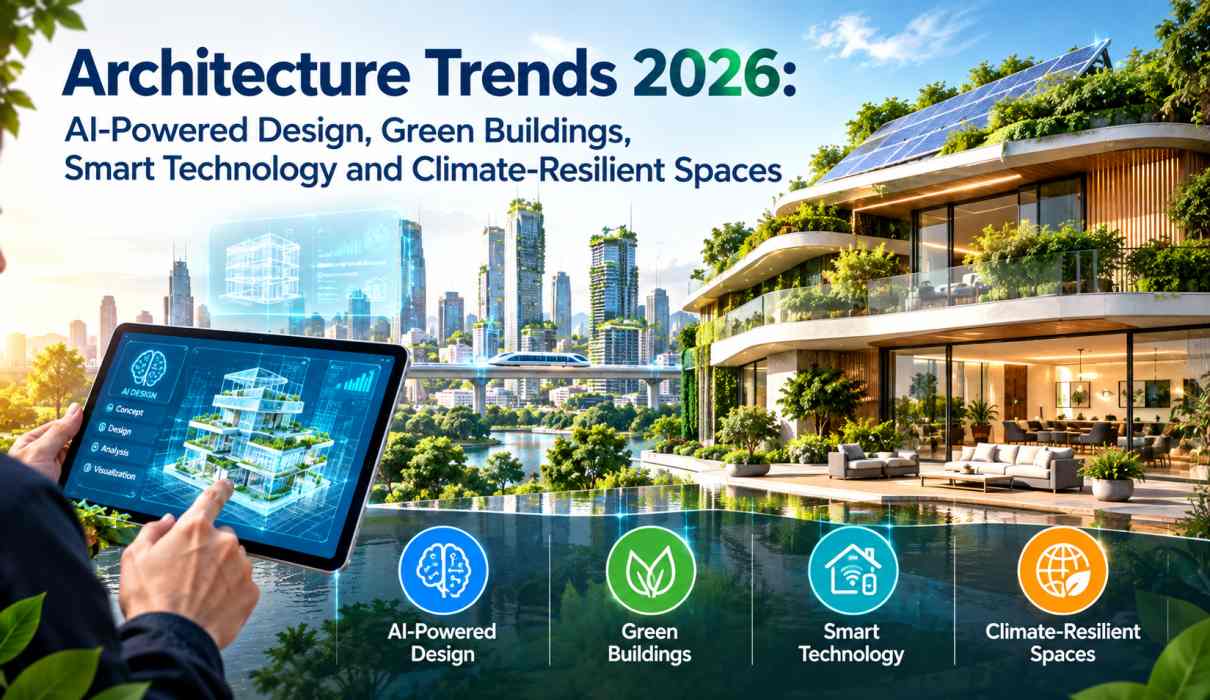
By Architecture Trends 2026: AI-Powered Design, Green Buildings, Smart Technology and Climate-Resilient Spaces
Architecture is entering a new era in 2026, shaped by rapid technological development, environmental challenges, changing lifestyles, and the growing demand for efficient and adaptable buildings. Modern architecture is no longer focused only on appearance. Today’s buildings are increasingly expected to perform better, consume fewer resources, respond to their surroundings, and provide healthier and more flexible spaces.
The architecture trends of 2026 reflect this transformation. Artificial intelligence is changing how architects explore ideas and develop designs, while sustainable construction is becoming increasingly important. Smart building technology is improving energy management and occupant comfort, and climate-resilient architecture is helping buildings prepare for heat, flooding, extreme weather, and other environmental pressures.
At the same time, architects are combining advanced technology with natural materials, biophilic design, adaptive reuse, passive design strategies, and human-centered planning. The result is a new generation of buildings that aim to be intelligent, sustainable, comfortable, and visually distinctive.
1. AI-Powered Architecture Is Transforming Design
Artificial intelligence is one of the most significant technology trends influencing architecture in 2026.
AI tools can help architects explore design possibilities, generate concepts, analyze building performance, optimize layouts, and visualize projects at different stages. Instead of replacing the architect, these technologies can act as design assistants that accelerate repetitive or computational tasks.
AI-assisted architecture can be used for:
- Concept generation
- Site analysis
- Space planning
- Building optimization
- Energy-performance analysis
- Image and 3D visualization
- Material exploration
- Design alternatives
- Construction planning
For example, an architect can establish project requirements such as site dimensions, building use, orientation, environmental conditions, and space requirements. AI-assisted software can then help generate multiple design possibilities that can be evaluated and refined.
Human expertise remains essential. Architects still need to consider structural requirements, building codes, accessibility, cultural context, construction methods, costs, materials, and the needs of occupants.
The major change is that architects can now explore more possibilities in less time.
2. Green Buildings Become a Core Architectural Priority
Sustainability is moving from an optional feature to a fundamental part of modern architecture.
Green buildings are designed to reduce resource consumption while providing comfortable and functional spaces. Their design can consider energy use, water efficiency, materials, waste, indoor environmental quality, and long-term building performance.
Common green-building strategies include:
- Energy-efficient systems
- Solar energy
- Natural ventilation
- Daylight optimization
- Efficient insulation
- Water-saving fixtures
- Rainwater management
- Sustainable materials
- Green roofs
- Renewable-energy integration
The most effective sustainable buildings consider environmental performance from the earliest design stages rather than adding green technologies after construction has already been planned.
This approach can also improve operating efficiency over the building’s lifetime.
3. Climate-Resilient Architecture Gains Importance
Climate change is influencing architectural decisions around the world.
Buildings increasingly need to account for higher temperatures, intense rainfall, flooding, storms, drought, wildfire risk, and other location-specific environmental challenges.
Climate-resilient architecture focuses on designing buildings that can continue functioning under changing environmental conditions.
Depending on the location, strategies may include:
- Elevated structures in flood-prone areas
- Flood-resistant materials
- Improved drainage
- Shading systems
- Heat-resistant building envelopes
- Natural ventilation
- Reflective roofs
- Storm-resistant construction
- Backup energy systems
- Water-storage solutions
Climate resilience is not identical everywhere. A building designed for a hot and dry environment requires different strategies from one located in a coastal flood-prone region.
Architects are therefore increasingly considering local climate data and environmental risks when developing building concepts.
4. Smart Buildings Connect Architecture and Technology
Smart technology is becoming an important component of modern buildings.
A smart building uses connected systems, sensors, automation, and software to monitor and manage building functions.
These systems can help control:
- Lighting
- Heating and cooling
- Ventilation
- Security
- Access
- Energy consumption
- Water systems
- Indoor air quality
- Equipment performance
Sensors can provide information about occupancy, temperature, humidity, air quality, and energy use. Building-management systems can then use this information to adjust certain systems according to predefined settings.
The goal is not technology for its own sake. Smart architecture should use technology to improve efficiency, comfort, safety, and building performance.
5. Passive Design Returns to the Spotlight
While digital technology is growing rapidly, many architects are also returning to fundamental principles of passive design.
Passive architecture uses the building’s orientation, form, materials, windows, shading, ventilation, and thermal properties to reduce dependence on mechanical systems.
Important strategies include:
- Orienting buildings to optimize sunlight
- Using external shading
- Designing for cross-ventilation
- Maximizing useful daylight
- Providing thermal mass
- Improving insulation
- Creating shaded outdoor areas
Passive design can reduce energy demand before mechanical systems are even considered.
This makes it an important component of sustainable architecture, particularly in regions with strong sunlight or significant seasonal temperature differences.
6. Biophilic Architecture Connects People With Nature
Biophilic design continues to influence architecture in 2026.
The approach focuses on creating stronger connections between people and natural environments.
Architects can incorporate nature through:
- Indoor gardens
- Green walls
- Courtyards
- Natural materials
- Water features
- Outdoor terraces
- Natural ventilation
- Large windows
- Views of greenery
- Daylight
Biophilic architecture is particularly valuable in dense urban environments where access to natural landscapes may be limited.
A building can use plants, natural textures, daylight, and outdoor spaces to create a more comfortable and visually engaging environment.
7. Sustainable Materials Shape Modern Buildings
Material selection is becoming increasingly important in sustainable architecture.
Architects and developers are exploring materials based on durability, energy requirements, recyclability, availability, embodied carbon, and overall lifecycle performance.
Potential approaches include:
- Recycled materials
- Reclaimed timber
- Responsibly sourced wood
- Low-carbon concrete alternatives
- Recycled metals
- Locally sourced materials
- Bio-based materials
- Durable finishes
The best material choice depends on the project’s location, budget, structural requirements, climate, maintenance needs, and building purpose.
Sustainability is therefore not simply about choosing a material because it is labeled “green.” Its complete lifecycle and practical performance also need to be considered.
8. Adaptive Reuse Becomes a Major Design Strategy
Adaptive reuse involves giving an existing building a new purpose instead of demolishing it and constructing an entirely new structure.
Examples include converting:
- Warehouses into offices
- Industrial buildings into residential spaces
- Historic properties into hotels
- Old offices into housing
- Former retail buildings into community spaces
Adaptive reuse can preserve architectural character while reducing the need for some new construction materials.
It can also help revitalize existing neighborhoods.
However, adaptive reuse can involve complex structural, regulatory, accessibility, fire-safety, and energy-efficiency challenges. Architects need to balance preservation with the requirements of modern use.
9. Modular and Prefabricated Construction Expands
Construction technology is also changing architectural possibilities.
Modular and prefabricated construction involves producing components or sections of buildings in controlled manufacturing environments before transporting them to the construction site.
Potential advantages include:
- Faster assembly
- More controlled production
- Reduced material waste
- Improved construction planning
- Consistent manufacturing
- Potential cost efficiencies
Prefabrication can be particularly useful for projects requiring repeated building components.
Technology is also making customized prefabricated designs increasingly possible, allowing architects to combine efficiency with architectural variety.
10. Flexible Buildings Are Designed for Change
The needs of buildings can change over time.
An office may become residential space. A home may need to accommodate remote work. A retail building may require new uses. Educational spaces may need to support different teaching methods.
This is increasing demand for flexible architecture.
Flexible buildings can incorporate:
- Movable partitions
- Modular furniture
- Adaptable floor plans
- Multi-purpose rooms
- Expandable spaces
- Accessible service systems
Designing for future change can extend a building’s useful life and reduce the need for major renovations.
Flexibility is therefore becoming an important aspect of sustainable architecture.
11. Net-Zero and Low-Energy Buildings
Energy performance is becoming a central consideration in building design.
Net-zero and low-energy buildings aim to reduce energy demand and, where applicable, balance remaining energy consumption through renewable generation or other strategies.
Architectural strategies can include:
- High-performance building envelopes
- Efficient glazing
- Solar panels
- Heat pumps
- Energy-efficient lighting
- Passive cooling
- Smart energy management
- Efficient mechanical systems
The exact definition and performance requirements of net-zero buildings can vary by standard and jurisdiction, so architects need to work with appropriate local regulations and certification frameworks.
The broader direction is clear: reducing operational energy use is becoming an increasingly important architectural goal.
12. Urban Architecture Focuses on Greener Cities
As cities become denser, architecture is increasingly connected with urban sustainability.
Future-oriented buildings can contribute to greener urban environments through:
- Rooftop gardens
- Green roofs
- Vertical landscaping
- Shaded pedestrian areas
- Mixed-use developments
- Bicycle facilities
- Efficient public spaces
- Water-sensitive landscaping
Mixed-use architecture can also bring residential, commercial, recreational, and community functions closer together.
This can support more walkable neighborhoods and reduce dependence on long-distance travel for everyday activities.
13. Digital Twins Improve Building Management
Digital twins are another emerging technology relevant to modern architecture and building management.
A digital twin is a digital representation of a physical building or system that can be connected to information about its operation.
During a building’s lifecycle, digital information can support:
- Maintenance planning
- Energy monitoring
- Equipment management
- Performance analysis
- Space management
- Renovation planning
When combined with sensors and building-management systems, digital models can provide building owners with a more detailed understanding of how a property is performing.
This represents a shift from designing a building once to continuously managing and improving its performance.
14. Human-Centered Architecture Remains Essential
Despite rapid technological development, architecture remains fundamentally about people.
A building can have advanced sensors and impressive energy systems but still fail if it is uncomfortable, confusing, inaccessible, or disconnected from its users.
Human-centered architecture considers:
- Comfort
- Accessibility
- Safety
- Natural light
- Acoustics
- Privacy
- Movement
- Social interaction
- Cultural identity
The best technology should support these objectives rather than overwhelm them.
In 2026, successful architecture is increasingly about finding the right balance between technology, environmental responsibility, and human experience.
15. The Future of Architecture in 2026 and Beyond
The future of architecture is likely to be defined by greater integration.
AI will support design exploration. Smart systems will improve building management. Sustainable materials will become more important. Climate-resilient strategies will influence building forms and construction methods. Adaptive reuse and flexible architecture will help extend the life of existing structures.
At the same time, traditional architectural principles such as proportion, orientation, materiality, context, craftsmanship, and human comfort will remain relevant.
Future architecture will therefore not be simply futuristic in appearance. It will be more intelligent in how it uses resources and responds to changing conditions.
Conclusion
The Architecture Trends 2026 demonstrate how the built environment is adapting to technological, environmental, and social change. AI-powered design, green buildings, smart technology, climate resilience, passive design, sustainable materials, adaptive reuse, modular construction, and flexible spaces are shaping the next generation of architecture.
The most important development is the movement toward buildings that perform as well as they look. Modern architecture increasingly needs to manage energy, water, climate risks, technology, comfort, and changing user requirements throughout a building’s lifecycle.
AI and smart technology can provide architects with powerful new tools, but thoughtful design remains essential. Sustainable architecture also requires more than adding solar panels or greenery; it involves considering materials, orientation, energy, water, durability, construction, and future adaptability from the beginning.
As cities and communities continue to evolve, the architecture of 2026 is moving toward a more intelligent and resilient model—one where innovation and sustainability work together to create buildings that are efficient, adaptable, comfortable, and prepared for the future.