
 By
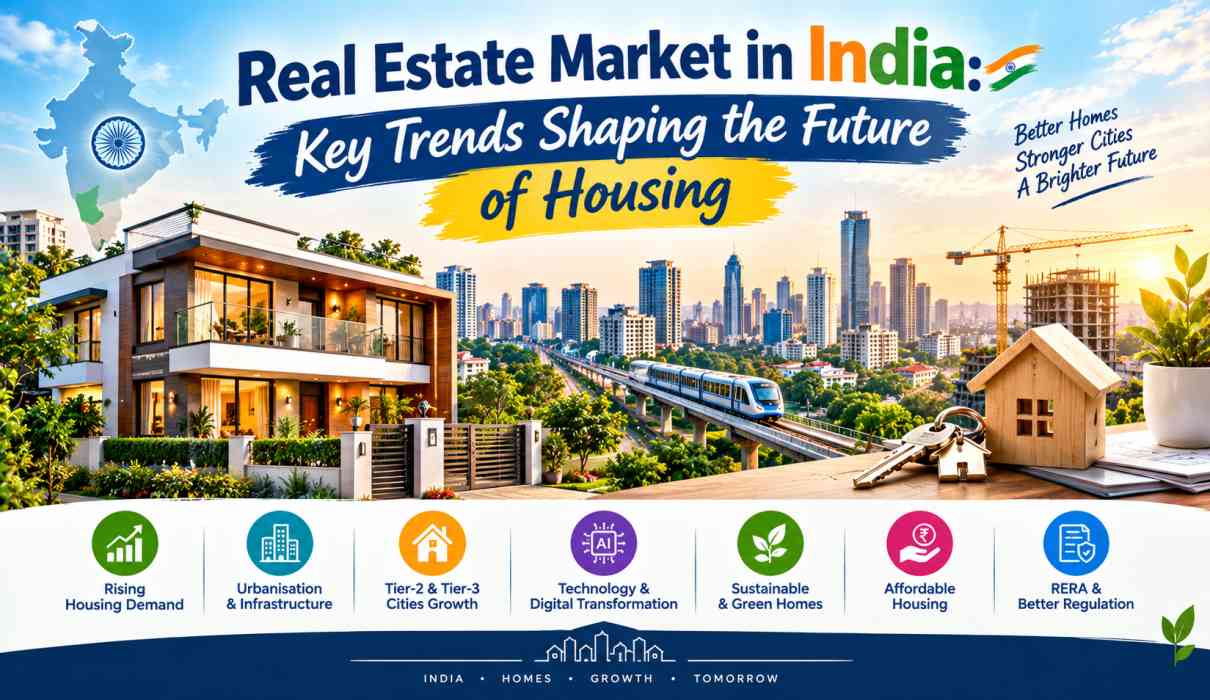
By Real Estate Market in India: Key Trends Shaping the Future of Housing
India’s real estate market is undergoing an important period of transformation. Rising urbanisation, changing homebuyer preferences, improved infrastructure, digital technology, housing finance, and evolving regulations are influencing how homes are designed, developed, purchased, and managed.
The Indian real estate market remains closely connected to the country’s economic development. According to the Government of India’s Economic Survey 2025–26, the real estate and ownership-of-dwellings sector has contributed about 7% of annual GVA on average over the past decade. The survey also notes that housing finance has expanded significantly, with individual housing-loan outstanding rising to more than ₹37 lakh crore by March 2025.
At the same time, the housing market is becoming more diverse. Buyers are looking beyond basic shelter and increasingly considering location, connectivity, amenities, sustainability, technology, quality of construction, and long-term value.
So, what are the major real estate trends in India shaping the future of housing?
1. Housing Demand Continues to Evolve
Housing demand in India has changed significantly over the past few years.
The Economic Survey 2025–26 describes a sustained post-pandemic upcycle in the housing sector, supported by household savings, improving affordability conditions, and expanding housing finance. It also reports that housing-volume sales have remained above the FY22–FY24 average in recent quarters.
This does not mean that every city or property segment is experiencing the same conditions. Real estate is highly local, and demand can vary considerably depending on employment, infrastructure, land availability, prices, and buyer demographics.
For homebuyers, this makes local market research particularly important.
2. Urbanisation Is Reshaping Housing
Urbanisation is one of the strongest long-term forces influencing Indian real estate.
As more people live and work in cities and surrounding urban areas, demand for residential properties, transportation, retail, schools, healthcare, offices, and other supporting infrastructure increases.
The Economic Survey 2025–26 highlights the importance of urban infrastructure, including transport, housing, water, sanitation, and governance, for India’s future growth.
This creates opportunities not only in established metropolitan areas but also in emerging urban centres.
As cities expand outward, locations that were once considered peripheral can become more connected to employment hubs and established neighbourhoods.
3. Tier-2 and Tier-3 Cities Are Gaining Attention
India’s real estate story is no longer limited to Mumbai, Delhi-NCR, Bengaluru, Hyderabad, Chennai, Pune, Kolkata, and other major metropolitan markets.
Improved road networks, metro systems, digital connectivity, employment opportunities, and local economic development are increasing interest in smaller cities.
The Economic Survey 2024–25 noted that real estate demand was emerging across Tier-1 and Tier-2 cities as connectivity improved.
For developers, smaller cities can offer opportunities to serve growing local demand. For buyers, these markets may provide different combinations of property prices, employment access, infrastructure, and lifestyle compared with major metropolitan markets.
However, buyers should assess each city’s employment base, infrastructure pipeline, civic services, and actual housing demand rather than assuming that every emerging location will perform similarly.
4. Premium Housing Has Become an Important Segment
Another noticeable trend is growing demand for higher-quality residential properties.
Recent industry research from Knight Frank India has highlighted continued residential demand and a strong premium-housing component in India’s major cities. Its 2025 homebuyer research also found that buyers increasingly considered larger homes and lifestyle improvements, with apartments remaining a major preference while affluent buyers showed interest in villas and independent homes.
Premium housing can include features such as:
- Larger floor plans
- Better amenities
- Clubhouses
- Landscaped spaces
- Security systems
- Home automation
- Better connectivity
- Dedicated workspaces
- Energy-efficient features
This trend reflects changing expectations among sections of India’s urban population.
5. Homebuyers Are Looking Beyond the Property
Modern homebuyers increasingly evaluate the entire neighbourhood rather than just the apartment or house.
Factors such as:
- Road connectivity
- Public transportation
- Schools
- Hospitals
- Shopping
- Employment hubs
- Parks
- Recreation
- Water supply
- Power infrastructure
can influence purchasing decisions.
A well-designed property in a poorly connected location may not provide the same practical value as a similarly priced home with better access to everyday services.
This is why infrastructure development has become closely connected with real estate growth.
6. Infrastructure Is Changing Property Markets
New roads, metro systems, airports, expressways, rail connections, and other infrastructure can reshape urban development.
Improved connectivity can reduce travel times and make previously distant locations more accessible.
The impact, however, depends on whether infrastructure is actually delivered and whether it creates meaningful access to employment and services.
The emergence of new economic corridors and transportation networks is therefore something developers and homebuyers increasingly monitor.
For buyers, it is important to distinguish between announced infrastructure and infrastructure that is funded, under construction, or operational.
7. RERA Has Changed the Housing Landscape
The Real Estate (Regulation and Development) Act, or RERA, has played an important role in formalising India’s real estate sector.
The Economic Survey 2025–26 states that policy reforms including RERA and GST have supported greater formalisation of the sector.
The Economic Survey 2024–25 also highlighted RERA’s role in improving transparency and accountability in real estate transactions.
For homebuyers, regulatory awareness remains important.
Before purchasing a property, buyers should check the applicable state RERA authority, project registration, approvals, developer information, possession commitments, and other relevant documents.
RERA does not eliminate every risk in a property transaction, so due diligence remains essential.
8. Digital Technology Is Transforming Property Buying
Technology is changing how people search for and evaluate properties.
Online property portals, digital documentation, virtual tours, online payments, mapping tools, video walkthroughs, and data-driven property searches have made the home-buying process increasingly digital.
Potential buyers can compare locations, examine floor plans, explore neighbourhoods, and communicate with developers without visiting every property physically.
Virtual tours can be particularly useful for initial screening.
However, digital information should complement—not replace—physical verification and professional legal or technical checks.
9. Artificial Intelligence and PropTech
Artificial intelligence is becoming increasingly relevant to real estate.
AI can potentially assist with:
- Property recommendations
- Customer-service chatbots
- Market-data analysis
- Automated valuation models
- Lead management
- Property marketing
- Predictive maintenance
- Building energy management
For developers and property managers, AI can help process large amounts of information and automate selected operational tasks.
For buyers, AI-powered search tools may eventually make it easier to identify properties according to budget, location, size, amenities, and lifestyle requirements.
Nevertheless, AI-generated recommendations should not be treated as independent property advice. Buyers still need to verify prices, documents, ownership, construction quality, approvals, and other important information.
10. Smart Homes Are Becoming More Relevant
Technology is also influencing the physical design of residential properties.
Modern smart-home features can include:
- Smart lighting
- Video doorbells
- Security systems
- Automated curtains
- Energy monitoring
- Smart locks
- Connected appliances
- Home automation controls
The value of these features depends on reliability, security, maintenance, and actual usefulness.
A smart home should not simply contain more technology. Good design should use technology to improve convenience, safety, energy management, and everyday living.
11. Sustainable Housing Is Gaining Importance
Sustainability is becoming an increasingly important part of real estate development.
Energy-efficient buildings can use features such as:
- Efficient lighting
- Solar power
- Better insulation
- Natural ventilation
- Rainwater management
- Efficient plumbing
- Waste-management systems
- Shading and climate-responsive design
Sustainable design can potentially reduce resource consumption and improve long-term building performance.
In India’s diverse climate, however, sustainable architecture needs to respond to local conditions. A building designed for a hot and dry environment may require different strategies from one in a hot and humid coastal region.
12. Affordability Remains a Major Challenge
Despite strong housing demand, affordability remains one of the biggest issues facing the Indian residential market.
Property prices, construction costs, land prices, interest rates, taxes, registration charges, and household income all influence affordability.
A home may appear affordable based on its advertised price but become significantly more expensive after adding:
- Registration and stamp-duty costs
- Maintenance charges
- Parking costs
- Interior expenses
- Loan interest
- Utility connections
- Other transaction expenses
Homebuyers should therefore calculate the total cost of ownership, not simply the property’s headline price.
13. Housing Finance Is Playing a Larger Role
Home loans remain an important part of India’s housing ecosystem.
The Economic Survey 2025–26 reported that outstanding individual housing loans had grown to more than ₹37 lakh crore by March 2025, compared with about ₹10 lakh crore in March 2015.
For buyers, the cost of borrowing can significantly affect the affordability of a property.
Before taking a home loan, buyers should consider:
- Interest rate
- Loan tenure
- Down payment
- Processing charges
- Prepayment conditions
- Monthly repayment
- Total interest payable
A longer loan tenure can reduce the monthly payment but may increase the total interest paid over the life of the loan.
14. Residential Property Prices Are Varying by City
Property-price growth is not uniform across India.
The National Housing Bank’s RESIDEX is designed to track residential property-price movements across cities. In its Q3 FY2025–26 release, NHB reported that its 50-city assessment-price index increased 5.0% year-on-year, while individual city movements varied substantially.
This is an important reminder that there is no single “Indian property price.”
Mumbai, Bengaluru, Kolkata, Hyderabad, Pune, Ahmedabad, Chennai, Delhi-NCR, and smaller cities can all experience different market conditions.
Homebuyers should therefore focus on the specific city, neighbourhood, property type, and project rather than relying only on national-level headlines.
15. Redevelopment Is Reshaping Older Urban Areas
In land-constrained cities, redevelopment is becoming an important part of the housing conversation.
Instead of continuously expanding outward, cities can renew ageing buildings and existing neighbourhoods.
Redevelopment can potentially provide:
- New housing stock
- Better building safety
- Modern amenities
- Improved infrastructure
- More efficient land use
Knight Frank’s research on Mumbai, for example, identifies redevelopment as an important response to the city’s limited land availability and ageing housing stock.
Redevelopment projects can be complex, however, and require careful attention to legal agreements, approvals, existing-owner rights, construction timelines, and financial arrangements.
16. The Rise of Mixed-Use Developments
Mixed-use developments combine different functions within a connected area.
A development might include:
- Residential apartments
- Offices
- Retail
- Restaurants
- Entertainment
- Public spaces
The idea is to reduce the need for residents to travel long distances for everyday activities.
As Indian cities become denser, mixed-use planning can become increasingly relevant to urban development.
17. Rental Housing and Flexible Living
Not everyone wants to purchase a property immediately.
Students, young professionals, migrant workers, and people who frequently relocate may prefer rental housing.
The growth of employment hubs and changing lifestyles is creating demand for different rental formats, including traditional apartments, managed rentals, co-living spaces, and serviced accommodation.
Rental demand is highly location-specific, so proximity to employment, education, transportation, and lifestyle facilities can be particularly important.
18. Commercial and Residential Real Estate Are Becoming More Connected
Residential development increasingly interacts with commercial real estate.
Office hubs can generate nearby housing demand, while new residential communities can encourage retail, schools, healthcare, and service businesses.
India’s commercial real estate sector is also evolving through office expansion, flexible workspaces, logistics, warehousing, and data-centre development.
These interconnected property markets can influence where future housing demand develops.
19. What Will Shape the Future of Indian Housing?
Several factors are likely to remain important over the coming years:
Urbanisation
More people living in cities will create continuing demand for housing and infrastructure.
Infrastructure
Roads, public transport, airports, and digital infrastructure can influence the attractiveness of different locations.
Technology
AI, PropTech, smart buildings, digital transactions, and data analytics will continue changing how properties are marketed and managed.
Sustainability
Energy efficiency, climate resilience, water conservation, and environmentally responsible construction are likely to become increasingly important.
Affordability
The industry will need to balance buyer demand for better homes with household purchasing capacity.
Regulation
Transparent documentation, consumer protection, project compliance, and financial discipline will remain important for a mature property market.
What Should Homebuyers Consider Before Purchasing?
Following market trends is useful, but buying a home is a major financial decision and should be based on individual circumstances.
Before purchasing, consider:
- Location and connectivity
- Total purchase cost
- Loan affordability
- Builder and project history
- RERA registration where applicable
- Title and ownership documents
- Building approvals
- Construction quality
- Maintenance costs
- Resale or rental considerations
- Water, electricity, and other infrastructure
- Long-term personal requirements
A property should be evaluated on its actual characteristics rather than only on marketing claims about future appreciation.
Frequently Asked Questions About India’s Real Estate Market
Is India’s real estate market growing?
India’s housing market has shown sustained activity in recent years. The Economic Survey 2025–26 reports a post-pandemic housing upcycle and continued housing-volume sales above the FY22–FY24 average. However, performance differs between cities and property segments.
Which factors influence property prices in India?
Location, employment opportunities, infrastructure, land availability, construction costs, financing conditions, local demand, supply, and government policies can all influence property prices.
Is RERA important for homebuyers?
Yes. RERA has strengthened the regulatory framework for real estate and increased transparency requirements. Buyers should still conduct independent legal and technical due diligence.
Are Tier-2 cities becoming important for real estate?
Yes. Improved connectivity, urbanisation, economic activity, and infrastructure are supporting real estate interest beyond India’s largest metropolitan markets. However, each city should be evaluated individually.
What is the future of housing in India?
The future of Indian housing is likely to be influenced by urbanisation, infrastructure development, technology, sustainability, changing buyer preferences, housing finance, and affordability.
Conclusion
The real estate market in India is evolving from a traditional property-focused industry into a more technology-driven, regulated, connected, and consumer-focused sector.
Urbanisation is expanding housing demand, while infrastructure is changing the geography of development. Tier-2 and Tier-3 cities are attracting greater attention, premium housing is an important segment in major markets, and digital technology is transforming property discovery and management.
At the same time, affordability, sustainable construction, regulatory compliance, and housing finance remain central challenges.
Recent government and industry data show that India’s housing market continues to have significant economic importance. The Economic Survey 2025–26 highlights the sector’s contribution to the economy and the continued expansion of housing finance, while NHB’s RESIDEX demonstrates that residential price movements can differ significantly from one city to another.
The future of Indian real estate will therefore not be defined by one single trend. Instead, it will be shaped by the interaction of housing demand, affordability, infrastructure, technology, sustainability, urbanisation, and regulation.
For buyers and industry participants, understanding these trends can provide useful context—but local research, careful documentation, and professional advice remain essential before making a property decision.