
 By
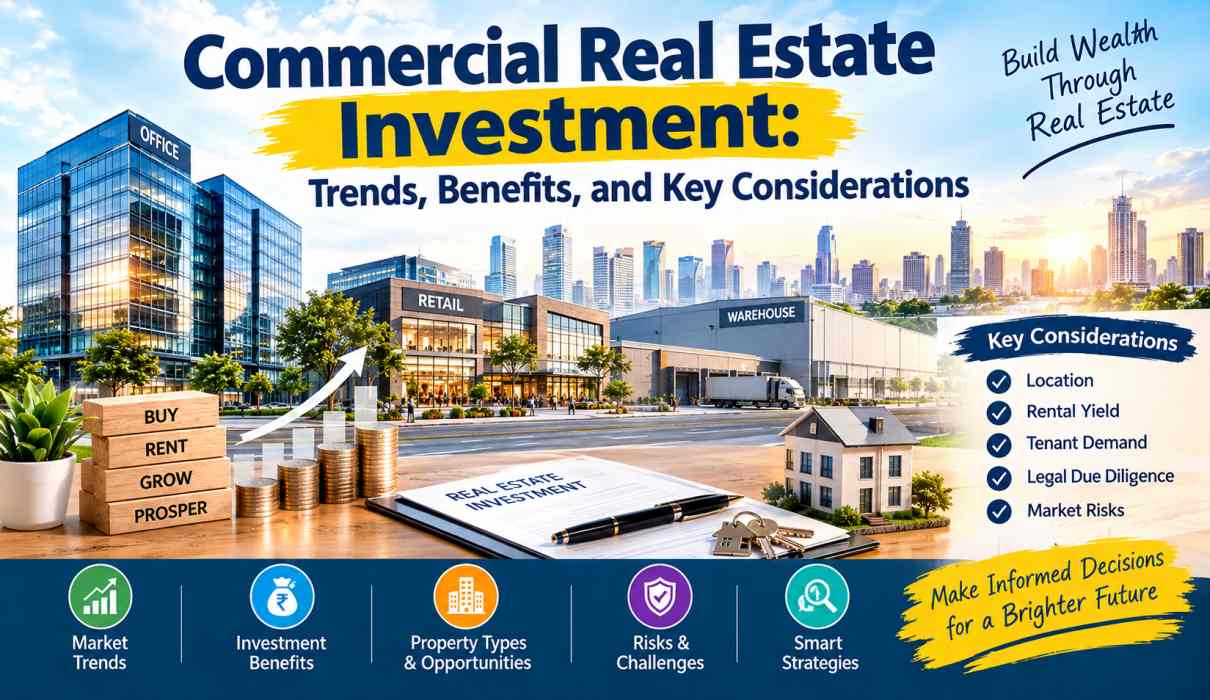
By Commercial Real Estate Investment: Trends, Benefits, and Key Considerations
Commercial real estate investment has become an important part of the broader property market, offering investors opportunities to generate rental income, build long-term assets, and diversify their investment portfolios. Unlike residential properties, commercial real estate includes offices, retail spaces, warehouses, industrial properties, hotels, and other properties designed primarily for business activities.
Changing consumer behavior, the growth of e-commerce, expansion of businesses, improved infrastructure, and increasing demand for professional workspaces are influencing commercial property markets in many cities. At the same time, commercial real estate involves significant capital requirements, market risks, tenant-related challenges, and ongoing property management responsibilities.
For investors considering this asset class, understanding market trends and evaluating a property carefully are essential. This guide explains the major commercial real estate investment trends, potential benefits, risks, and key factors investors should consider before making a decision.
What Is Commercial Real Estate Investment?
Commercial real estate investment involves purchasing, developing, or investing in properties that are primarily used for business or income-generating purposes.
Common examples include:
- Office buildings
- Retail shops and shopping centers
- Warehouses
- Industrial facilities
- Business parks
- Hotels
- Co-working spaces
- Logistics facilities
- Mixed-use commercial developments
Investors can earn returns from commercial property through rental income, property appreciation, or a combination of both. However, actual returns depend on factors such as location, property quality, occupancy, tenant demand, financing costs, operating expenses, and broader market conditions.
Why Commercial Real Estate Attracts Investors
Commercial properties can offer several characteristics that make them attractive to investors.
Potential Rental Income
Businesses often lease commercial properties for longer periods compared with some residential rental arrangements. Depending on the property and lease structure, this can provide investors with a relatively predictable income stream.
However, rental income is never guaranteed. Vacancy periods, tenant defaults, maintenance costs, and market changes can affect actual cash flow.
Long-Term Asset Potential
Well-located commercial properties may benefit from economic growth and infrastructure development over time. As an area develops, demand for offices, retail spaces, warehouses, and other commercial facilities may change.
Investors should therefore evaluate both the current condition of a property and its long-term market potential.
Portfolio Diversification
Investors who already have exposure to financial assets or residential property may consider commercial real estate as another asset category.
Diversification does not eliminate investment risk, but it can help prevent a portfolio from being concentrated in a single type of asset.
Major Commercial Real Estate Investment Trends
The commercial property market continues to evolve as businesses and consumers change how they work, shop, store products, and use physical spaces.
1. Growth of Logistics and Warehousing
The expansion of e-commerce, organized retail, manufacturing, and supply-chain networks has increased the importance of logistics infrastructure.
Warehouses and distribution centers located near major highways, ports, airports, and urban consumption centers can be strategically important for businesses.
For investors, location remains a critical factor. A warehouse with convenient access to transportation networks may have different demand characteristics from one located far from major commercial corridors.
2. Changing Office Space Requirements
The workplace has changed significantly as businesses adopt different combinations of office-based and remote work.
Instead of simply seeking large office areas, many companies are increasingly considering flexibility, connectivity, employee amenities, location, and efficient use of space.
This has increased interest in modern office buildings with adaptable layouts, technology infrastructure, meeting facilities, and convenient transportation access.
Investors evaluating office properties should examine local tenant demand rather than assuming that all office markets are performing in the same way.
3. Expansion of Flexible Workspaces
Co-working and flexible office spaces have become an important part of the commercial property ecosystem.
Startups, freelancers, small companies, consultants, and even larger businesses may use flexible workspace arrangements for different purposes.
For property owners, flexible workspace models can create additional opportunities, but they also require careful management and an understanding of changing tenant preferences.
4. Retail Property Transformation
Retail real estate is adapting to changes in consumer behavior and the growth of online shopping.
Physical stores remain important, but successful retail properties increasingly focus on convenience, experience, food and entertainment, services, and accessibility.
Retail investment decisions should therefore consider factors such as surrounding population, purchasing power, visibility, parking, accessibility, nearby competition, and tenant mix.
5. Rising Importance of Sustainability
Environmental considerations are becoming increasingly relevant in commercial real estate.
Energy-efficient lighting, water-saving systems, renewable energy, efficient cooling systems, waste management, and sustainable building materials can influence operating costs and tenant preferences.
Green building features may also become increasingly important for companies with environmental goals.
Investors should examine both the upfront cost of sustainability improvements and their potential effect on operating expenses, tenant demand, and property competitiveness.
Benefits of Commercial Real Estate Investment
Commercial real estate can provide several potential advantages, although outcomes vary by property and market.
Regular Income Potential
A leased commercial property can generate recurring rental income. The amount depends on the lease agreement, property type, location, tenant, and prevailing market rents.
Investors should calculate net income rather than looking only at gross rent.
Potential Property Appreciation
Property values can increase when demand grows, infrastructure improves, supply remains limited, or the surrounding area develops.
However, appreciation is not guaranteed, and property values can also decline because of economic conditions, oversupply, changing demand, or unfavorable local developments.
Professional Tenant Relationships
Commercial tenants may include companies, retailers, manufacturers, logistics businesses, or professional service providers.
A strong tenant and well-structured lease can contribute to stable property operations. At the same time, losing a major commercial tenant can create a significant vacancy and income gap.
Opportunities for Value Improvement
Investors may be able to improve a commercial property through renovations, better management, modernization, energy-efficiency upgrades, improved amenities, or repositioning.
These improvements can potentially make a property more attractive to tenants.
Key Factors to Consider Before Investing
Commercial real estate decisions require detailed analysis. Investors should avoid making decisions based solely on attractive photographs, promised rental returns, or assumptions about future development.
1. Location
Location is one of the most important factors in commercial real estate.
Consider:
- Road connectivity
- Public transportation
- Nearby residential areas
- Business activity
- Parking availability
- Infrastructure
- Accessibility
- Local competition
- Future development plans
A property in a strong commercial corridor may have different tenant demand from a similar property in an emerging but less-established area.
2. Tenant Demand
Before purchasing a commercial property, understand who the potential tenants are.
Ask:
- What businesses operate in the area?
- What types of businesses are expanding?
- What is the current vacancy level?
- What rental rates are common?
- How quickly do similar properties find tenants?
Understanding local demand can help investors avoid purchasing a property that looks attractive but has limited practical demand.
3. Rental Yield
Rental yield provides a way to compare rental income with the property’s purchase price.
A basic calculation is:
Rental Yield = Annual Rental Income ÷ Property Purchase Price × 100
For example, if a property generates ₹6 lakh in annual rent and costs ₹1 crore, the gross rental yield would be 6%.
However, investors should also consider maintenance, taxes, vacancy, insurance, financing costs, management expenses, and other charges when estimating actual returns.
4. Lease Terms
Commercial leases can be more complex than residential rental agreements.
Review:
- Lease duration
- Rent escalation clauses
- Security deposit
- Maintenance responsibilities
- Renewal terms
- Lock-in period
- Termination conditions
- Property taxes
- Insurance responsibilities
Professional legal advice can be valuable when reviewing significant commercial lease agreements.
5. Property Condition
A commercial building may require substantial maintenance.
Inspect:
- Structural condition
- Electrical systems
- Plumbing
- Elevators
- Fire-safety systems
- Air conditioning
- Parking facilities
- Common areas
- Building age
A professional property inspection can identify potential expenses before purchase.
6. Legal and Regulatory Due Diligence
Investors should verify ownership documents, approvals, zoning, building permissions, taxes, outstanding liabilities, and other applicable legal requirements.
The exact documents and regulations vary by location and property type.
A qualified legal professional can help verify documentation before a transaction is completed.
Understanding the Risks
Commercial real estate can provide opportunities, but investors should understand the associated risks.
Vacancy Risk
If a tenant leaves, the property may remain vacant until a replacement tenant is found. During this period, rental income may decline or disappear while certain expenses continue.
Market Risk
Economic slowdowns, changing business conditions, interest rates, oversupply, and shifts in consumer behavior can affect commercial property demand.
Tenant Risk
A tenant may face financial difficulties, delay payments, or terminate a lease according to its terms.
Liquidity Risk
Real estate is generally less liquid than assets that can be bought and sold quickly in financial markets. Selling a commercial property can take considerable time and may involve transaction costs.
Interest Rate and Financing Risk
Investors who use loans should consider how interest-rate changes could affect their monthly payments and overall investment costs.
A property that appears profitable before financing costs may produce different results after loan interest and other expenses are included.
How Technology Is Changing Commercial Real Estate
Technology is increasingly influencing commercial property management and investment.
Property owners and managers can use digital systems for:
- Tenant communication
- Rent collection
- Maintenance management
- Security
- Building access
- Energy monitoring
- Property marketing
- Data analysis
Smart building technologies can also help monitor energy consumption, occupancy, temperature, security, and maintenance requirements.
For investors, technology can improve operational efficiency and provide better information for decision-making.
Commercial Real Estate Investment for First-Time Investors
First-time investors should start with research rather than rushing into a purchase.
A practical process can include:
Step 1: Define Your Investment Goal
Decide whether your priority is rental income, long-term appreciation, portfolio diversification, or another objective.
Step 2: Establish a Budget
Consider not only the purchase price but also taxes, registration, financing costs, maintenance, renovations, and emergency reserves.
Step 3: Research Locations
Compare different commercial areas based on demand, infrastructure, accessibility, and development.
Step 4: Compare Properties
Evaluate multiple properties rather than focusing on the first opportunity you see.
Step 5: Analyze Cash Flow
Estimate realistic rental income, vacancy periods, operating expenses, financing costs, and taxes.
Step 6: Complete Due Diligence
Verify legal documents, physical condition, tenant agreements, and applicable approvals.
Step 7: Seek Professional Advice
For a significant investment, consider advice from qualified legal, financial, tax, and real estate professionals.
Is Commercial Real Estate Right for Every Investor?
Commercial real estate is not suitable for every investor.
It can require significant capital, careful research, ongoing management, and tolerance for periods of vacancy or changing market conditions.
Investors should consider their financial position, investment horizon, liquidity requirements, risk tolerance, and ability to manage property-related responsibilities before investing.
There are also alternatives to directly purchasing commercial property, including certain professionally managed real estate investment structures. These options have their own risks, costs, and regulatory considerations and should be researched separately.
Future Outlook for Commercial Real Estate
The future of commercial real estate will likely be influenced by urbanization, infrastructure development, e-commerce, changing workplace patterns, sustainability, technology, and evolving consumer behavior.
Different property sectors may perform differently. Demand for warehouses, offices, retail spaces, and mixed-use developments can vary significantly between cities and even between neighborhoods.
For this reason, investors should avoid treating commercial real estate as a single uniform market. Local research remains essential.
Conclusion
Commercial real estate investment can provide opportunities for rental income, asset ownership, diversification, and long-term growth. However, successful investing requires more than finding a property in a busy location.
Investors should carefully evaluate location, tenant demand, rental yield, lease conditions, property quality, legal documentation, financing costs, operating expenses, and market risks.
Emerging trends such as logistics expansion, flexible offices, evolving retail spaces, sustainability, and smart-building technology are changing the commercial property landscape. These developments can create new opportunities while also introducing new considerations for investors.
Whether you are a first-time investor or an experienced property owner, thorough research and professional due diligence are essential before committing significant capital. A well-researched commercial property investment strategy should focus on realistic cash-flow expectations, appropriate risk management, and long-term market fundamentals rather than short-term speculation.