
 By
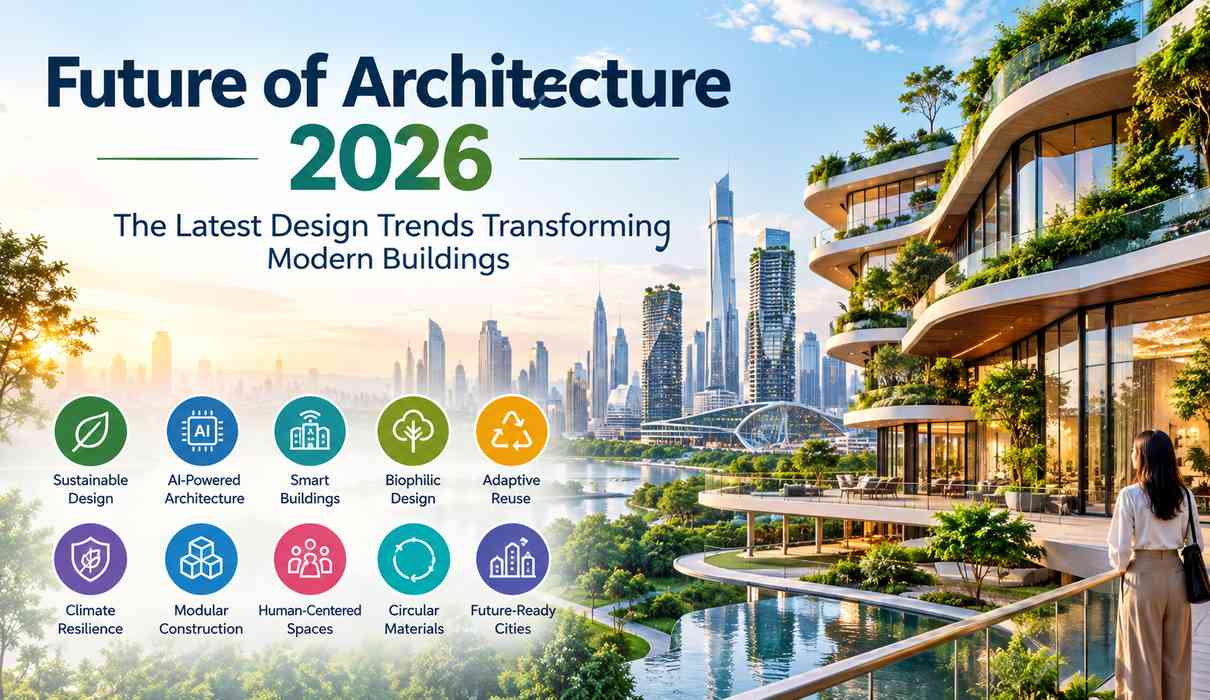
By Future of Architecture 2026: The Latest Design Trends Transforming Modern Buildings
Architecture is entering a new era in 2026. Modern buildings are no longer designed only to look impressive; they are increasingly expected to be sustainable, adaptable, intelligent, resilient and human-centered. Advances in artificial intelligence, climate-conscious construction, smart-building technology and new approaches to existing structures are changing the way architects imagine and create the built environment.
The future of architecture is also becoming less about creating buildings that remain unchanged for decades and more about designing spaces that can adapt to changing technology, climate conditions, lifestyles and community needs. Gensler’s 2026 Design Forecast identifies AI-powered design intelligence, adaptive reuse, agility and resilience among major forces shaping the future of cities and buildings. (Gensler)
From sustainable materials and biophilic design to smart buildings and adaptive reuse, the architecture trends of 2026 reflect a broader shift toward responsible innovation.
In this article, we explore the latest architecture trends transforming modern buildings in 2026 and examine how these ideas may influence homes, offices, commercial spaces and cities in the years ahead.
1. Artificial Intelligence Is Transforming Architectural Design
One of the most important architecture trends in 2026 is the growing use of artificial intelligence (AI) throughout the design process.
AI can help architects explore multiple design possibilities, analyze building performance, optimize layouts and evaluate different environmental conditions. Instead of replacing architects, AI is increasingly being used as a tool that allows design teams to move more quickly from an initial idea to multiple possible solutions.
AI-assisted design can help analyze factors such as daylight, energy consumption, occupancy, circulation and spatial efficiency. This makes it possible to test ideas earlier and make more informed decisions.
Gensler’s 2026 research describes AI as a creative and design intelligence capable of changing how designers approach projects. (Gensler)
The result is likely to be a more experimental architecture industry where architects combine human creativity with computational analysis.
2. Sustainable Architecture Becomes the New Standard
Sustainability is no longer simply an additional feature of modern architecture. It is becoming a fundamental part of building design.
In 2026, architects are paying greater attention to energy efficiency, embodied carbon, responsible materials, water conservation, passive design and long-term environmental performance.
Sustainable buildings may incorporate:
- Energy-efficient lighting and appliances
- Solar energy systems
- Natural ventilation
- High-performance insulation
- Low-carbon materials
- Rainwater collection
- Green roofs
- Efficient heating and cooling systems
- Recycled and locally sourced materials
The American Institute of Architects has highlighted a shift toward sustainable and regenerative design, including greater use of performance analysis and measurable environmental outcomes. (The American Institute of Architects)
This means future buildings will increasingly be evaluated not only by appearance and cost but also by their environmental impact and long-term performance.
3. Regenerative Architecture Goes Beyond Sustainability
A particularly important development is the movement from sustainable architecture toward regenerative architecture.
Sustainable design generally aims to reduce environmental damage. Regenerative architecture goes a step further by asking how buildings and communities can contribute positively to their surrounding ecosystems.
A regenerative building might integrate renewable energy, restore biodiversity, manage stormwater naturally, use circular materials and create healthier environments for occupants.
According to AIA’s 2026 discussion of sustainable and regenerative design, architecture is increasingly moving toward regeneration rather than simply minimizing environmental impact. (The American Institute of Architects)
This approach could influence future developments by encouraging architects to think of buildings as part of larger ecological systems rather than isolated structures.
4. Adaptive Reuse Will Transform Existing Buildings
Another major architecture trend for 2026 is adaptive reuse—giving existing buildings new purposes instead of demolishing them and starting from scratch.
Old offices can become apartments. Warehouses can become creative workspaces. Shopping centers can be redesigned as community hubs. Historic buildings can receive modern infrastructure while retaining their original character.
Adaptive reuse can help preserve resources, reduce demolition waste and maintain important connections between buildings and communities.
Gensler identifies radical adaptive reuse as one of the major forces influencing real estate and urban resilience in its 2026 Design Forecast. (Gensler)
This trend is particularly relevant as cities deal with changing work patterns, housing demand and underused commercial properties.
Rather than asking, “What should we build?”, architects are increasingly asking, “What can we transform?”
5. Smart Buildings Will Become More Intelligent
Technology is becoming deeply integrated into modern architecture.
Smart buildings use connected systems, sensors and automation to monitor and manage building operations. These technologies can control lighting, temperature, ventilation, security and energy use.
For example, sensors can detect when rooms are occupied and adjust lighting or climate control accordingly. Building management systems can analyze energy consumption and identify opportunities for greater efficiency.
Future smart buildings may also use AI to predict maintenance requirements before equipment fails.
This creates buildings that are more responsive to their occupants while potentially reducing operating costs and resource consumption.
However, smart architecture should not focus on technology for its own sake. The best smart buildings will use technology quietly in the background to make spaces more comfortable, efficient and adaptable.
6. Biophilic Design Brings Nature Into Buildings
People are spending much of their lives indoors, increasing interest in architecture that reconnects people with nature.
This is the principle behind biophilic design, which incorporates natural elements and experiences into built environments.
Common features include:
- Indoor plants
- Green walls
- Courtyards
- Natural daylight
- Views of nature
- Natural materials
- Water features
- Outdoor terraces
- Natural ventilation
- Organic forms and textures
A 2026 review in Frontiers in Sustainable Cities describes biophilic design as an approach that integrates natural systems, ecological performance and human-centered wellbeing into architecture. (Frontiers)
Biophilic architecture can be particularly valuable in offices, schools, healthcare facilities, hotels and residential buildings where comfort and wellbeing are important.
The future may therefore see more buildings designed not simply around rooms and corridors, but around light, air, greenery and human experience.
7. Climate-Resilient Architecture Will Become Essential
Extreme weather and changing environmental conditions are influencing architectural decisions around the world.
Future-ready buildings need to consider risks such as extreme heat, flooding, storms, drought and other climate-related stresses.
Climate-resilient architecture can include elevated structures, flood-resistant materials, shading systems, passive cooling, stronger building envelopes, rainwater management and landscape strategies.
Designing beyond minimum building requirements can provide additional resilience benefits for both building owners and occupants, according to AIA guidance on resilient design. (The American Institute of Architects)
In 2026, resilience is therefore becoming a core design consideration rather than something added after a building has been planned.
8. Flexible and Adaptable Spaces Are Gaining Importance
The way people use buildings is changing quickly.
Offices may need to accommodate hybrid work. Retail spaces may become entertainment or community destinations. Homes may need dedicated work areas. Educational spaces may require more flexible learning environments.
As a result, architects are designing spaces that can serve multiple purposes.
Movable partitions, modular furniture, flexible floor plans and adaptable infrastructure can allow a building to change without major reconstruction.
This concept of designing for uncertainty is increasingly important. Gensler’s 2026 research emphasizes the value of environments capable of continuous adaptation as organizations and communities change. (Gensler)
The building of the future may therefore be designed for several possible uses rather than just one fixed purpose.
9. Circular Design and Responsible Materials
Material selection is another area undergoing significant change.
Traditional construction can generate considerable waste through demolition, manufacturing and discarded materials. Circular architecture attempts to reduce this impact by keeping materials and components in use for as long as possible.
Architects are increasingly considering:
- Recycled materials
- Reclaimed wood
- Low-carbon concrete
- Reusable building components
- Locally sourced materials
- Modular construction
- Design for disassembly
Instead of treating a building as a disposable product, circular design considers what happens to its materials throughout their entire lifecycle.
This approach can make architecture more resource-efficient while creating opportunities for innovative materials and construction methods.
10. Human-Centered Architecture Will Remain Important
Despite rapid advances in AI and smart technology, architecture in 2026 is still fundamentally about people.
A technologically advanced building is not successful if it is uncomfortable, confusing or disconnected from its community.
Human-centered architecture considers accessibility, wellbeing, social interaction, safety and cultural identity.
Public spaces, shared courtyards, pedestrian-friendly environments and mixed-use developments can encourage people to interact and create stronger communities.
AIA’s 2026 sustainable design research also emphasizes community as an important part of climate action and responsible design. (The American Institute of Architects)
The future of architecture will therefore involve balancing technological innovation with human experience and social value.
11. Mixed-Use Buildings Will Shape Future Cities
Modern cities are becoming increasingly interested in mixed-use development.
Instead of separating residential, commercial, retail and recreational areas, mixed-use buildings combine different functions within the same development.
A single project might include:
- Apartments
- Offices
- Shops
- Restaurants
- Fitness facilities
- Public spaces
- Green areas
- Community facilities
This can reduce unnecessary travel and create more active neighborhoods throughout the day.
Gensler’s 2026 research also highlights mixed-use environments and the transformation of urban spaces as important areas of future design. (Gensler)
The trend is especially relevant to growing cities where land is limited and communities need efficient ways to combine different activities.
12. Data-Driven Architecture Will Improve Building Performance
Architecture is becoming increasingly measurable.
Instead of relying only on experience and visual judgment, architects can use simulations and performance data to evaluate design decisions.
Energy modeling, occupancy analysis, environmental simulations and digital building models can help teams understand how a building may perform before construction begins.
AIA has specifically identified performance modeling, occupancy evaluation and interdisciplinary research as increasingly important parts of evidence-based sustainable design. (The American Institute of Architects)
This could make future architecture more precise and reduce the gap between a building’s design intentions and its actual performance.
13. Modular and Prefabricated Construction Will Continue to Grow
Another important development is the increasing interest in modular and prefabricated construction.
Instead of producing every component at the construction site, certain building elements can be manufactured in controlled environments and assembled later.
Potential advantages include faster construction, better quality control, reduced material waste and improved predictability.
Modular systems can also support adaptable architecture because components may be easier to replace, rearrange or expand.
As construction technology develops, prefabrication could become increasingly common in housing, commercial buildings, healthcare facilities and other building types.
14. Architecture Will Become More Regional and Culturally Relevant
Although technology is global, good architecture remains connected to its location.
Future buildings are likely to combine modern technology with local climate conditions, materials, traditions and cultural identity.
A building in a hot climate may prioritize shade and natural ventilation, while architecture in colder regions may focus on insulation and passive solar strategies.
Local materials and craftsmanship can also create distinctive architectural identities.
This approach avoids the idea that every modern building should look the same and instead encourages architecture that is globally informed but locally responsive.
What Will the Future of Architecture Look Like?
The architecture of the future will probably not be defined by one particular visual style.
Instead, it will be defined by how effectively buildings respond to changing needs.
A future-ready building could combine AI-assisted design, renewable energy, smart sensors, natural materials, adaptive reuse, flexible spaces, biophilic features and climate-resilient systems within one project.
The most successful buildings will likely be those that balance multiple objectives: beauty, functionality, affordability, sustainability, technology and human wellbeing.
Architecture is therefore moving from a focus on simply creating structures toward creating responsive environments.
Conclusion
The future of architecture in 2026 is being shaped by a combination of technology, sustainability and changing human needs. AI is transforming the design process, while adaptive reuse is giving existing buildings new life. Smart technology is making buildings more responsive, and biophilic design is reconnecting people with nature.
At the same time, climate resilience, regenerative design, circular materials and flexible spaces are becoming increasingly important. These trends suggest that tomorrow’s buildings will need to do more than provide shelter or workspace—they will need to perform efficiently, adapt to change and contribute positively to the communities around them.
For architects, developers and property owners, the key lesson is clear: future-ready architecture is not simply about futuristic appearance. It is about creating buildings that can remain useful, efficient, resilient and relevant for years to come.
As technology continues to evolve and environmental challenges become more urgent, architecture will play an increasingly important role in shaping healthier, smarter and more sustainable cities.