
 By
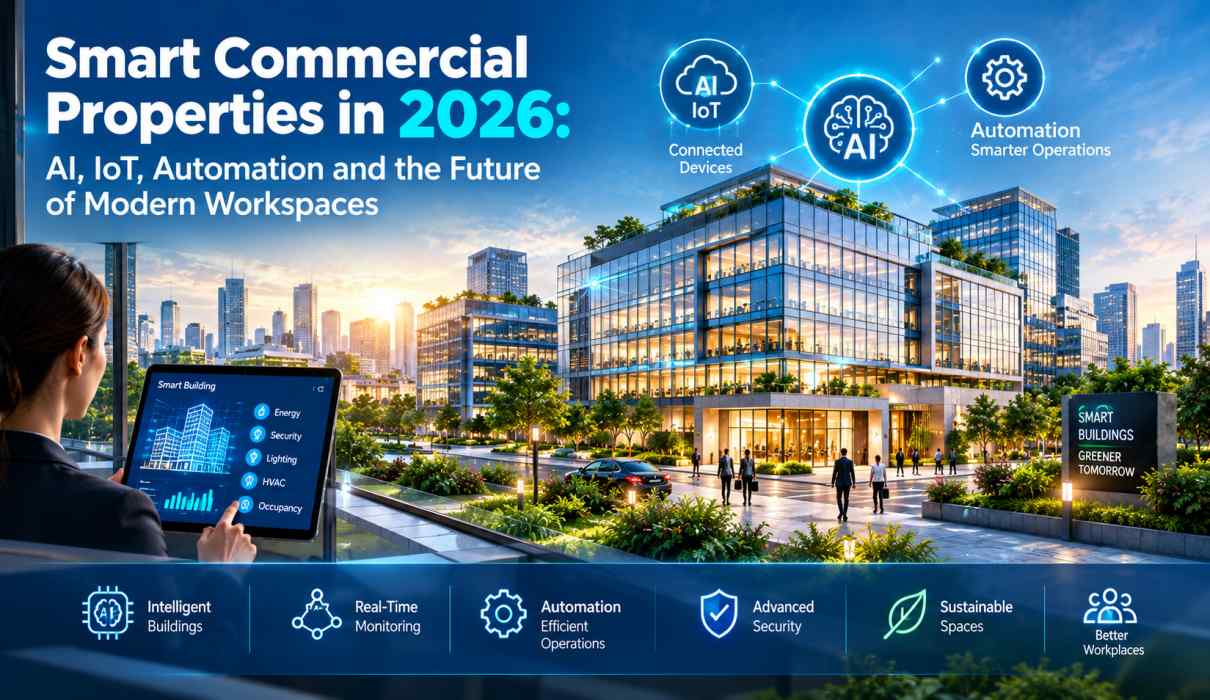
By Smart Commercial Properties in 2026: AI, IoT, Automation and the Future of Modern Workspaces
Commercial real estate is entering a new phase in 2026. Offices, business parks, retail buildings and other commercial properties are becoming more connected, intelligent and adaptable as businesses increasingly depend on technology, data and flexible working models.
The traditional commercial building was primarily designed around physical space. Today, businesses are looking for much more than desks, meeting rooms and attractive interiors. They want smart buildings, reliable digital infrastructure, automation, energy efficiency, flexible workspaces, stronger security and better employee experiences.
This transformation is creating a new category of smart commercial properties. These properties combine artificial intelligence (AI), Internet of Things (IoT), building automation, analytics and sustainable infrastructure to make buildings more efficient and responsive.
India’s commercial real estate market is particularly well positioned for this transition. Colliers expects Grade A office demand in India to reach around 70–75 million square feet in 2026, supported by Global Capability Centres (GCCs), flexible workspaces, technology-enabled offices and sustainability-focused developments.
What Are Smart Commercial Properties?
Smart commercial properties are buildings that use connected technologies and intelligent systems to monitor, manage and improve building operations.
Instead of operating independently, systems such as lighting, heating and cooling, security, elevators, access control and energy management can communicate through a central digital infrastructure.
Typical smart-building technologies include:
- AI-powered building management systems
- IoT sensors
- Smart lighting
- Automated HVAC systems
- Occupancy sensors
- Digital access control
- Smart parking
- Energy monitoring
- Predictive maintenance
- Workplace management applications
- Real-time analytics
- Digital twins
- Automated security systems
The purpose is not simply to install more technology. The objective is to create commercial properties that can respond intelligently to changing business requirements.
Why Smart Commercial Properties Matter in 2026
Businesses are increasingly operating in a technology-driven environment. Employees expect reliable connectivity, comfortable workspaces and convenient digital services, while companies want to control operating costs and use office space more effectively.
At the same time, sustainability has become an important consideration for corporate real estate decisions.
CBRE’s 2026 India Office Occupier Survey found that 93% of surveyed occupiers were at some stage of AI adoption, while 67% expected flexible workspaces to form part of their portfolios within two years. The survey also found that commute infrastructure and sustainability are important factors in workplace decisions.
These developments are changing what businesses expect from commercial properties.
A modern office building increasingly needs to provide an ecosystem where people, technology, physical space and business operations work together.
1. AI-Powered Commercial Buildings
Artificial intelligence is becoming one of the most important technologies influencing commercial real estate.
AI can analyse large amounts of information collected from buildings and provide insights that would be difficult to obtain through manual monitoring.
For example, AI can analyse:
- Occupancy patterns
- Energy consumption
- Meeting-room usage
- Temperature conditions
- Equipment performance
- Security alerts
- Maintenance requirements
- Workplace utilisation
AI-powered systems can then help building managers make better operational decisions.
A building may automatically adjust cooling based on occupancy or identify areas that are consistently underused. Facility teams can use predictive analytics to identify equipment that may require maintenance before a breakdown occurs.
JLL reported that AI adoption in India’s corporate real estate has expanded dramatically, with the share of Indian companies piloting or planning AI-enabled CRE solutions rising from under 5% in 2023 to 91% in 2025.
This indicates that AI is moving beyond experimentation and becoming an important part of commercial property strategy.
2. IoT and Connected Buildings
The Internet of Things is another major foundation of smart commercial properties.
IoT connects physical devices and sensors to digital networks so they can collect and exchange information.
In a commercial building, sensors can monitor:
- Occupancy
- Temperature
- Humidity
- Air quality
- Lighting
- Electricity consumption
- Water usage
- Equipment performance
- Movement
- Parking availability
This information gives property managers a real-time understanding of what is happening inside the building.
For example, occupancy sensors can identify how frequently meeting rooms are used. Energy sensors can identify areas consuming excessive electricity. Environmental sensors can monitor indoor conditions.
When IoT data is combined with AI, the building can become more predictive and responsive.
3. Automated Building Management
Building automation is transforming the way commercial properties operate.
A Building Management System (BMS) can bring different building systems together through a central platform.
Automation can control or coordinate:
- HVAC
- Lighting
- Elevators
- Security
- Access control
- Fire systems
- Energy systems
- Water systems
For example, lights can automatically switch off in unoccupied areas, while HVAC systems can adjust according to occupancy.
This can improve operational efficiency while reducing unnecessary resource consumption.
The real value of automation is therefore not the technology itself. It is the ability to create a building that requires less manual intervention while responding more effectively to real-world conditions.
4. Smart Energy Management
Energy efficiency is becoming increasingly important for commercial property owners and occupiers.
Large offices can consume significant amounts of electricity through air conditioning, lighting, computers, elevators and other equipment.
Smart energy-management systems can track consumption in real time and identify opportunities to reduce waste.
AI can analyse historical usage and predict future demand. Automated systems can then adjust building operations according to occupancy and environmental conditions.
Smart commercial properties may also integrate:
- Solar power
- Energy-efficient lighting
- Smart meters
- Battery storage
- Efficient HVAC systems
- Renewable energy procurement
- Carbon monitoring
Colliers expects sustainability and climate resilience to remain important drivers of India’s office market in 2026, with green-certified buildings becoming increasingly important to occupiers.
5. Smart Security and Access Control
Security is another critical component of intelligent commercial properties.
Traditional security systems are increasingly being supported by digital technologies such as:
- Biometric access
- Smart access cards
- Mobile-based entry
- Video analytics
- AI-assisted surveillance
- Visitor management systems
- Digital security monitoring
- Smart parking controls
These systems can help property managers monitor access and respond to unusual activity.
For large office complexes, digital visitor-management systems can simplify the process of registering guests while maintaining better control over building access.
However, smart security also creates new cybersecurity responsibilities. Connected buildings must protect their networks, devices and data from unauthorised access.
6. Flexible Workspaces and Hybrid Offices
The workplace has changed significantly, and commercial properties are adapting.
Companies increasingly want offices that can support a mixture of fixed workstations, collaboration areas, meeting rooms, quiet spaces and flexible seating.
Flexible workspace providers are also becoming an important part of the commercial real estate market.
Colliers expects flexible workspaces to account for roughly 20–25% of overall office leasing activity in India in 2026.
This means future commercial properties need to be designed for adaptability.
Instead of creating offices for one fixed configuration, developers can provide modular spaces that can be adjusted as tenant requirements change.
7. AI-Powered Space Planning
One of the most useful applications of AI in commercial properties is intelligent space planning.
Businesses may not always know exactly how much office space they need. Some meeting rooms may remain unused while other areas become overcrowded.
Occupancy sensors and workplace analytics can provide actual usage data.
AI can analyse this information and help businesses determine:
- Which areas are underused
- When meeting rooms are in highest demand
- How many desks are required
- Where collaboration spaces should be located
- How workplace layouts could be improved
This can help companies make better leasing and workplace decisions.
The objective is to move from space planning based on assumptions to space planning based on real-time data.
8. Better Employee Experience
A smart commercial property is not only about reducing costs.
Employee experience is becoming an important factor in workplace design.
Modern offices can use technology to provide:
- App-based room booking
- Smart visitor management
- Digital wayfinding
- Personalised workplace settings
- Automated lighting
- Indoor air-quality monitoring
- Smart parking
- Digital employee services
These features can make everyday office experiences more convenient.
Well-designed smart buildings can also support wellness through natural lighting, better air quality, ergonomic environments, green spaces and biophilic design.
9. Sustainable and Green Commercial Properties
Sustainability is becoming a core element of modern commercial real estate.
Businesses increasingly want properties that support environmental goals while maintaining operational efficiency.
Green commercial buildings may incorporate:
- Renewable energy
- Energy-efficient equipment
- Water conservation
- Rainwater harvesting
- Waste management
- Green landscaping
- Sustainable construction materials
- EV charging
- Carbon monitoring
Sustainability can also influence the long-term attractiveness of a property.
Colliers expects 80–90% of new office supply in India to be green certified in 2026, illustrating how strongly sustainability is becoming integrated into commercial development.
10. Digital Connectivity as a Core Property Feature
Reliable digital infrastructure is becoming as important as physical infrastructure.
Modern businesses depend on high-speed internet, cloud applications, video conferencing, cybersecurity systems and AI tools.
As AI adoption increases, offices may require stronger connectivity and specialised technology infrastructure.
CBRE’s 2026 office outlook notes that AI integration is contributing to demand for premium spaces with high-performance digital infrastructure, secure data environments and adaptable layouts.
Commercial buildings that cannot provide reliable connectivity may become less competitive over time.
11. Predictive Maintenance
Traditional property maintenance is often reactive. A problem occurs, and the maintenance team responds.
Smart buildings can shift toward predictive maintenance.
IoT sensors can monitor equipment such as:
- Air-conditioning units
- Elevators
- Pumps
- Generators
- Electrical systems
- Water systems
AI can analyse performance data and identify unusual patterns.
If a machine begins operating outside its normal range, the system can alert facility managers before a major failure occurs.
This approach can reduce downtime, improve equipment reliability and potentially lower maintenance costs.
12. Digital Twins and Intelligent Property Management
Digital twins are another emerging technology in commercial real estate.
A digital twin is a virtual representation of a physical building or property. It can combine information about the building’s structure, equipment, systems and operations.
Property managers can use digital models to understand building performance and simulate potential changes.
For example, a digital twin could help evaluate the potential impact of changing HVAC settings, modifying layouts or improving energy systems.
This can support better decision-making throughout a property’s lifecycle.
13. Commercial Properties Designed for GCCs
Global Capability Centres are becoming a major driver of India’s office market.
These centres increasingly perform high-value functions including artificial intelligence, research and development, engineering, analytics and product development.
Colliers expects GCC leasing to reach approximately 30–35 million square feet in 2026 and account for a substantial share of Grade A office demand.
GCCs often require high-quality buildings with strong connectivity, advanced security, sustainability features and flexible layouts.
This is encouraging developers to create commercial properties designed around technology-intensive business operations.
14. The Rise of Smart Commercial Investment
Smart technology can also influence the investment value of commercial properties.
Investors increasingly evaluate more than location and rental income.
Important considerations may include:
- Building quality
- Digital infrastructure
- Energy efficiency
- Tenant experience
- Sustainability certification
- Technology readiness
- Operating costs
- Flexibility
- Long-term adaptability
Properties that can adapt to changing tenant requirements may have stronger long-term appeal.
The growing institutionalisation of India’s office market is also important. Colliers notes that REITs already account for a significant portion of Grade A office stock and expects further growth in REIT penetration.
Challenges of Smart Commercial Properties
Despite their advantages, smart buildings also face several challenges.
High Initial Investment
Advanced sensors, automation systems, cybersecurity infrastructure and energy technologies can increase development costs.
Cybersecurity Risks
Connected buildings create additional digital entry points. Strong cybersecurity and regular system updates are essential.
Technology Obsolescence
Technology changes quickly. Building owners need systems that can be upgraded rather than replaced entirely.
Data Privacy
Occupancy analytics and workplace systems can collect significant amounts of information. Companies need responsible data-management practices.
Integration Problems
Different technologies may not always communicate effectively. Open and interoperable systems can help reduce this challenge.
Skilled Workforce
Smart buildings require professionals who understand both property management and technology.
What Does the Future of Commercial Real Estate Look Like?
The future commercial property is likely to become more intelligent, flexible, sustainable and data-driven.
Buildings will increasingly use AI to analyse operations, IoT sensors to collect information and automation to respond to changing conditions.
Workspaces will become more adaptable as companies balance traditional offices with flexible and hybrid working models.
Sustainability will also become more deeply integrated into building operations through renewable energy, smart energy management and climate-resilient design.
The most successful commercial properties will not simply be buildings filled with technology. They will be intelligent ecosystems designed around people, business performance and long-term efficiency.
Conclusion
Smart commercial properties in 2026 are redefining the future of offices and modern workspaces. AI, IoT, automation, smart security, predictive maintenance, flexible layouts and sustainable infrastructure are changing how commercial buildings are designed, operated and valued.
For businesses, these technologies can improve employee experience, operational efficiency and workplace flexibility. For property owners and investors, smart infrastructure can help create more adaptable and competitive assets.
India’s commercial real estate market is particularly well positioned for this transformation, supported by GCC expansion, flexible workspace demand, technology adoption and increasing emphasis on sustainability.
The future of commercial real estate is therefore not simply about constructing bigger buildings. It is about creating smarter buildings that can understand changing needs, use resources efficiently, protect occupants and adapt to the future.
As AI and connected technologies continue to mature, smart commercial properties are likely to become an increasingly important part of the next generation of modern workspaces.