
 By
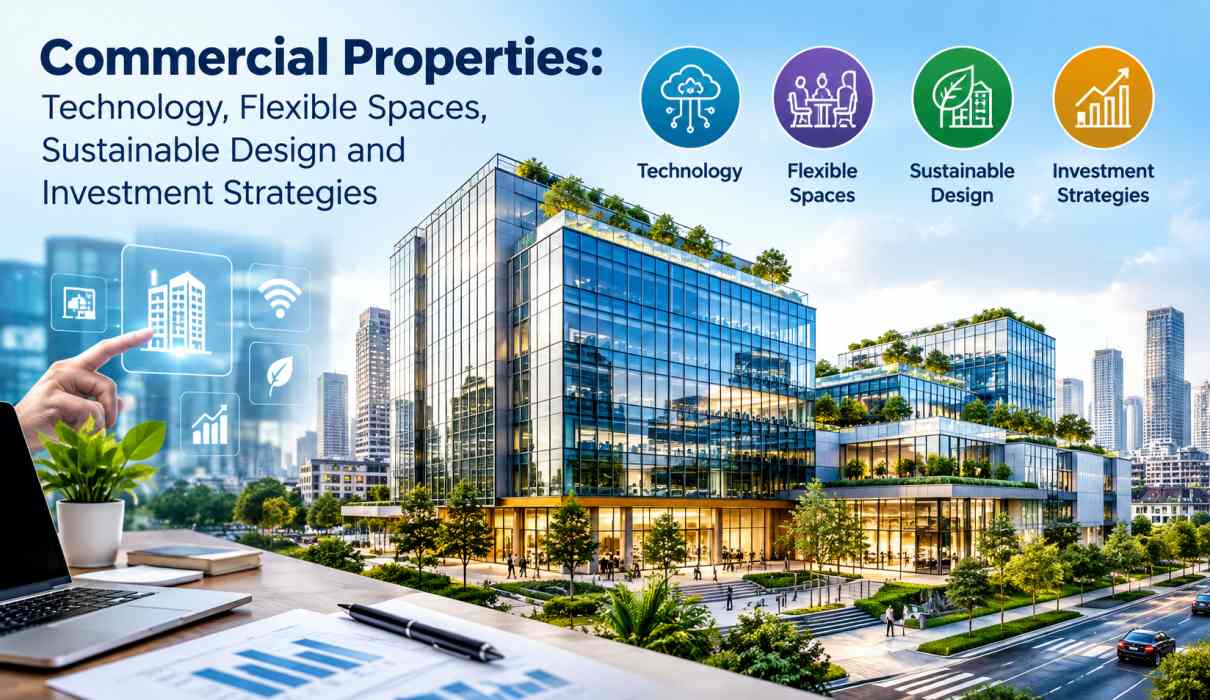
By The Future of Commercial Properties: Technology, Flexible Spaces, Sustainable Design and Investment Strategies
Commercial properties are changing rapidly as businesses, investors, employees, and consumers expect more from the spaces they use. Traditional offices, retail centres, warehouses, and mixed-use developments are increasingly being transformed by technology, flexible design, sustainability, and data-driven decision-making. As the commercial real estate industry moves forward, property owners and investors are looking for ways to create buildings that are efficient, adaptable, attractive, and prepared for changing market conditions.
The future of commercial properties is not simply about constructing larger buildings. It is about developing intelligent spaces that can respond to business requirements, reduce operating costs, support employee wellbeing, and deliver long-term value. Technologies such as artificial intelligence, Internet of Things (IoT) devices, automation, cloud platforms, and advanced building-management systems are becoming important components of modern commercial real estate.
At the same time, flexible workspaces, sustainable construction, energy efficiency, and environmentally responsible development are influencing property decisions. Investors are also paying closer attention to location, tenant demand, technology infrastructure, operating costs, and the potential for long-term appreciation.
The Rise of Smart Commercial Properties
One of the most significant trends shaping the future of commercial properties is the growth of smart buildings. A smart commercial property uses connected technologies and digital systems to monitor and manage different aspects of a building.
Sensors can collect information about temperature, lighting, occupancy, energy consumption, air quality, equipment performance, and security. Building-management platforms can then use this information to improve operations.
For example, an office building can automatically adjust lighting and heating or cooling based on occupancy. Meeting rooms can be monitored to understand how frequently they are being used. Maintenance systems can identify unusual equipment behaviour and alert facility managers before a major failure occurs.
Artificial intelligence can make these systems even more useful by analysing large volumes of property data. AI-powered platforms can identify patterns, support predictive maintenance, improve energy management, and help property managers make more informed operational decisions.
Smart technology can therefore help commercial property owners create more efficient and responsive buildings while providing tenants with a modern experience.
Flexible Workspaces Are Reshaping Commercial Real Estate
The traditional office model is being replaced or supplemented by more flexible approaches to workplace design. Businesses increasingly want spaces that can adapt to different team sizes, working patterns, and operational requirements.
Flexible commercial properties may include private offices, shared workspaces, meeting rooms, collaboration areas, lounges, event spaces, and technology-enabled conference facilities. Instead of dedicating every square metre to one fixed purpose, modern buildings can be designed to support multiple activities.
This flexibility is particularly relevant for businesses that experience changing workforce requirements. A company may need additional space during a period of expansion but less space during restructuring or remote-work periods.
Flexible leases and coworking arrangements can also allow businesses to access professional environments without committing to conventional long-term office structures.
For landlords, flexible commercial spaces can create opportunities to attract different categories of tenants. For tenants, they can provide greater adaptability and potentially help businesses manage occupancy requirements more efficiently.
Sustainable Design Is Becoming a Core Property Strategy
Sustainability is another major factor influencing the future of commercial properties. Buildings consume significant amounts of energy and resources, making efficient design increasingly important for owners, occupiers, and investors.
Modern sustainable commercial properties may incorporate energy-efficient lighting, high-performance insulation, smart HVAC systems, renewable energy, efficient water systems, recycled materials, and environmentally responsible construction methods.
Solar power is also becoming an attractive option for suitable commercial developments. Rooftop solar installations can help properties generate renewable electricity while reducing dependence on conventional energy sources.
Green roofs, natural landscaping, rainwater management, and water-efficient fixtures can further improve the environmental performance of commercial buildings.
Sustainable design is not only about environmental responsibility. Energy-efficient buildings may also reduce operating expenses over time. A property that uses less energy and water can potentially offer better cost management for owners and tenants.
Technology-Enabled Property Management
Property management is becoming increasingly digital. Traditional manual processes are being replaced by cloud-based platforms that allow owners and facility managers to manage buildings from centralized systems.
Digital property-management solutions can support lease administration, maintenance requests, tenant communication, energy monitoring, security management, and financial reporting.
Mobile applications can also improve communication between tenants and property managers. Tenants may be able to report maintenance issues, reserve meeting spaces, access building information, or receive important notifications through a single platform.
Artificial intelligence can further improve property management by analysing operational information and identifying areas where performance can be improved.
For example, predictive maintenance systems can monitor equipment and identify potential problems before they result in expensive breakdowns. This approach can reduce unexpected downtime and help property managers plan maintenance more efficiently.
Smart Security and Access Control
Security remains a fundamental requirement for commercial properties, but modern technology is changing how buildings are protected.
Smart access-control systems can use digital credentials, mobile devices, biometric technologies, or other authentication methods to manage entry. Property managers can create different access permissions for employees, visitors, contractors, and tenants.
Modern security systems can also integrate cameras, alarms, access controls, and monitoring platforms. Data from these systems can provide facility managers with a clearer understanding of activity throughout a property.
Visitor-management systems can make reception processes more efficient by allowing guests to register digitally and receive appropriate access permissions.
As commercial properties become more connected, cybersecurity will also become increasingly important. Building systems, tenant networks, access controls, and connected devices need appropriate security measures to reduce digital risks.
Mixed-Use Commercial Developments
The future of commercial real estate is also connected to the growth of mixed-use developments. Instead of separating offices, retail, entertainment, hospitality, and residential spaces completely, developers are increasingly exploring integrated environments.
A mixed-use commercial development might combine offices with restaurants, shops, hotels, entertainment facilities, public spaces, and residential buildings.
These environments can create more active destinations throughout the day. Workers may have access to restaurants and services close to their offices, while retailers and hospitality businesses can benefit from nearby customers.
Well-designed mixed-use properties can also support walkability and reduce the need for frequent travel between different destinations.
This approach is particularly relevant in growing urban areas where efficient land use and convenient access to services are important considerations.
The Importance of Location Is Evolving
Location continues to be one of the most important factors in commercial property. However, the definition of a desirable location is changing.
Businesses may increasingly evaluate properties based on connectivity, public transportation, digital infrastructure, nearby services, parking, environmental quality, and access to skilled workers.
A commercial building with excellent digital connectivity and flexible space may remain attractive even as workplace models change.
Similarly, properties located near major transport networks, business districts, educational institutions, residential communities, and consumer destinations may benefit from strong surrounding activity.
Investors should therefore look beyond the building itself and examine the wider economic and infrastructure environment.
Data-Driven Commercial Property Investment
Technology is also transforming commercial property investment strategies. Investors now have access to more data than ever before, including information about property performance, tenant demand, rental trends, operating expenses, local development, and market activity.
Data analytics can help investors compare properties and understand potential risks and opportunities.
AI-based analytical tools can process large datasets and identify patterns that may be difficult to detect through manual analysis. These technologies can support research, forecasting, portfolio monitoring, and scenario analysis.
However, technology should complement rather than replace professional due diligence. Investors still need to evaluate property condition, location, tenant quality, lease structures, financing costs, legal considerations, market conditions, and other relevant factors.
Emerging Investment Opportunities
Commercial property investment is becoming more diverse. Traditional office buildings remain an important category, but investors are also examining logistics facilities, data centres, healthcare properties, retail spaces, industrial buildings, flexible offices, and mixed-use developments.
The growth of e-commerce has increased interest in logistics and distribution infrastructure. Digital transformation has also increased demand for data infrastructure in many markets.
Meanwhile, healthcare, education, hospitality, and community-oriented commercial spaces can provide additional opportunities depending on local market conditions.
The key consideration is that different commercial property sectors have different demand drivers, operating requirements, risks, and investment characteristics. Investors should therefore conduct sector-specific research rather than treating commercial real estate as a single category.
Flexible Buildings Can Improve Long-Term Adaptability
One of the biggest challenges for commercial property owners is uncertainty. Business models, technologies, workplace practices, and consumer expectations can change quickly.
Buildings designed with adaptability in mind may be better positioned to respond to these changes.
Movable partitions, modular interiors, flexible floor plans, shared facilities, raised flooring, advanced connectivity, and adaptable mechanical systems can make it easier to modify a building without major reconstruction.
For example, an office floor could potentially be converted from traditional workstations into collaborative spaces, private offices, training rooms, or shared work areas as tenant requirements evolve.
Designing for adaptability can therefore become an important component of long-term property planning.
Employee Experience and Wellbeing
Commercial buildings are increasingly designed around the people who use them. Employee experience has become an important consideration for companies choosing office locations.
Modern workplaces may include natural lighting, comfortable furniture, improved ventilation, outdoor areas, wellness spaces, collaboration zones, and quiet working areas.
Biophilic design, which incorporates elements of nature into buildings, is another approach being explored in commercial environments. Plants, natural materials, daylight, and outdoor views can contribute to a more appealing workplace environment.
Technology can support this experience through smart lighting, temperature controls, room-booking systems, digital building services, and personalized workplace applications.
A commercial property that provides a comfortable and convenient environment can become an important part of a company’s workplace strategy.
The Future of Retail Properties
Retail commercial properties are also evolving as consumer behaviour changes. Physical stores are increasingly being integrated with digital commerce rather than operating separately.
Retail properties may include interactive displays, digital payment systems, click-and-collect facilities, experiential spaces, entertainment areas, restaurants, and flexible pop-up stores.
Shopping centres are becoming more focused on experiences rather than simply providing rows of traditional retail units. Entertainment, food, community events, wellness services, and lifestyle businesses can help create destinations that attract visitors.
Technology can support retailers through customer analytics, inventory systems, digital signage, and connected shopping experiences.
Challenges Facing Future Commercial Properties
Despite the opportunities, the transformation of commercial real estate also brings challenges.
The cost of upgrading older buildings can be significant. Installing smart systems, improving energy efficiency, modernizing infrastructure, and adapting interiors may require substantial investment.
Cybersecurity is another growing concern. Connected buildings create additional digital access points that must be protected.
Market uncertainty can also affect property values, rents, occupancy levels, and financing conditions. Investors therefore need to consider both technological opportunities and broader economic conditions.
Regulatory requirements are another factor. Building standards, energy policies, environmental regulations, accessibility requirements, and local planning rules can influence development and renovation projects.
Successful commercial property strategies will need to balance innovation with financial practicality and risk management.
Investment Strategies for the Future
Commercial property investors can consider several strategic approaches when evaluating future opportunities.
First, understanding local market fundamentals remains essential. Population growth, employment, infrastructure development, business activity, and tenant demand can influence long-term property performance.
Second, investors should examine the technological readiness of a property. Strong connectivity, smart-building infrastructure, efficient energy systems, and adaptable design may become increasingly valuable.
Third, sustainability should be considered as part of long-term property planning. Energy efficiency and responsible design can influence operating expenses, tenant preferences, and regulatory compliance.
Fourth, diversification can help investors manage exposure to a single property sector. Different commercial categories may respond differently to economic and technological changes.
Finally, investors should consider the property’s ability to adapt. A building that can accommodate changing tenant requirements may have greater long-term flexibility than a highly specialized property with limited alternative uses.
Conclusion
The future of commercial properties will be shaped by technology, flexibility, sustainability, and changing investment strategies. Smart building systems, artificial intelligence, IoT devices, digital property management, flexible workplaces, sustainable construction, and data-driven analysis are transforming how commercial real estate is designed, operated, and evaluated.
The most important shift is the move from static buildings toward adaptable property ecosystems. Modern commercial spaces are expected to support businesses, employees, customers, investors, and communities while responding to changing economic and technological conditions.
For property owners and developers, investing in efficient infrastructure, flexible design, sustainability, and digital capabilities can help create properties prepared for future requirements. For investors, careful research into location, tenant demand, property quality, operating costs, technology, and market conditions remains essential.
As commercial real estate continues to evolve, the properties that can adapt to new expectations will remain an important part of the modern business environment. Technology will continue to transform how buildings operate, while sustainable design and flexible spaces will influence how people experience them. Together, these trends are creating a new generation of commercial properties designed not only for today’s businesses but also for the changing needs of tomorrow.