 By
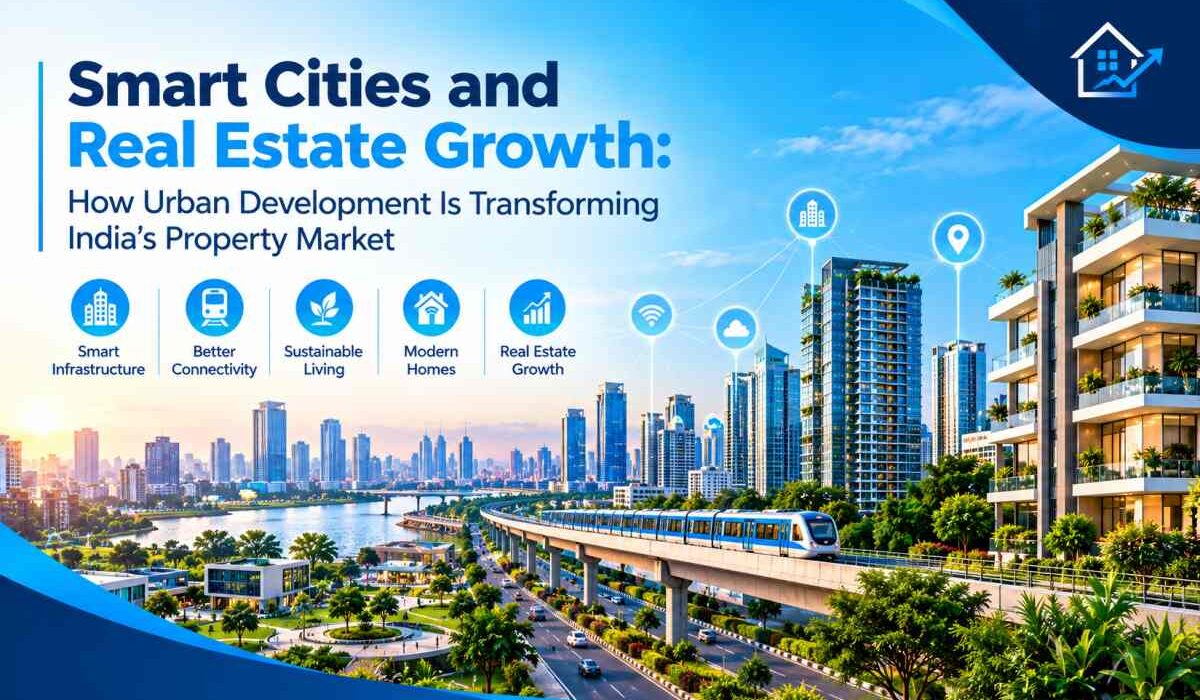
Smart Cities and Real Estate Growth: How Urban Development Is Transforming India’s Property Market
Introduction
India is undergoing a major urban transformation as cities adopt modern infrastructure, digital technologies, sustainable planning, and improved public services. Growing urban populations, expanding economic opportunities, and changing lifestyle expectations are influencing how residential and commercial properties are developed.
Smart cities and real estate growth are increasingly interconnected. Better transportation networks, intelligent infrastructure, reliable utilities, and technology-enabled urban services can make cities more attractive to residents, businesses, and property investors.
The Government of India’s Smart Cities Mission, launched in June 2015, selected 100 cities for targeted urban improvement. Its initiatives have included public infrastructure upgrades, integrated command and control centres, smart mobility systems, and improvements to essential urban services.
These developments demonstrate how planned urban investment can support economic activity and improve living conditions.
However, smart city designation alone does not guarantee higher property prices. Real estate performance depends on employment opportunities, affordability, infrastructure completion, housing supply, and local market demand.
This article explores how smart city development is transforming India’s property market, creating investment opportunities, and influencing the future of urban living.
1. What Are Smart Cities in India?
A smart city uses technology, efficient infrastructure, sustainable planning, and responsive governance to improve urban services and residents’ quality of life.
Smart cities are not simply locations filled with advanced buildings and digital devices. Their primary purpose is to make urban environments more accessible, efficient, inclusive, and environmentally responsible.
Important features include:
- Reliable electricity, water supply, and sanitation systems.
- Efficient public transportation and road connectivity.
- Digital governance and accessible public services.
- Intelligent traffic and parking management.
- Energy-efficient buildings and renewable energy.
- Public safety systems and emergency response facilities.
- Green spaces, waste management, and environmental monitoring.
In India, smart city projects vary according to local priorities.
Some cities focus on transport infrastructure, while others prioritise public spaces, digital governance, water management, or urban redevelopment.
These differences are important when evaluating their potential influence on property markets.
2. The Connection Between Smart Cities and Real Estate Growth
Urban infrastructure plays an important role in determining where people choose to live, work, and invest.
When cities improve transportation, utilities, public amenities, and economic infrastructure, certain neighbourhoods may become more desirable.
Improved Connectivity
Metro systems, upgraded roads, railway connections, and efficient public transportation can reduce commuting difficulties.
Residential properties near reliable transport networks may attract buyers seeking convenient access to employment centres.
Better Urban Infrastructure
Reliable water supply, drainage, electricity, and sanitation improve the practicality of residential and commercial developments.
These facilities can influence long-term property demand and neighbourhood attractiveness.
Business Development
Modern office districts, industrial parks, and commercial infrastructure can encourage business expansion.
Employment growth may subsequently increase demand for nearby housing, retail facilities, and rental accommodation.
Improved Living Standards
Parks, pedestrian-friendly streets, healthcare facilities, schools, and recreational spaces contribute to residential appeal.
Well-planned urban environments may attract families seeking better living conditions.
Together, these factors explain why infrastructure quality often influences property demand more directly than smart city branding.
3. How India’s Smart Cities Mission Supports Urban Development
India’s Smart Cities Mission represents an important effort to modernise selected urban areas.
The programme introduced approaches such as area-based development and pan-city solutions.
Area-Based Development
Area-based development concentrates investment within selected urban locations.
Projects may involve neighbourhood redevelopment, public infrastructure upgrades, improved streets, and more efficient land use.
Such improvements can enhance the functionality and attractiveness of surrounding properties.
Pan-City Technology Solutions
Pan-city initiatives apply technology across broader urban areas.
Examples include integrated traffic management, digital monitoring systems, and coordinated municipal services.
These solutions aim to improve city operations rather than directly increase real estate values.
Integrated Command and Control Centres
Many smart cities have developed integrated command and control centres to support municipal monitoring and coordination.
These systems can help manage traffic, public services, and emergency responses.
Their effectiveness depends on operational capacity, data quality, and continued maintenance.
Public Infrastructure Investment
Smart city projects also support improvements in roads, public spaces, water systems, and sanitation.
For real estate markets, completed and well-maintained infrastructure is generally more meaningful than announced development plans.
4. Major Indian Cities Experiencing Urban Transformation
Several Indian cities demonstrate how infrastructure development and economic activity can influence real estate markets.
Pune: Technology and Urban Mobility
Pune has experienced substantial growth in technology services, manufacturing, education, and residential development.
Urban transport improvements and expanding employment corridors influence housing demand across different neighbourhoods.
Pune’s Smart Cities Mission initiatives have also included public infrastructure and technology-enabled urban services.
Investors should distinguish established employment locations from emerging areas where infrastructure remains incomplete.
Surat: Industrial Growth and Urban Services
Surat is an important centre for textiles, diamonds, and commercial activity.
Its urban development initiatives have included improvements in public services, infrastructure management, and technology-based municipal systems.
Continued business activity can support residential and commercial property demand.
However, property performance varies by neighbourhood, land availability, and local economic conditions.
Ahmedabad: Infrastructure and Planned Development
Ahmedabad benefits from industrial activity, educational institutions, and expanding urban infrastructure.
Transport projects and planned commercial development influence residential demand in selected locations.
The wider Ahmedabad-Gandhinagar region also includes GIFT City, a separately planned financial and business district.
Investors should evaluate individual projects rather than treating the entire metropolitan region as one property market.
Bhubaneswar: Planned Urban Development
Bhubaneswar has attracted attention for its planned urban structure and Smart Cities Mission initiatives.
Improvements in public spaces, transport planning, and urban services contribute to its development.
Growing educational, administrative, and business activity also influences residential demand.
Nevertheless, investment outcomes depend on project location, pricing, and actual occupancy demand.
Indore: Urban Management and Infrastructure
Indore has received recognition for urban cleanliness and municipal service improvements.
Its development initiatives demonstrate how effective urban management can improve a city’s residential appeal.
Reliable public services and economic opportunities may support housing demand over time.
However, improvements in municipal performance do not automatically translate into property appreciation.
5. Impact of Smart Infrastructure on Residential Property Markets
Residential real estate is among the sectors influenced by improvements in urban infrastructure.
Demand for Connected Homes
Homebuyers increasingly consider commuting time, public transportation, digital connectivity, and access to essential services.
Residential projects with strong transport connections may appeal to working professionals and families.
Development of Integrated Townships
Integrated townships combine residential buildings with commercial spaces, schools, recreational facilities, and community amenities.
These developments aim to reduce dependence on distant urban services.
Their success depends on occupancy, maintenance quality, transport access, and the availability of promised facilities.
Growth of Smart Residential Buildings
Developers are introducing smart security systems, automated lighting, energy monitoring, and digital maintenance platforms.
Such technologies can improve convenience and building management.
However, buyers should consider installation costs, cybersecurity, repair expenses, and long-term technical support.
Affordable Housing Opportunities
Urban expansion can create opportunities for housing development beyond established city centres.
Yet affordability remains a major challenge.
Without suitable transport links and essential infrastructure, lower-priced housing may not meet residents’ practical needs.
6. Commercial Real Estate Opportunities in Smart Cities
Smart urban development can also influence demand for commercial property.
Modern Office Spaces
Technology companies, financial services businesses, and professional organisations require reliable connectivity and modern office infrastructure.
Well-connected business districts may attract employers seeking efficient workplaces.
Retail and Mixed-Use Developments
Growing residential populations can support neighbourhood retail, supermarkets, restaurants, and service businesses.
Mixed-use projects combine different property functions within a single development or district.
Their performance depends on population density, accessibility, consumer spending, and tenant demand.
Warehousing and Logistics
Improved highways, industrial corridors, and transport networks can support logistics infrastructure.
Warehousing demand is particularly influenced by manufacturing, distribution activity, and access to major consumption centres.
Flexible Workspaces
Coworking facilities and managed offices may benefit from businesses seeking flexible accommodation.
However, commercial investors must assess occupancy rates, lease conditions, operating expenses, and competing supply.
7. Technology Transforming India’s Real Estate Industry
Digital innovation is changing how real estate is researched, developed, purchased, and managed.
Artificial Intelligence
AI-powered tools can assist with property searches, customer enquiries, market comparisons, and building operations.
Advanced analytics may help identify patterns in housing demand and neighbourhood development.
However, automated property valuations should be verified against reliable transaction data.
Internet of Things
IoT devices connect building systems through digital networks.
Applications include smart electricity meters, water monitoring, security sensors, and automated climate control.
These technologies may improve operational efficiency when properly maintained.
Digital Property Platforms
Online listings, virtual tours, digital documentation, and remote consultations simplify property research.
Buyers can compare multiple developments before arranging physical inspections.
Geographic Information Systems
GIS technology supports urban planning through spatial analysis.
It can help identify transport routes, land-use patterns, environmental risks, and infrastructure requirements.
For investors, reliable geographic data can improve location assessment.
8. Sustainable Urban Development and Green Real Estate
Environmental sustainability is becoming increasingly important in India’s urban planning.
Rapid urbanisation creates challenges involving air pollution, water availability, energy consumption, and extreme weather.
Smart city development can help address these issues through better infrastructure and resource management.
Energy-Efficient Buildings
Green buildings may incorporate efficient cooling systems, natural ventilation, improved insulation, and renewable energy.
These features can reduce energy consumption and operating expenses.
Water Conservation
Rainwater harvesting, wastewater recycling, efficient plumbing, and water monitoring systems support responsible water management.
Such features are particularly valuable in cities experiencing water stress.
Sustainable Transportation
Public transit, cycling infrastructure, and pedestrian-friendly streets can reduce dependence on private vehicles.
Improved mobility may also make neighbourhoods more accessible.
Climate-Resilient Infrastructure
Urban planners increasingly need to consider flooding, heatwaves, drainage capacity, and other climate-related risks.
Climate resilience is important for protecting buildings, infrastructure, and long-term property value.
9. Real Estate Investment Opportunities in Developing Smart Cities
Urban transformation can create opportunities for investors who carefully evaluate local conditions.
Emerging Residential Corridors
Neighbourhoods near operational transport infrastructure and growing employment centres may attract housing demand.
Investors should assess current accessibility rather than relying exclusively on proposed projects.
Rental Housing
Cities with expanding employment and educational institutions may generate demand for rental accommodation.
Rental performance depends on tenant affordability, vacancy rates, property condition, and local competition.
Commercial Properties
Retail units, office spaces, and mixed-use developments may benefit from economic activity.
However, commercial property investment involves tenant concentration, lease, financing, and liquidity risks.
Long-Term Investment Potential
Urban infrastructure often develops over several years.
Investors should consider realistic holding periods and avoid assuming immediate capital appreciation.
Careful financial planning is essential because real estate investments involve substantial transaction costs.
10. Challenges Facing Smart City Real Estate Development
Despite significant opportunities, smart urban development faces several challenges.
Infrastructure Delays
Large urban projects can experience delays due to funding, land acquisition, approvals, and construction difficulties.
Such delays may affect property demand and investment timelines.
Rising Property Prices
Infrastructure announcements sometimes encourage speculative purchasing.
Rapid price increases can make housing less affordable and reduce potential investment returns.
Uneven Urban Development
Smart city investment may concentrate in selected neighbourhoods.
Other areas can continue experiencing inadequate infrastructure and public services.
Environmental Pressures
Urban expansion can increase pressure on water resources, green spaces, and drainage systems.
Poorly planned construction may create long-term environmental and financial risks.
Digital Infrastructure Risks
Technology-enabled cities require dependable systems, cybersecurity safeguards, and ongoing maintenance.
Digital solutions cannot replace effective governance and reliable basic infrastructure.
11. How to Evaluate Property Investment in Smart Cities
Before investing in an emerging urban location, buyers should follow a structured evaluation process.
Research infrastructure progress: Verify whether important roads, metro services, and utilities are operational, under construction, or merely proposed.
Examine employment opportunities: Locations with established businesses and employment centres may offer more dependable housing demand.
Compare property prices: Review comparable transactions, rental levels, and competing developments.
Check legal compliance: Verify ownership documents, development approvals, and applicable RERA registration.
Assess environmental risks: Consider flooding, drainage, water availability, and local climate conditions.
Calculate ownership costs: Include taxes, maintenance, financing expenses, registration charges, and potential vacancy periods.
Professional legal and financial advice can help investors identify risks before making substantial commitments.
12. Future of Smart Cities and Real Estate Growth in India
India’s future urban development will increasingly depend on coordinated infrastructure planning, economic growth, environmental sustainability, and effective municipal governance.
Digital services, intelligent mobility systems, efficient buildings, and improved public transportation may influence how cities expand.
Residential developers are also likely to respond to demand for connected communities, energy-efficient homes, and accessible neighbourhood amenities.
Commercial development may follow employment corridors, logistics networks, and established business districts.
However, the benefits of smart urbanisation will vary between cities.
Locations combining reliable infrastructure, employment opportunities, affordable housing, and responsible planning may be better positioned for sustainable long-term development.
The most important measure of success will not be the number of digital systems installed, but whether cities become more functional, inclusive, resilient, and liveable.
Conclusion
Smart cities and real estate growth are closely connected through infrastructure development, technology adoption, economic activity, and changing urban lifestyles.
India’s urban transformation is creating new possibilities for residential housing, commercial development, sustainable buildings, and property investment.
Improved connectivity, efficient public services, and modern urban planning can make selected neighbourhoods more attractive to residents and businesses.
Nevertheless, property appreciation is not guaranteed by smart city status or infrastructure announcements.
Investors and homebuyers should prioritise location fundamentals, completed infrastructure, legal compliance, affordability, and realistic financial expectations.
As India continues developing its cities, thoughtful urban planning and responsible real estate investment will play important roles in shaping a more connected and sustainable property market.