
 By
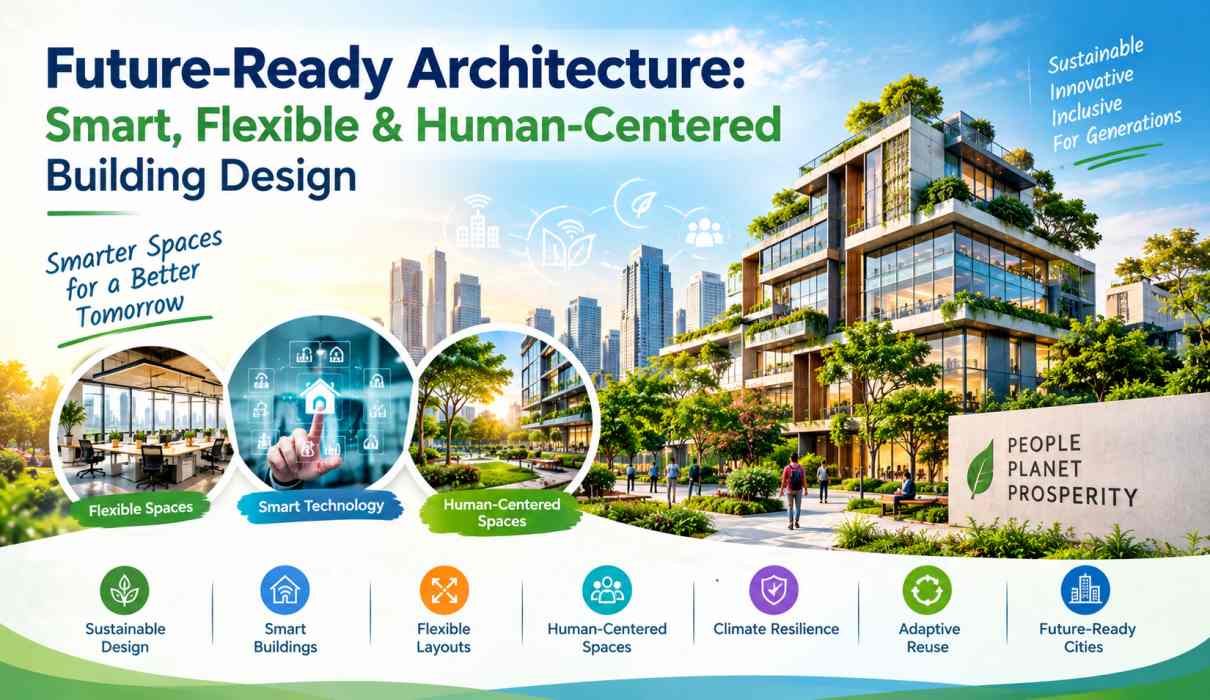
By Future-Ready Architecture: Smart, Flexible & Human-Centered Building Design
Architecture is changing rapidly as technology, climate concerns, urban growth, and evolving lifestyles influence how buildings are designed and used. Modern buildings are no longer expected to provide only shelter, workspace, or commercial space. They are increasingly expected to be smart, flexible, sustainable, comfortable, and responsive to human needs.
This shift has created growing interest in future-ready architecture—an approach to building design that prepares structures for changing technologies, environmental conditions, user expectations, and community requirements.
From smart building systems and energy-efficient materials to adaptable floor plans and biophilic design, future-ready architecture combines innovation with practical human-centered thinking. The goal is not simply to create futuristic-looking buildings but to design spaces that can remain useful, efficient, comfortable, and adaptable for many years.
What Is Future-Ready Architecture?
Future-ready architecture refers to the design and construction of buildings that can adapt to changing needs, technologies, environmental conditions, and patterns of use.
Traditional buildings are often designed around a specific purpose. A floor may be planned exclusively for offices, apartments, classrooms, or retail. Future-ready buildings take a more flexible approach by considering how the space might need to change over time.
For example, an office floor could be designed so that it can later accommodate collaborative workspaces, private offices, training rooms, or other functions. Similarly, a residential building can incorporate flexible rooms that can serve as bedrooms, home offices, study areas, or multipurpose spaces.
Future-ready architecture therefore focuses on long-term adaptability rather than short-term functionality.
Why Future-Ready Building Design Matters
Cities are growing, technology is evolving, and people’s expectations of buildings are changing. These factors are making adaptability increasingly important.
A building constructed today may remain in use for decades. During that time, technology, workplace patterns, environmental requirements, and user preferences can change significantly.
Future-ready design can help address these changes through:
- Flexible layouts
- Smart technology infrastructure
- Energy-efficient systems
- Sustainable materials
- Better indoor environments
- Accessible design
- Climate-responsive construction
- Adaptable building services
- Improved connectivity
Instead of replacing buildings whenever requirements change, adaptable architecture can allow structures to evolve with their users.
Smart Buildings and Connected Architecture
One of the most visible elements of future-ready architecture is smart building technology.
Smart buildings use sensors, connected devices, automation systems, and data to monitor and manage different building functions. These technologies can control or optimize lighting, heating, cooling, security, ventilation, energy consumption, and other services.
For example, occupancy sensors can help determine which areas of a building are being used. Lighting and air-conditioning systems can then respond according to occupancy patterns.
Smart building systems can also provide building managers with information about energy use, equipment performance, maintenance requirements, and indoor environmental conditions.
The result is a building that can respond more intelligently to its users instead of operating entirely through fixed settings.
Artificial Intelligence in Architecture
Artificial intelligence is becoming an increasingly important tool in architectural design and building management.
Architects can use AI-assisted tools to explore design alternatives, analyze building performance, create visualizations, and identify potential improvements during the planning process.
AI can also support operational functions after construction. Building management systems can analyze data and help identify unusual energy consumption, equipment problems, or changing occupancy patterns.
However, AI should be viewed as a tool that supports architectural decision-making rather than a replacement for human creativity and professional judgment.
The combination of architectural expertise and advanced technology can help designers create buildings that are more responsive and efficient.
Flexible Architecture for Changing Needs
Flexibility is one of the defining principles of future-ready architecture.
A flexible building is designed to accommodate different activities without requiring major structural changes.
In residential architecture, flexibility can include movable partitions, multipurpose rooms, adaptable furniture layouts, and spaces that can support changing family requirements.
In commercial buildings, flexibility can involve modular office layouts, shared work areas, meeting rooms, collaboration zones, and spaces that can be reconfigured as business requirements change.
Flexible design is especially valuable because buildings often outlive the purpose for which they were originally constructed.
Modular and Adaptable Building Systems
Modular construction can contribute to future-ready architecture by making buildings easier to assemble, modify, expand, or repurpose.
Prefabricated components can be manufactured in controlled environments and assembled at construction sites. Depending on the building system, modular components may also allow certain areas to be changed without rebuilding the entire structure.
Adaptability can extend the useful life of buildings and reduce waste associated with major renovations.
Modular design can also support faster construction and standardized quality control when appropriately planned.
Human-Centered Architecture
Technology is important, but future-ready architecture is not only about smart devices and automation.
A truly future-ready building must also consider the people who use it.
Human-centered architecture focuses on comfort, accessibility, wellbeing, safety, productivity, and emotional experience.
Important considerations can include:
- Natural daylight
- Fresh air and ventilation
- Acoustic comfort
- Thermal comfort
- Easy navigation
- Accessibility
- Privacy
- Views and connection to nature
- Comfortable communal areas
- Safe pedestrian movement
A technologically advanced building can still be unsuccessful if people find it uncomfortable or difficult to use.
Biophilic Design and Connection With Nature
Biophilic architecture is another important part of human-centered building design.
The concept focuses on creating stronger connections between people and nature through architectural elements such as plants, natural materials, daylight, water features, outdoor spaces, natural textures, and views of greenery.
In dense urban environments, these features can make buildings feel more connected to the natural environment.
Green courtyards, rooftop gardens, planted terraces, indoor greenery, and naturally lit common spaces can contribute to more pleasant environments.
Biophilic design can therefore complement smart technology by ensuring that future buildings remain human-focused.
Sustainable Architecture for the Future
Sustainability has become a central consideration in modern architecture.
Future-ready buildings need to address energy consumption, water use, material efficiency, waste reduction, and environmental impact throughout their lifecycle.
Architects can incorporate strategies such as:
- Passive solar design
- Natural ventilation
- Energy-efficient glazing
- Solar energy
- Rainwater harvesting
- Efficient lighting
- Low-impact materials
- Green roofs
- High-performance insulation
- Water-efficient fixtures
The objective is not simply to add green technology to a building but to integrate environmental performance into the fundamental design.
Climate-Responsive Architecture
Climate change is also influencing the way buildings are designed.
Climate-responsive architecture considers local weather conditions when determining building orientation, materials, shading, ventilation, landscaping, and energy strategies.
In hot climates, buildings may use shading devices, reflective surfaces, insulated envelopes, courtyards, and controlled ventilation to reduce heat gain.
In areas with heavy rainfall, building design may prioritize drainage, water management, elevated areas, and resilient materials.
The right approach depends on local climate conditions, geography, building type, and available technologies.
Smart Materials and Innovative Building Technologies
Materials are another area where architecture is evolving.
Modern buildings can incorporate high-performance glass, advanced insulation, recycled materials, engineered timber, low-carbon concrete alternatives, photovoltaic materials, and other innovative products.
Material selection increasingly considers more than appearance and structural performance. Architects may also evaluate durability, embodied carbon, recyclability, maintenance requirements, and lifecycle performance.
Future-ready architecture therefore involves selecting materials that support both design objectives and long-term environmental performance.
Resilient Architecture
Future-ready buildings also need to be resilient.
Resilience means designing structures that can continue to function or recover effectively during disruptions such as extreme weather, power interruptions, infrastructure failures, or other unexpected events.
Resilient architecture can involve:
- Strong structural systems
- Backup power
- Water storage
- Emergency access
- Passive cooling strategies
- Flood-resistant design
- Durable materials
- Redundant building systems
Resilience becomes particularly important as cities face increasingly complex environmental and infrastructure challenges.
Smart Homes and Residential Architecture
Future-ready principles are also transforming residential architecture.
Smart homes can integrate automated lighting, security systems, climate control, appliances, energy monitoring, and entertainment systems.
However, good smart-home design requires careful planning. Technology should be easy to use, secure, upgradeable, and integrated into the home’s overall design.
Residential architecture is also becoming more flexible. Homeowners increasingly value multipurpose rooms that can function as home offices, study areas, guest rooms, exercise spaces, or creative studios.
This flexibility allows homes to respond to changing lifestyles without requiring major renovations.
Future-Ready Commercial and Office Buildings
Workplaces are undergoing major changes, creating new requirements for commercial architecture.
Modern offices increasingly combine focused work areas with meeting rooms, collaborative spaces, informal lounges, technology-enabled conference rooms, wellness facilities, and flexible work zones.
Instead of designing offices around rows of fixed desks, architects can create environments that support different work styles.
Technology infrastructure is also becoming essential. Reliable connectivity, smart meeting systems, digital access control, and adaptable electrical and data infrastructure can help buildings remain useful as workplace technologies evolve.
Adaptive Reuse and Existing Buildings
Future-ready architecture does not always require new construction.
Adaptive reuse involves transforming existing buildings for new purposes. An old industrial structure might become a creative office, residential development, cultural facility, or mixed-use project.
Adaptive reuse can preserve architectural character while reducing the need for demolition and new construction.
It can also help cities make better use of existing infrastructure and underutilized properties.
As sustainability becomes increasingly important, adaptive reuse is likely to remain a valuable architectural strategy.
Accessibility and Inclusive Design
A future-ready building should be usable by as many people as possible.
Inclusive architecture considers the needs of people with different physical abilities, ages, mobility requirements, and sensory needs.
Features can include:
- Step-free entrances
- Accessible elevators
- Appropriate corridor widths
- Accessible restrooms
- Clear signage
- Tactile indicators
- Good lighting
- Easy-to-understand navigation
- Inclusive public spaces
Designing for accessibility from the beginning is generally more effective than attempting to make buildings accessible after construction.
Data-Driven Building Design
Data is becoming another important component of modern architecture.
Architects and building managers can use information about energy consumption, occupancy, temperature, air quality, maintenance, and user behavior to understand how buildings perform.
This information can support continuous improvement.
For example, if data shows that certain areas consistently consume more energy than expected, building managers can investigate the cause and adjust systems accordingly.
Data-driven architecture can therefore transform buildings from static structures into continuously optimized environments.
The Future of Architecture in India
India’s rapidly growing cities create significant opportunities for future-ready architecture.
Urbanization, rising technology adoption, climate challenges, changing lifestyles, and increasing demand for efficient infrastructure are influencing architectural practices across the country.
Indian architecture can combine advanced technology with local knowledge.
Traditional concepts such as courtyards, shaded verandas, natural ventilation, climate-sensitive orientation, and locally appropriate materials can complement modern technologies.
This combination can create buildings that are technologically advanced while remaining responsive to India’s diverse climates and cultural contexts.
Key Features of Future-Ready Architecture
The most important characteristics of future-ready building design include:
- Smart technology – Connected systems that monitor and manage building performance.
- Flexible spaces – Layouts that can adapt to changing requirements.
- Human-centered design – Buildings designed around comfort, wellbeing, safety, and accessibility.
- Sustainability – Efficient use of energy, water, and materials.
- Climate responsiveness – Design strategies suited to local environmental conditions.
- Resilience – Buildings capable of handling disruptions and changing conditions.
- Connectivity – Strong digital and communication infrastructure.
- Adaptability – Structures that can evolve rather than become obsolete.
- Biophilic design – Meaningful connections with nature.
- Lifecycle thinking – Considering performance, maintenance, reuse, and environmental impact over time.
Frequently Asked Questions
What is future-ready architecture?
Future-ready architecture is an approach to designing buildings that can adapt to changing technology, environmental conditions, user requirements, and social needs. It combines flexibility, sustainability, smart technology, resilience, and human-centered design.
Why is flexible design important in architecture?
Flexible design allows spaces to accommodate changing activities and users without requiring major structural modifications. This can extend the useful life of buildings and make them more adaptable.
How does AI affect architecture?
AI can assist architects with design exploration, visualization, analysis, building performance optimization, and workflow automation. It can support professional decision-making while leaving creative and contextual decisions to architects and project teams.
What makes a building human-centered?
A human-centered building prioritizes the comfort, safety, wellbeing, accessibility, and experience of its occupants. Natural light, ventilation, acoustics, accessibility, intuitive navigation, and connection to nature are common considerations.
Is sustainable architecture part of future-ready design?
Yes. Sustainability is an important component of future-ready architecture because buildings need to manage energy, water, materials, waste, and environmental impacts over their entire lifecycle.
Conclusion
Future-ready architecture represents a shift from designing buildings simply for today’s requirements toward creating spaces that can evolve with tomorrow’s needs.
Smart technologies, flexible layouts, sustainable materials, climate-responsive strategies, biophilic design, adaptive reuse, and human-centered planning are becoming increasingly important in modern building design.
The most successful future-ready buildings will not necessarily be the ones filled with the most technology. Instead, they will be buildings where technology, sustainability, flexibility, and human experience work together.
As cities continue to grow and technology changes how people live and work, architecture has an opportunity to create buildings that are not only efficient and innovative but also comfortable, inclusive, resilient, and adaptable.
Future-ready architecture is ultimately about designing buildings that can change with people, respond to their environment, and remain useful for generations to come.