
 By
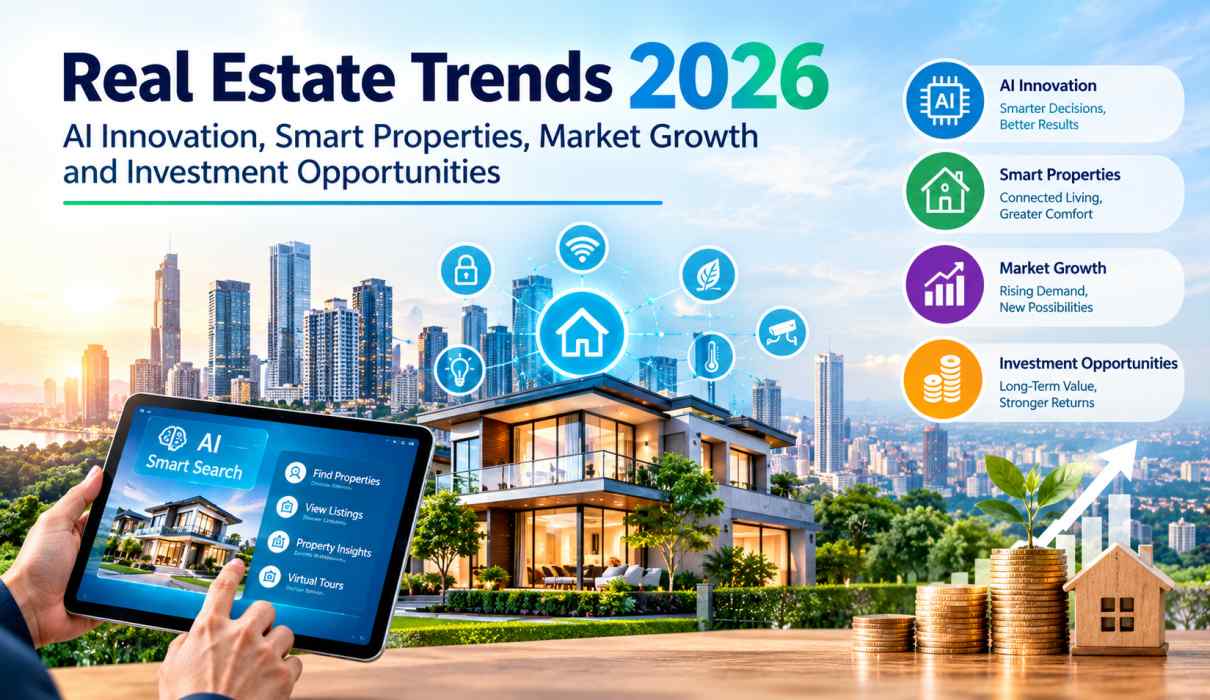
By Real Estate Trends 2026: AI Innovation, Smart Properties, Market Growth and Investment Opportunities
The real estate industry is entering a new phase in 2026, shaped by technology, changing consumer preferences, sustainability goals and evolving investment strategies. From artificial intelligence (AI) and smart buildings to digital property platforms and data-driven decision-making, the property market is becoming increasingly connected and technology-focused.
Real estate trends in 2026 are not limited to residential housing. Commercial properties, industrial spaces, data centres, logistics facilities, mixed-use developments and sustainable buildings are also influencing the direction of the industry. At the same time, buyers and investors are paying greater attention to location, quality, energy efficiency, connectivity, amenities and long-term value.
AI innovation is particularly important. Real estate companies can use AI to analyse property data, automate routine tasks, improve customer experiences and support more informed decisions. Smart property technology is also changing how buildings are designed, managed and used.
For investors, these developments are creating new opportunities while also introducing new considerations. Understanding the major real estate trends 2026 can help buyers, businesses and property professionals better understand where the industry is heading.
1. AI Is Transforming the Real Estate Industry
Artificial intelligence is becoming one of the most important technologies influencing real estate in 2026. Property businesses generate large amounts of information related to prices, locations, transactions, customer preferences, occupancy and market demand. AI can help process this information faster and identify useful patterns.
Real estate companies are increasingly exploring AI for:
- Property search and recommendations
- Market analysis
- Customer service and chatbots
- Property valuation support
- Lead generation
- Predictive maintenance
- Marketing automation
- Document processing
- Investment research
- Building management
AI-powered property platforms can potentially provide buyers with more personalised recommendations based on budget, location, property type and lifestyle preferences.
For developers and investors, AI can also support scenario analysis. Instead of relying entirely on historical information, businesses can analyse multiple factors and consider how changing market conditions could affect a property or development.
However, AI is a decision-support technology rather than a replacement for professional due diligence. Property transactions still require verification of ownership, legal documents, regulations, physical conditions, financing and other important factors.
2. Smart Properties Are Becoming Mainstream
Smart technology is another major real estate trend in 2026. Modern buyers increasingly expect properties to offer convenience, security, connectivity and energy efficiency.
Smart homes may include:
- Connected lighting
- Smart thermostats
- Video doorbells
- Digital locks
- Security cameras
- Automated curtains
- Smart appliances
- Energy monitoring systems
- Voice-controlled devices
In commercial buildings, smart technology can be even more extensive. Building management systems can monitor lighting, temperature, energy consumption, ventilation and occupancy.
Smart buildings can use sensors and connected devices to collect real-time information. Property managers can then use this data to improve building operations and identify potential maintenance requirements.
The result is a shift from traditional buildings toward more responsive and connected environments.
3. Sustainable Real Estate Continues to Grow
Sustainability is becoming increasingly important across the property sector. Developers, businesses, homeowners and investors are paying more attention to energy consumption, construction materials, water efficiency and environmental performance.
Green buildings may incorporate:
- Solar energy
- Energy-efficient lighting
- Efficient heating and cooling systems
- Water-saving technologies
- Natural ventilation
- Sustainable construction materials
- Green roofs and landscaping
- Waste-management systems
- Smart energy monitoring
Sustainable real estate can also become attractive to businesses looking to reduce operating costs and meet environmental goals.
In residential markets, energy-efficient homes can offer potential long-term benefits through lower utility consumption and improved comfort.
The concept of sustainability is also expanding beyond individual buildings. Developers are increasingly considering walkability, public transportation, green spaces, mixed-use planning and community infrastructure.
4. Data Centres and Digital Infrastructure Are Creating New Opportunities
The growth of cloud computing, artificial intelligence and digital services is increasing demand for digital infrastructure. Data centres are becoming an important part of the commercial real estate landscape.
Data centres require specialised facilities with reliable power, cooling systems, connectivity and security. Their development can create new opportunities for landowners, developers, infrastructure companies and investors.
The rapid expansion of AI is particularly relevant because advanced computing requires substantial infrastructure.
This means real estate is increasingly connected with the technology sector. Locations with suitable power availability, connectivity and infrastructure can become important for digital infrastructure development.
Data-centre real estate is therefore one of the emerging areas worth watching in 2026.
5. Residential Property Demand Is Becoming More Diverse
Residential real estate continues to evolve as household preferences change. Buyers are looking beyond basic floor space and increasingly considering lifestyle, connectivity, amenities and technology.
Modern residential developments may offer:
- Home automation
- Fitness centres
- Co-working areas
- Community spaces
- Security systems
- Landscaped areas
- EV charging facilities
- Recreation zones
- High-speed internet infrastructure
Larger and premium homes remain an important segment in many markets, while affordability continues to influence purchasing decisions.
At the same time, rental housing is becoming increasingly relevant for people who prioritise flexibility, employment mobility and access to urban locations.
Developers are therefore creating different residential formats for different demographic groups.
6. Commercial Real Estate Is Adapting to New Work Patterns
Commercial real estate is also undergoing significant changes in 2026. Office buildings are adapting to changing workplace models, including hybrid and flexible working arrangements.
Businesses may no longer require traditional office layouts with fixed desks for every employee. Instead, modern workplaces can include:
- Flexible workstations
- Collaboration areas
- Meeting rooms
- Technology-enabled conference spaces
- Wellness facilities
- Shared amenities
- Flexible leasing options
This is encouraging property owners to reconsider how office space is designed and managed.
High-quality buildings with strong connectivity, attractive amenities, convenient locations and efficient operations may appeal to businesses seeking workplaces that support collaboration and employee experience.
Commercial property is therefore becoming more focused on flexibility and usability rather than simply providing physical office space.
7. PropTech Is Changing Property Transactions
Property technology, commonly called PropTech, is transforming how people search for, buy, sell, rent and manage real estate.
Online property portals have already changed property discovery. In 2026, the next stage involves more advanced digital tools.
These can include:
- Virtual property tours
- AI-powered recommendations
- Digital documentation
- Online property management
- Automated customer communication
- Digital payment systems
- Data analytics
- Smart contract technologies
- Property management applications
Virtual tours can allow potential buyers or tenants to explore properties remotely. This is particularly useful for people moving between cities or countries.
Digital platforms can also reduce friction in the property search process by bringing listings, communication, documentation and other services together.
8. Real Estate Investment Is Becoming More Technology-Driven
Investment decisions are increasingly influenced by data. Investors can examine property prices, rental demand, vacancy rates, infrastructure development, population trends and economic indicators before making decisions.
Technology can help investors compare properties and monitor portfolios.
However, technology does not eliminate investment risk. Property investors still need to consider:
- Location
- Purchase price
- Rental demand
- Financing costs
- Taxes
- Maintenance expenses
- Vacancy risk
- Market cycles
- Regulatory requirements
- Exit opportunities
Diversification is also becoming important. Instead of focusing only on traditional residential properties, investors may explore commercial real estate, logistics, data centres, student accommodation, senior living and other specialised property segments.
9. Logistics and Industrial Real Estate Continue to Expand
E-commerce and modern supply chains are supporting demand for warehouses, distribution centres and logistics facilities.
Businesses increasingly need strategically located properties close to consumers, transportation networks and major markets.
Modern logistics properties may include:
- Automated storage systems
- Robotics
- Real-time inventory technology
- Smart security
- Energy-efficient infrastructure
- Advanced loading facilities
The rise of online shopping has made speed and efficiency critical in supply chains. As a result, industrial real estate is becoming an increasingly important part of the broader property market.
10. Mixed-Use Developments Are Gaining Attention
Mixed-use developments combine different functions within the same project. A development might include residential apartments, offices, retail stores, restaurants, entertainment spaces and community facilities.
These developments can provide convenience by bringing multiple services closer together.
For urban planners and developers, mixed-use projects can also support more integrated communities.
The idea of living, working, shopping and socialising within connected areas is becoming increasingly relevant as cities become more densely populated.
11. Smart Cities Will Influence Future Property Development
Real estate does not exist independently from its surrounding infrastructure. Roads, public transport, digital connectivity, utilities, healthcare, education and commercial activity all influence property demand.
Smart-city development is therefore closely connected with real estate.
Future-oriented urban areas may use technology for:
- Traffic management
- Energy distribution
- Public safety
- Waste management
- Public transportation
- Digital public services
- Environmental monitoring
Properties located within well-connected urban ecosystems may benefit from improved accessibility and infrastructure.
For property investors, infrastructure development can therefore be an important factor when evaluating emerging locations.
12. Property Management Is Becoming More Automated
Technology is changing property management as well. Landlords and facility managers can use digital platforms to manage maintenance requests, rent collection, tenant communication and building operations.
IoT sensors can monitor equipment and identify unusual activity. Predictive maintenance systems can potentially detect problems before they become expensive failures.
Automation can reduce administrative work and improve responsiveness.
For large property portfolios, these systems can also provide centralised information across multiple buildings.
13. Flexible Living and New Housing Models
Changing lifestyles are creating demand for alternative housing models.
Co-living, serviced apartments, build-to-rent developments and flexible rental arrangements are receiving greater attention in some markets.
These models can appeal to students, young professionals, relocating workers and people seeking convenient short- or medium-term accommodation.
Amenities such as shared kitchens, lounges, workspaces, fitness areas and community facilities can become important differentiators.
The housing market is therefore becoming more diverse, with traditional ownership existing alongside multiple rental and flexible-living models.
14. Real Estate Markets Are Becoming More Data Transparent
Access to information is becoming increasingly important for property buyers and investors.
Digital platforms can provide information about prices, neighbourhoods, amenities, transportation and market conditions. More accessible data can help consumers compare options before making decisions.
For real estate businesses, transparency can also improve trust.
At the same time, property data must be handled responsibly. Accurate information, privacy protection and cybersecurity are increasingly important as more real estate processes become digital.
15. What Real Estate Investors Should Watch in 2026
The real estate market will continue to vary significantly by country, city and property segment. There is no single trend that applies equally to every market.
Investors and property buyers may therefore pay attention to several indicators:
Market demand: Understanding whether demand is increasing, stable or declining can help evaluate potential opportunities.
Infrastructure: New transportation, business districts and digital infrastructure can influence future property activity.
Rental performance: For income-focused investors, rental demand and operating costs are important considerations.
Technology: Smart buildings and PropTech can affect the efficiency and attractiveness of properties.
Sustainability: Energy efficiency and environmental performance are becoming more relevant to both occupiers and investors.
Economic conditions: Interest rates, employment, inflation and consumer confidence can influence property markets.
Location: Accessibility, connectivity and neighbourhood development remain fundamental factors.
The Future of Real Estate in 2026 and Beyond
The future of real estate is likely to be increasingly digital, intelligent, sustainable and customer-focused. AI can support property analysis and operations, while smart-building technologies can make buildings more responsive.
At the same time, sustainability, urban development and changing lifestyles will continue influencing demand.
The most important transformation may be the convergence of several technologies and trends. AI, IoT, automation, digital platforms, renewable energy and data analytics are increasingly working together rather than developing independently.
For property businesses, this means adapting to changing expectations will be essential. Developers may need to think beyond construction and consider the complete digital and environmental experience of a property.
For buyers and investors, understanding the fundamentals remains important. Technology can provide better information, but factors such as location, affordability, property quality, legal due diligence and market conditions still matter.
Conclusion
Real Estate Trends 2026 demonstrate how quickly the property industry is changing. AI innovation, smart properties, sustainable buildings, PropTech, digital infrastructure and new housing models are reshaping the way real estate is developed, managed and experienced.
Residential and commercial properties are becoming more technology-enabled, while specialised sectors such as logistics, data centres and flexible living are creating additional areas of interest.
For investors, the changing real estate landscape offers a broad range of possibilities but also requires careful research. Understanding market fundamentals, technology adoption, sustainability, infrastructure and consumer demand can help stakeholders navigate an increasingly complex industry.
As 2026 progresses, the real estate sector is likely to remain closely connected with technology and wider economic and social changes. The properties of the future will not simply provide space—they will increasingly function as connected, efficient and adaptable environments designed around the needs of people, businesses and communities.