
 By
By Here is a comprehensive, SEO-friendly article built around the latest 2026 architecture themes, including AI, sustainability, adaptive reuse, smart buildings and climate resilience. Current professional sources show that AI adoption, regenerative design, adaptive reuse and resilience are major areas of focus for the architecture profession in 2026. (RIBA)
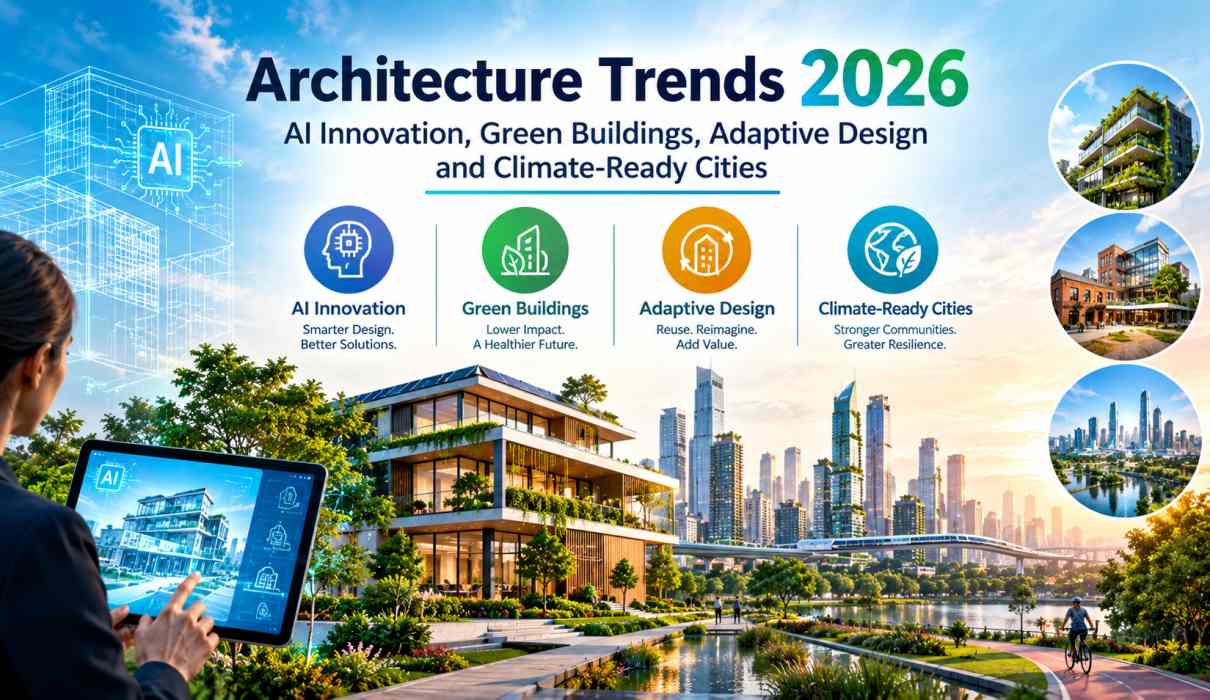
Architecture Trends 2026: AI Innovation, Green Buildings, Adaptive Design and Climate-Ready Cities
Architecture in 2026 is being shaped by rapid technological development, environmental challenges, changing lifestyles and the growing need for resilient communities. Buildings are no longer designed only around appearance and functionality. Modern architecture increasingly considers energy performance, climate risks, digital technology, resource efficiency, adaptability and the long-term experience of occupants.
Among the most significant architecture trends in 2026 are artificial intelligence, sustainable and regenerative design, adaptive reuse, smart buildings, climate-responsive architecture and innovative construction materials. These trends are influencing everything from individual homes and commercial buildings to public spaces and entire cities.
Artificial intelligence is becoming increasingly integrated into architectural workflows. The Royal Institute of British Architects (RIBA) reported in its 2026 AI research that 74% of surveyed practices were using AI on at least some projects. At the same time, professional organisations such as the American Institute of Architects (AIA) are developing guidance around responsible AI adoption and regenerative design.
The result is a profession that is becoming more technology-driven while maintaining a strong focus on human creativity, environmental responsibility and professional judgment.
1. AI Is Transforming Architectural Design
Artificial intelligence is one of the biggest forces influencing architecture trends 2026. Architects can use AI-assisted tools to explore design concepts, create visualisations, analyse information and automate repetitive tasks.
Instead of spending large amounts of time producing initial variations manually, architects can use generative design systems to explore multiple possibilities based on specific requirements.
AI can assist with:
- Concept generation
- Early-stage visualisation
- Site analysis
- Space planning
- Building performance analysis
- Regulatory and compliance checking
- Project management
- Documentation
- Design optimisation
- Client presentations
RIBA’s 2026 research indicates that AI is already being used across areas including early design visualisation, technical design, project management and regulatory compliance. The organisation also notes that architects continue to emphasise human judgment, ethics and responsible implementation.
AI is therefore not simply about producing attractive images. Its broader architectural role is developing around analysis, efficiency and decision support.
2. Sustainable Architecture Is Becoming More Performance-Focused
Sustainable architecture continues to be a central priority in 2026. The focus is increasingly moving beyond simply adding individual green features to creating buildings that perform efficiently throughout their entire life cycle.
Modern sustainable buildings may incorporate:
- Passive solar design
- Natural ventilation
- High-performance insulation
- Energy-efficient glazing
- Renewable energy
- Water-efficient systems
- Sustainable materials
- Smart energy management
- Green roofs
- Efficient heating and cooling
Designers are increasingly considering energy consumption and environmental performance from the earliest stages of a project.
This approach can help reduce operational energy requirements while improving indoor comfort.
The AIA’s sustainability framework emphasises resource efficiency, ecosystem protection, resilience, health and long-term environmental performance.
3. Green Buildings Are Moving Toward Regenerative Design
A major development beyond conventional sustainable architecture is the growing interest in regenerative design.
Sustainable design generally seeks to reduce environmental harm. Regenerative approaches aim to create buildings and places that can contribute positively to ecological and community systems.
Regenerative architecture may consider:
- Biodiversity
- Soil health
- Water systems
- Renewable energy
- Local materials
- Carbon reduction
- Community wellbeing
- Ecosystem restoration
In 2026, AIA has identified regenerative design as a major professional priority, connecting it with climate resilience, ecosystem restoration and community wellbeing.
This represents a broader change in architectural thinking: buildings are increasingly viewed as part of larger ecological and social systems rather than isolated structures.
4. Adaptive Reuse Is Redefining Existing Buildings
Adaptive reuse is another important architecture trend in 2026. Instead of demolishing an older structure and constructing an entirely new building, architects can transform an existing property for a new purpose.
Examples include converting:
- Warehouses into offices
- Factories into cultural centres
- Offices into housing
- Historic buildings into hotels
- Industrial properties into mixed-use developments
- Retail spaces into community facilities
Adaptive reuse can preserve existing materials and structures while extending the useful life of buildings.
The AIA highlights adaptive reuse as an important climate strategy because renovation can preserve material value and reduce demolition waste.
The approach can also preserve architectural character and cultural heritage while allowing buildings to serve contemporary needs.
5. Climate-Ready Architecture Is Becoming Essential
Climate resilience is becoming an increasingly important part of architectural planning. Buildings and communities in different regions may face risks including extreme heat, flooding, storms, wildfires, drought and other climate-related stresses.
Climate-ready architecture considers these risks during design rather than treating them as an afterthought.
Strategies may include:
- Flood-resistant planning
- Elevated structures
- Heat-resistant materials
- Shading systems
- Natural ventilation
- Water-management infrastructure
- Fire-resistant design
- Landscape-based cooling
- Emergency power systems
- Resilient building envelopes
In June 2026, AIA launched a Disaster Risk Reduction and Resilience Commitment designed to encourage architects to incorporate resilience and disaster-risk reduction into new construction and renovation projects.
This highlights the growing importance of designing buildings that can continue functioning under changing environmental conditions.
6. Smart Buildings Are Becoming More Connected
Smart-building technology is changing how modern properties operate. Sensors, connected systems and automation can monitor building performance and respond to changing conditions.
A smart building may automatically adjust:
- Lighting
- Temperature
- Ventilation
- Security
- Energy consumption
- Occupancy settings
- Equipment operation
Internet of Things (IoT) technology allows different building systems to communicate with one another.
For example, occupancy sensors can identify when a room is being used and help adjust lighting or climate controls. Building managers can use collected data to identify unusual energy consumption or maintenance requirements.
The future of smart architecture is therefore increasingly focused on buildings that respond dynamically to their occupants and surroundings.
7. Digital Twins and Building Data Are Changing Planning
Digital twins are becoming increasingly relevant to advanced architectural and construction workflows. A digital twin is a digital representation of a physical building or environment that can incorporate information about its design, systems and performance.
When combined with building information modelling (BIM), sensors and analytics, digital systems can support:
- Design coordination
- Construction planning
- Facility management
- Energy monitoring
- Maintenance
- Performance analysis
- Renovation planning
This creates a stronger connection between design, construction and long-term building operation.
Rather than treating architecture as complete when construction finishes, digital technologies encourage a more continuous approach to building performance.
8. Low-Carbon and Circular Materials Are Gaining Attention
Material selection is becoming increasingly important in sustainable architecture.
Architects are exploring materials and construction systems that can reduce environmental impacts while maintaining performance and durability.
These may include:
- Recycled materials
- Reclaimed timber
- Low-carbon concrete
- Recycled steel
- Bio-based materials
- Locally sourced materials
- Modular components
- Reusable building elements
Circular design also considers what happens to materials at the end of a building’s life.
Instead of designing structures that eventually become waste, architects can consider how components might be repaired, reused, recycled or disassembled.
Recent architecture discussions increasingly connect sustainability with circular economy principles and material reuse.
9. Human-Centred Architecture Remains Important
Technology may be transforming architecture, but human experience remains central to good design.
Modern buildings are increasingly being designed around wellbeing, accessibility, comfort and community interaction.
Human-centred architecture can incorporate:
- Natural daylight
- Access to outdoor areas
- Green spaces
- Comfortable acoustics
- Good air quality
- Flexible spaces
- Inclusive access
- Social gathering areas
The goal is to create environments that support the physical and psychological needs of occupants.
This is particularly important in workplaces, healthcare facilities, schools, residential developments and public buildings.
10. Flexible and Adaptable Spaces Are Growing
Buildings need to respond to changing requirements. A space designed for one specific purpose may become inefficient if user needs change.
Flexible architecture allows spaces to be modified over time.
For example, an office may be designed to support individual work, collaboration, meetings and events. Residential buildings can incorporate adaptable layouts that accommodate changing household needs.
Movable partitions, modular furniture and flexible infrastructure can make buildings easier to adapt.
This approach can also support longer building lifespans because structures can evolve rather than becoming obsolete.
11. Architecture and Urban Design Are Becoming More Integrated
The future of architecture is increasingly connected with urban planning.
Buildings influence transportation, energy use, public spaces, local economies and community life. As cities grow, architects and planners are exploring ways to create more connected and efficient urban environments.
Important approaches include:
- Mixed-use development
- Walkable neighbourhoods
- Public transportation integration
- Green corridors
- Community spaces
- Urban trees
- Compact development
- Cycling infrastructure
- Climate-responsive public areas
The goal is to create places where buildings work as part of a larger urban ecosystem.
12. Data Centres and Technology Infrastructure Are Influencing Architecture
The expansion of artificial intelligence, cloud computing and digital services is creating demand for specialised technology infrastructure.
Data centres are highly technical architectural projects requiring substantial attention to power, cooling, security and connectivity.
The 2026 AIA construction forecast identifies data centres as a particularly strong area within the nonresidential construction outlook, with continued growth projected for the sector.
This illustrates how developments in technology can directly influence architectural and construction demand.
Architecture is increasingly required to accommodate not only people but also the physical infrastructure supporting the digital economy.
13. Modular and Prefabricated Construction Is Advancing
Modular and prefabricated construction methods are gaining attention as the industry looks for ways to improve efficiency and reduce waste.
Components can be manufactured in controlled environments before being transported to a construction site.
Potential advantages include:
- Faster assembly
- Better manufacturing control
- Reduced material waste
- More predictable construction
- Repeatable components
- Improved site efficiency
Modular construction can be particularly useful for housing, healthcare, education and other building types where speed and consistency are important.
The combination of modular construction, digital design and automation could further change how buildings are produced.
14. Architecture Is Becoming More Adaptable to Future Technology
One of the most important architectural challenges of the future is uncertainty.
Technology, work patterns, transportation, energy systems and environmental conditions can change rapidly. Buildings therefore need to accommodate future requirements.
Architects are increasingly considering infrastructure that can be upgraded without major reconstruction.
Examples include:
- Flexible electrical systems
- Accessible service zones
- Modular interiors
- Upgradeable technology
- Adaptable floor plans
- Expandable infrastructure
Future-ready architecture is therefore less about predicting exactly what will happen and more about creating buildings capable of responding to change.
15. The Role of Architects Is Evolving
AI and digital technology are changing architectural workflows, but they are also changing the skills expected from professionals.
Architects increasingly need knowledge of:
- AI tools
- Digital modelling
- Sustainability
- Building performance
- Data
- Climate resilience
- Materials
- Collaboration
- Ethical technology use
At the same time, traditional architectural skills remain essential.
Design judgment, communication, creativity, understanding of context and responsibility toward clients and communities cannot simply be replaced by software.
RIBA’s 2026 AI research emphasises that professional judgment, ethical responsibility and human skills remain important as AI adoption expands.
The Future of Architecture in 2026 and Beyond
The architecture industry is moving toward a more integrated model in which technology, sustainability and human experience work together.
AI can help architects explore options and analyse complex information. Smart building systems can improve operational efficiency. Sustainable materials can reduce environmental impacts. Adaptive reuse can extend the life of existing structures. Climate-resilient design can help communities prepare for environmental risks.
These trends are not isolated. They increasingly overlap.
For example, an adaptive-reuse project can combine AI analysis, energy-efficient systems, reclaimed materials, smart sensors and climate-resilient landscaping. A new residential development can integrate renewable energy, digital building management, flexible spaces and water-efficient design.
This convergence is likely to define much of the future of architecture.
Conclusion
Architecture Trends 2026 demonstrate a major transformation in the way buildings and cities are conceived, designed and operated. AI innovation is accelerating digital workflows, while green buildings and regenerative design are placing greater emphasis on environmental performance.
Adaptive reuse is giving existing structures new purposes, while climate-ready architecture is addressing growing environmental risks. Smart buildings, digital twins, circular materials, modular construction and flexible spaces are also contributing to a more adaptable built environment.
The architecture of the future will not be defined by technology alone. Successful design will increasingly depend on combining innovation with human needs, environmental responsibility, cultural context and long-term adaptability.
As the industry moves forward, architects, developers and communities will have opportunities to create buildings that are not only visually compelling but also efficient, resilient, flexible and better connected to the people and environments they serve.