
 By
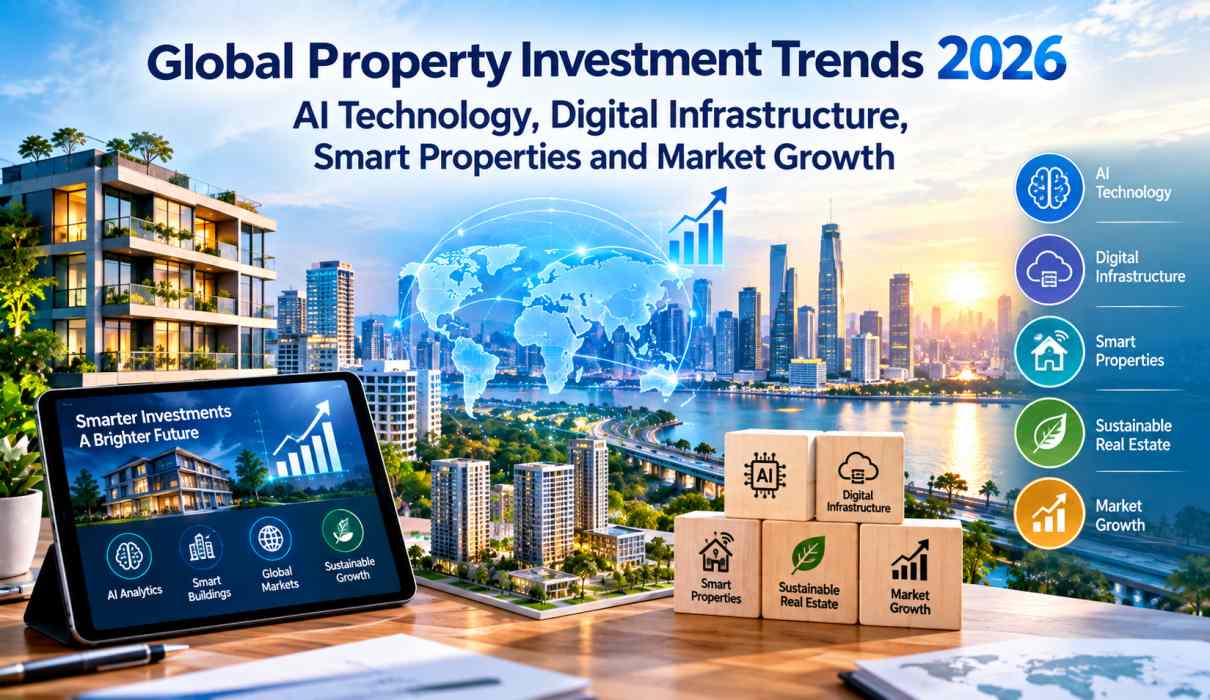
By Global Property Investment Trends 2026: AI Technology, Digital Infrastructure, Smart Properties and Market Growth
The global property investment market is entering a new phase in 2026. Technology, changing consumer needs, digital infrastructure, sustainability, and evolving capital flows are reshaping how investors evaluate real estate. Property is no longer viewed only as land, buildings, rental income, and capital appreciation. Increasingly, investors are considering technology infrastructure, energy availability, operating efficiency, data, connectivity, and long-term demographic trends.
Global real estate investment activity has strengthened during 2026. Colliers reported that rolling global real estate investment volumes were up 21.2% year over year in the second quarter of 2026, with Asia-Pacific leading regional growth at 28%. Data centres were one of the fastest-growing sectors, while multifamily remained a major sector in North America.
At the same time, artificial intelligence is creating an entirely new infrastructure investment cycle. PwC estimates that global investment in AI infrastructure could reach US$31.6 trillion through 2050, with annual data-centre capital expenditure projected to rise from approximately US$800 billion in 2026 to US$1.8 trillion by 2050.
These developments are creating new opportunities while also introducing new risks. From smart buildings and data centres to residential communities and sustainable properties, the future of property investment is increasingly connected to technology and infrastructure.
1. AI Is Transforming Property Investment
Artificial intelligence is becoming an important tool across the real estate investment lifecycle. Investors, developers, property managers, lenders, and asset managers can use AI and advanced analytics to process large amounts of information and identify patterns that may be difficult to detect manually.
AI can support property valuation, market research, tenant analysis, rent forecasting, investment screening, portfolio management, maintenance planning, and customer service. Real estate companies are also experimenting with AI-enabled workflows for deal sourcing, underwriting, leasing, pricing, and asset management.
PwC’s 2026 real estate outlook describes a shift toward AI-enabled operating models, with technology becoming increasingly important in determining how real estate platforms operate and scale.
For investors, this means technology capability can increasingly become part of the investment thesis. A building with modern data systems, automated operations, connected equipment, and strong digital infrastructure may offer different operational possibilities from an otherwise similar property without those capabilities.
However, AI does not eliminate investment risk. The quality of the underlying data, implementation costs, cybersecurity, regulatory requirements, and human oversight remain important considerations.
2. Digital Infrastructure Becomes a Major Property Investment Theme
One of the most significant property investment trends in 2026 is the growing connection between real estate and digital infrastructure.
Data centres, cloud infrastructure, fibre networks, telecommunications facilities, and technology-oriented buildings are becoming increasingly important to the digital economy. As AI applications, cloud computing, streaming, enterprise software, and digital services expand, demand for computing capacity and supporting infrastructure continues to increase.
PwC’s 2026 Global Data Centre Outlook projects a major long-term increase in data-centre capital expenditure and highlights electricity availability, digital sovereignty, and chip supply chains as factors that can influence where future investment is located.
Colliers reported that global data-centre investment activity nearly doubled in the second quarter of 2026, reaching 5.2% of overall activity. Data-centre investment in APAC rose to approximately US$20 billion, while EMEA reached about US$10 billion.
This trend demonstrates that property investors are increasingly evaluating buildings according to their role in wider digital ecosystems.
3. Power Availability Is Becoming a Property Investment Factor
The growth of AI and data centres is changing the importance of energy infrastructure in property investment.
A traditional property analysis may focus heavily on location, rental income, vacancy, construction quality, and transportation access. For technology-intensive assets, electricity availability and grid capacity can be equally important.
Data centres require substantial and reliable power. As AI computing becomes more intensive, locations with suitable energy infrastructure may attract additional development interest.
PwC identifies power availability as a decisive factor influencing where AI infrastructure investment flows.
This creates opportunities for investors who understand the relationship between real estate, utilities, renewable energy, transmission infrastructure, and digital infrastructure. It also means that development projects can face delays or additional costs when power connections are limited.
4. Smart Buildings Are Changing the Value of Properties
Smart buildings are another important trend shaping property investment in 2026.
Modern commercial and residential properties can integrate sensors, building-management systems, automated lighting, smart heating and cooling, access-control technology, security systems, energy monitoring, and predictive maintenance.
These technologies can help owners understand how buildings are being used and potentially improve operational efficiency.
For example, sensors can monitor equipment performance and identify maintenance requirements before a major failure occurs. Smart energy systems can track consumption patterns, while automated building controls can adjust systems according to occupancy and environmental conditions.
The investment case for smart buildings therefore goes beyond technology itself. Investors may evaluate whether digital systems can improve operating efficiency, tenant experience, maintenance planning, and long-term asset competitiveness.
5. Residential Property Remains an Important Investment Segment
Despite the growth of technology-focused assets, residential property continues to play a major role in global real estate investment.
Multifamily housing, rental communities, student accommodation, senior living, and other residential-oriented assets are receiving attention because they are connected to long-term demographic and housing requirements.
PwC and the Urban Land Institute’s global 2026 outlook identifies residential and living-related property as an important part of the changing real estate landscape. The report also highlights senior housing as a sector benefiting from demographic changes.
Investors are increasingly looking beyond traditional homeownership models and considering professionally managed rental communities and specialized living formats.
Factors such as population growth, urbanisation, household formation, affordability, employment centres, and migration patterns can influence residential investment opportunities.
However, residential investment remains highly market-specific. Local regulations, housing supply, interest rates, construction costs, rental demand, and affordability can produce very different outcomes from one city or country to another.
6. Logistics and Industrial Properties Continue to Evolve
The expansion of e-commerce, manufacturing, supply-chain diversification, and regional distribution networks continues to support interest in logistics and industrial real estate.
Modern logistics properties are increasingly connected to technology. Automated warehouses, robotics, inventory systems, tracking technology, and data-driven logistics can influence the design and value of industrial properties.
Investors are therefore evaluating not only warehouse size and location but also access to highways, ports, airports, labour markets, power infrastructure, and digital connectivity.
PwC’s 2026 real assets outlook identifies logistics among the infrastructure-adjacent sectors attracting capital as investors search for assets supported by structural economic and technological trends.
7. Sustainable Real Estate Is Becoming More Important
Environmental considerations are increasingly integrated into property investment decisions.
Energy-efficient buildings, renewable energy systems, efficient water management, lower-carbon construction, green building certifications, and climate-resilient design can influence both operating costs and long-term asset positioning.
Investors may increasingly examine questions such as:
- How energy efficient is the property?
- Can renewable energy be incorporated?
- Is the building vulnerable to extreme weather?
- What are its water requirements?
- Can operating emissions be reduced?
- How adaptable is the property to future environmental standards?
Sustainability is therefore becoming connected to financial and operational considerations rather than being treated solely as a branding exercise.
Properties that require significant future upgrades may face additional capital expenditure requirements, while efficient and adaptable buildings may be better positioned for changing tenant expectations and regulations.
8. Global Capital Is Becoming More Selective
The recovery in global property investment does not mean that every market or asset type is experiencing the same conditions.
Colliers reported that global investment momentum strengthened during Q2 2026, with APAC recording particularly strong growth. At the same time, fundraising remained below the previous year’s level, showing that investors continue to be selective about where and how capital is deployed.
PwC also describes capital rotation toward infrastructure-adjacent and operationally intensive real estate, including digital infrastructure, logistics, residential assets, senior housing, and renewable platforms.
This suggests that investors are increasingly focusing on asset quality, operating performance, infrastructure access, and long-term demand rather than relying solely on broad market appreciation.
9. India Is Becoming an Important Investment Market
India is also participating in the broader transformation of global property investment.
CBRE’s 2026 India Real Estate Investment Market Outlook identifies continued investment momentum, institutional interest in office and retail, industrial and logistics consolidation, and expanding capital allocation toward data centres, flexible workspaces, healthcare, hospitality, and living platforms.
CBRE also reported that Indian real estate equity inflows reached more than US$14 billion in 2025, with investment expected to maintain momentum into 2026. Residential, office, mixed-use, warehousing, and data-centre developments were among the areas identified for continued activity.
For the broader Asian property market, this development is significant because investors are increasingly examining cities and regions based on economic growth, infrastructure, technology adoption, demographic trends, and connectivity.
10. Property Investors Need Stronger Due Diligence
Technology can create opportunities, but property investment still requires fundamental due diligence.
Investors should examine location, ownership documentation, zoning, construction quality, tenant demand, rental income, operating costs, financing conditions, taxation, insurance, environmental risks, and future development potential.
For technology-enabled assets, additional questions may be necessary. These can include cybersecurity, data infrastructure, power availability, technology maintenance, equipment replacement cycles, and dependence on specialised operators.
AI-generated forecasts should also be treated as analytical tools rather than guarantees. Investment decisions require human review, reliable data, professional advice, and an understanding of local market conditions.
11. Interest Rates and Financing Still Matter
Even with strong structural trends, property investment remains sensitive to financing costs.
Interest rates influence borrowing costs, valuations, development feasibility, refinancing, and investor returns. Properties with high debt levels may face different risks from assets financed conservatively.
PwC’s 2026 outlook notes that refinancing pressures, maturity schedules, and valuation gaps continue to influence transaction timing.
Investors therefore need to consider both the long-term growth story and the short-term financing environment.
A technologically advanced property is not automatically a successful investment if acquisition costs, debt servicing, operating expenses, or development risks are excessive.
12. The Future of Property Investment
The future of property investment is likely to become increasingly integrated with technology and infrastructure.
AI may improve investment research and portfolio management. Smart buildings may improve operational visibility. Data centres may become increasingly important infrastructure assets. Renewable energy may become more closely connected with real estate development. Residential and living assets may benefit from demographic trends, while logistics properties can support increasingly complex supply chains.
At the same time, the distinction between real estate and infrastructure is becoming less clear.
PwC describes this convergence as an important feature of the 2026 market, with investors increasingly considering operating capabilities, data, technology, infrastructure, and access to capital alongside the physical property itself.
This creates a more complex investment environment. Successful property analysis may increasingly require knowledge of technology, energy, demographics, finance, sustainability, and local regulation.
Conclusion
Global Property Investment Trends 2026 reflect a major transformation in how real estate is created, operated, valued, and financed. AI technology, digital infrastructure, smart buildings, sustainable development, residential demand, logistics, and changing global capital flows are influencing the direction of the industry.
Data centres and other digital infrastructure are emerging as major investment themes, while AI is becoming increasingly important in property analysis and operations. At the same time, traditional fundamentals such as location, demand, financing, asset quality, and cash flow remain essential.
The property market of 2026 is therefore not simply about buying buildings. It is increasingly about understanding the infrastructure, technology, people, energy, and economic activity that make those buildings valuable.
For investors, developers, and real estate professionals, staying informed about these trends can help create a clearer framework for evaluating opportunities in a rapidly changing global property market.
SEO Keywords: global property investment trends 2026, property investment 2026, real estate investment trends, AI in real estate, smart buildings, digital infrastructure investment, data centre investment, global real estate market, sustainable property investment, real estate technology, property market growth.