
 By
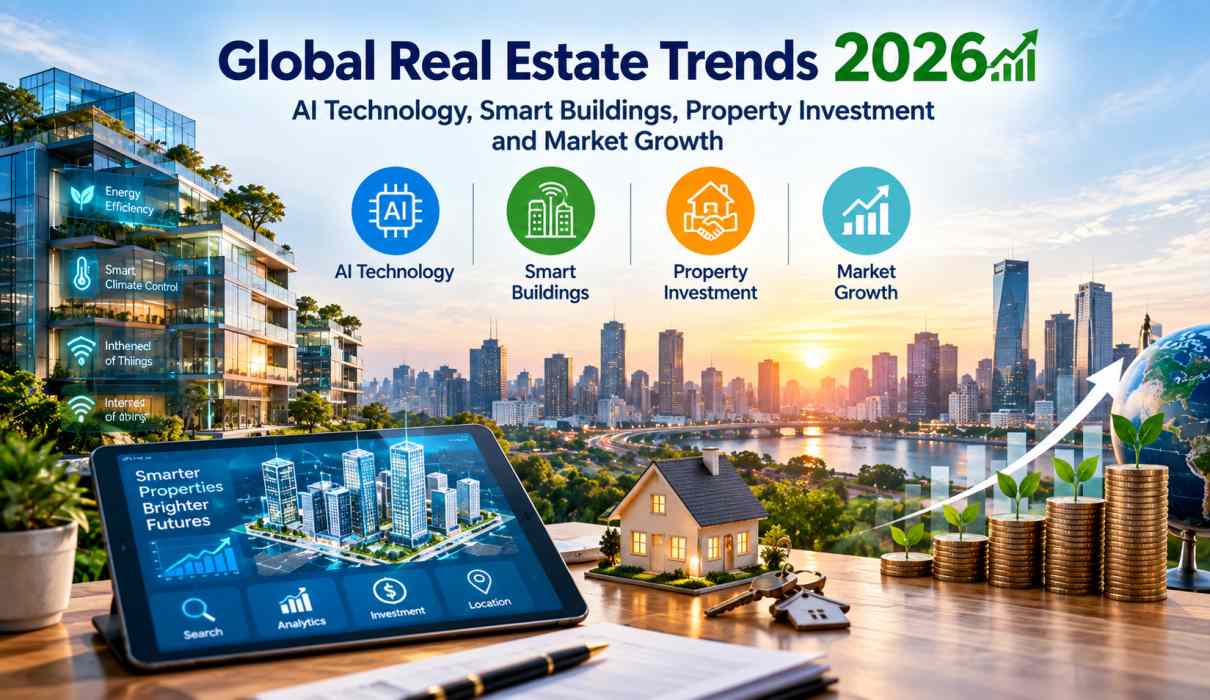
By Global Real Estate Trends 2026: AI Technology, Smart Buildings, Property Investment and Market Growth
The global real estate industry is entering a new phase in 2026, shaped by artificial intelligence, smart building technology, changing investment strategies, digital infrastructure and evolving expectations from buyers, tenants and businesses. After several years of economic uncertainty, higher financing costs and changing workplace patterns, property markets are increasingly becoming technology-driven and data-focused.
Real estate is no longer simply about land, buildings and location. Today, investors and developers are also considering energy efficiency, artificial intelligence, connectivity, automation, digital infrastructure, sustainability and long-term operating performance.
Global real estate investment activity has shown signs of renewed momentum. PwC and the Urban Land Institute reported that global real estate deal volumes reached approximately $888.6 billion in 2025, representing a 14% year-over-year increase. More recently, Reuters reported that cross-border commercial property investment increased 56% in the first half of 2026 to $71.8 billion, although higher borrowing costs remain an important consideration.
Against this background, several major trends are defining the global property market in 2026.
1. Artificial Intelligence Is Transforming Real Estate
Artificial intelligence is becoming one of the most important technologies in the real estate industry. Property companies are using AI for market analysis, property valuation, customer service, investment research, leasing, property management and operational decision-making.
AI can process large amounts of property data much faster than traditional methods. This can help businesses identify market patterns, compare properties, analyse rental information and understand changing customer demand.
AI is also becoming part of everyday real estate operations. Property managers can use intelligent systems to monitor maintenance requirements, identify unusual energy consumption and automate routine communications.
JLL’s 2026 research found that more than 90% of occupiers and investors are now using AI tools, while its Future of Work research shows that many real estate leaders expect AI to influence portfolio strategies over the next three to five years.
The next stage will be particularly important as companies move from experimenting with AI to integrating it into their operating models.
2. Smart Buildings Are Becoming a Major Property Trend
Smart buildings are another defining feature of real estate trends in 2026. Modern buildings increasingly combine sensors, connected devices, automation, artificial intelligence and advanced building management systems.
A smart building can monitor factors such as:
- Energy consumption
- Temperature and air quality
- Lighting
- Occupancy
- Security
- Equipment performance
- Water usage
- Maintenance requirements
Instead of operating buildings through fixed schedules, intelligent systems can respond to actual usage.
For example, lighting and cooling systems can automatically adjust according to occupancy. Maintenance systems can identify potential equipment problems before major failures occur.
This technology can improve operational efficiency while potentially reducing unnecessary energy consumption and maintenance costs.
JLL reports that 66% of surveyed organizations show a preference for AI-enabled buildings over basic building management systems, demonstrating the growing importance of technology-enabled property experiences.
3. Data Centers Are Becoming a Major Real Estate Sector
One of the biggest changes in the global property market is the growing importance of data centers.
The expansion of cloud computing, artificial intelligence, streaming, digital services and enterprise software is creating enormous demand for computing infrastructure. Data centers therefore increasingly sit at the intersection of real estate, technology and infrastructure.
JLL’s 2026 global data center outlook projects global data center capacity could reach around 200 gigawatts by 2030, with AI and cloud computing among the primary drivers. It also estimates that approximately $3 trillion of investment could be required to deliver 100 GW of new supply by 2030.
However, data center development has unique challenges. Electricity availability, grid connections, cooling requirements, land availability and construction costs are becoming important factors in site selection.
This means that future property investment decisions may increasingly depend not only on location but also on access to reliable power and digital infrastructure.
4. Power Availability Is Becoming a Real Estate Issue
Energy is becoming increasingly important in property development and investment.
Historically, investors often focused on location, transportation, tenant demand and construction costs. In 2026, reliable electricity supply is becoming an additional strategic consideration, particularly for data centers, advanced manufacturing facilities and technology-intensive properties.
The growth of AI and cloud computing is increasing electricity demand. At the same time, building owners are under pressure to control energy costs and improve efficiency.
As a result, properties with efficient energy systems, renewable generation, battery storage and strong grid connections may become increasingly attractive for certain types of development.
JLL identifies energy security and power availability as increasingly important factors affecting real estate site selection and development feasibility.
5. Global Property Investment Is Becoming More International
Cross-border investment is another important global real estate trend in 2026.
Investors are looking beyond their domestic markets for opportunities in commercial property, logistics, offices, residential assets and infrastructure-related real estate.
According to Reuters, global cross-border commercial property investment reached $71.8 billion in the first half of 2026, up 56% year over year. Asia recorded particularly strong growth, while European investment also increased.
However, international real estate investment involves more than identifying attractive property prices. Investors must consider currency movements, interest rates, taxation, regulations, geopolitical conditions, economic growth and local property-market fundamentals.
The result is a more diversified but also more complex global investment environment.
6. Real Estate Markets Are Becoming More Diverse
The idea of a single global property cycle is becoming less useful. Different cities, property types and economic sectors are experiencing different levels of demand.
For example, demand for premium office buildings may differ significantly from demand for older office properties. Residential property markets can also behave differently from logistics, retail or data center markets.
JLL’s 2026 outlook describes increasing divergence across markets, with asset quality, supply conditions, technology adoption and local economic conditions influencing performance.
This creates an environment where investors increasingly need to analyse individual markets and property sectors rather than relying only on broad global trends.
7. Office Real Estate Is Entering a New Phase
The office market continues to evolve following major changes in workplace practices.
Hybrid work has changed how businesses use office space. Many companies are reassessing the amount of space they need, while employees increasingly expect better workplace experiences.
Instead of focusing only on desk capacity, modern offices may include collaboration areas, technology-enabled meeting rooms, wellness facilities, hospitality-style services and flexible workspaces.
The market is also becoming increasingly divided between high-quality buildings and older properties that may require significant investment.
Technology can help offices become more flexible and efficient, but the role of the office will ultimately depend on individual industries, companies and employees.
8. Residential Real Estate Is Becoming More Technology-Driven
Technology is also changing residential properties.
Smart homes can integrate connected security systems, smart locks, lighting, heating and cooling controls, energy monitoring and home automation.
AI can also influence the home-buying process by helping consumers search for properties, compare features and understand neighbourhood information.
For property developers, smart technology can become a selling point, particularly among buyers who value convenience, security and energy efficiency.
At the same time, affordability remains a major consideration. Technology adds value only when it addresses genuine consumer needs without unnecessarily increasing property costs.
9. Sustainability Is Moving Into the Mainstream
Sustainable real estate is no longer limited to environmentally focused projects. Energy efficiency, building performance and climate resilience are becoming increasingly important to investors, tenants and regulators.
Modern sustainable buildings may incorporate:
- Solar power
- Energy-efficient lighting
- High-performance insulation
- Smart heating and cooling
- Water-saving systems
- Sustainable construction materials
- Green roofs
- Efficient waste management
- Electric vehicle charging
- Building energy monitoring
Sustainability can also influence operating costs. Energy-efficient properties may reduce long-term utility expenses while helping businesses meet environmental objectives.
JLL’s 2026 Global Real Estate Transparency Index highlights the growing importance of building-efficiency standards and in-use energy tracking across markets.
10. Logistics and Industrial Property Continue to Evolve
The growth of e-commerce, manufacturing, supply-chain restructuring and nearshoring continues to influence logistics real estate.
Warehouses are becoming more technologically advanced, with automated storage systems, robotics, inventory management platforms and connected equipment.
Location remains extremely important. Properties close to major highways, ports, airports, population centers and manufacturing hubs can offer logistical advantages.
The modern warehouse is therefore increasingly becoming a technology-enabled infrastructure asset rather than simply a large storage building.
11. Real Estate Investment Is Moving Toward Infrastructure-Linked Assets
Investors are increasingly considering real estate together with infrastructure and operating businesses.
Digital infrastructure, data centers, logistics facilities, renewable energy assets, senior housing and residential platforms are examples of sectors where property and operational infrastructure increasingly overlap.
PwC’s 2026 real estate deals research identifies digital infrastructure, logistics, senior housing, renewables and residential-oriented housing among areas attracting capital as investors focus on long-term demand drivers.
This shift could change how assets are valued. Investors may increasingly assess not just the physical building but also its technology, operating platform, infrastructure access and scalability.
12. Real Estate Technology Is Improving Transparency
Digital technology is also making property markets more transparent.
Online property databases, digital land registries, automated valuation systems, transaction platforms and AI-powered analytics can make property information easier to access and analyse.
JLL’s 2026 Global Real Estate Transparency Index found that two-thirds of tracked markets improved their transparency, with digitization and better property data contributing to progress. India was among the leading Asia-Pacific improvers identified in the report.
Better data can help investors make more informed decisions, although data quality and privacy remain important concerns.
13. The Future of Property Investment Will Be More Data-Driven
Traditional real estate investment has always depended on factors such as location, rental income, occupancy and capital appreciation. These fundamentals remain important, but investors now have access to far more data.
AI and advanced analytics can help analyse:
- Rental trends
- Demographic changes
- Occupancy patterns
- Construction activity
- Property transactions
- Local economic indicators
- Energy performance
- Tenant behaviour
- Infrastructure development
The challenge is knowing which data matters.
Technology should support investment analysis rather than replace fundamental due diligence. Investors still need to understand local markets, regulations, financing conditions and property-specific risks.
14. Affordability and Housing Supply Remain Important
Despite technological progress, one of the biggest real estate challenges remains housing affordability.
Many cities continue to face pressure from population growth, limited land availability, construction costs and housing shortages.
Technology can make construction and property management more efficient, but it cannot solve housing affordability by itself.
Developers and policymakers continue to face the challenge of increasing housing supply while balancing infrastructure, environmental requirements, construction costs and consumer affordability.
15. What Real Estate May Look Like Beyond 2026
The real estate industry is likely to become increasingly connected to technology, energy and infrastructure.
Future properties may operate as intelligent systems rather than static structures. Buildings could continuously collect data, adjust energy consumption, predict maintenance requirements and personalize experiences.
AI may also become deeply integrated into property investment, leasing, asset management and development.
At the same time, human expertise will remain important. Real estate decisions involve local relationships, regulations, negotiation, design, financing and community considerations that cannot always be reduced to algorithms.
The most significant transformation may therefore be the combination of technology with human decision-making.
Conclusion
Global real estate trends in 2026 demonstrate how quickly the property industry is changing. Artificial intelligence, smart buildings, data centers, sustainable construction, digital infrastructure and international investment are reshaping the way properties are developed, operated and valued.
Investment activity has also shown signs of recovery, although interest rates, financing costs, geopolitical uncertainty and economic conditions continue to influence markets. Cross-border investment has increased significantly, while investors are increasingly examining infrastructure-linked and technology-enabled sectors.
For property owners, developers and investors, understanding these trends is becoming increasingly important. The future of real estate will not be defined by technology alone. Successful properties are likely to combine strong locations, efficient operations, quality design, sustainable performance, reliable infrastructure and intelligent technology.
As the industry moves forward, real estate is becoming more connected, data-driven and adaptable. The combination of AI technology, smart buildings, global investment and changing consumer expectations is likely to remain one of the defining forces shaping the property market throughout 2026 and beyond.