
 By
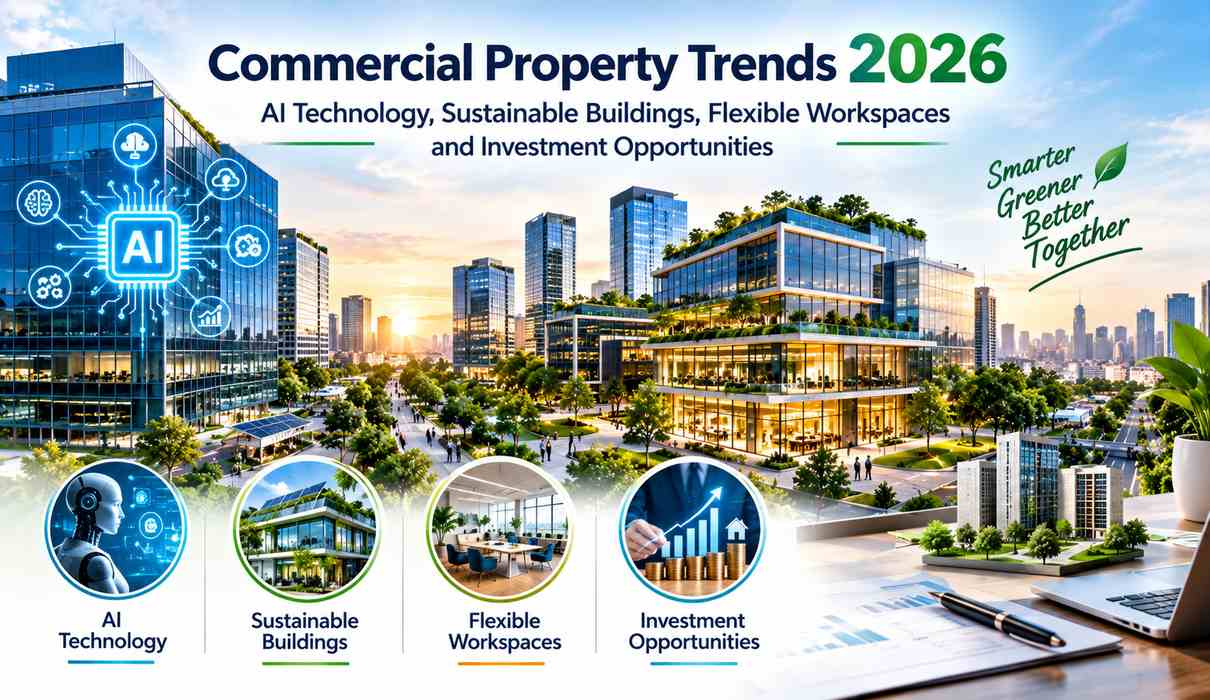
By Commercial Property Trends 2026: AI Technology, Sustainable Buildings, Flexible Workspaces and Investment Opportunities
The commercial property sector is entering an important period of transformation in 2026. Changing workplace expectations, artificial intelligence, sustainability requirements, digital infrastructure, and evolving business models are influencing how offices, retail spaces, warehouses, business parks, and mixed-use developments are designed and managed.
Businesses are no longer looking for commercial properties based only on location and floor space. Modern occupiers increasingly consider technology, energy efficiency, employee experience, flexibility, connectivity, security, and long-term operating costs when evaluating a property.
At the same time, commercial property investors are looking for assets that can remain competitive as technology and business requirements change. This has increased interest in smart buildings, sustainable construction, flexible office models, logistics facilities, data infrastructure, and strategically located mixed-use developments.
This article explores the major commercial property trends in 2026, including AI technology, sustainable buildings, flexible workspaces, smart infrastructure, changing investment opportunities, and the future direction of commercial real estate.
1. AI Technology Is Transforming Commercial Properties
Artificial intelligence is becoming an important part of modern commercial property management. Property owners and facility managers can use AI-powered systems to analyze building performance, understand occupancy patterns, improve maintenance, and automate routine operations.
AI can process information from sensors, building management systems, security equipment, energy meters, and other connected devices. This allows commercial buildings to respond more intelligently to changing conditions.
For example, an AI-enabled building may analyze occupancy levels and adjust lighting, heating, cooling, and ventilation according to actual usage. Predictive maintenance systems can also identify unusual equipment behavior before a major breakdown occurs.
AI is also influencing property investment and management decisions. Data analytics can help investors compare locations, evaluate operating costs, understand tenant requirements, and identify potential risks.
As these technologies become more accessible, AI-powered property management is likely to become an increasingly important feature of competitive commercial buildings.
2. Smart Buildings Are Becoming the New Standard
Smart buildings combine connected technology, sensors, automation, and centralized management systems to improve building performance.
In 2026, smart commercial properties may include:
- Automated lighting systems
- Intelligent heating and cooling
- Occupancy sensors
- Smart access control
- Digital visitor management
- Connected security systems
- Energy monitoring
- Predictive maintenance
- Mobile building applications
- Real-time facility management dashboards
The objective is not simply to add technology. Successful smart buildings use technology to create measurable improvements in efficiency, convenience, security, and occupant experience.
For businesses, smart infrastructure can make offices and commercial facilities easier to manage. For property owners, automation can potentially reduce unnecessary energy consumption and maintenance costs while making buildings more attractive to technology-focused tenants.
3. Sustainable Buildings Are Becoming a Major Priority
Sustainability is one of the most important commercial property trends 2026. Businesses, investors, employees, and communities are paying greater attention to environmental performance and resource efficiency.
Modern commercial buildings are increasingly incorporating sustainable features such as energy-efficient lighting, high-performance insulation, efficient HVAC systems, renewable energy, water-saving technologies, green roofs, and environmentally responsible materials.
Sustainable design can also improve the long-term operating performance of a property. Lower energy and water consumption may help reduce operating expenses, while efficient building systems can support better indoor comfort.
Green commercial properties may also benefit from stronger appeal among organizations with environmental objectives. Companies seeking to reduce their environmental impact may prefer workplaces and facilities that support their sustainability goals.
4. Renewable Energy and Energy Efficiency
Energy management is becoming increasingly important for commercial property owners.
Large offices, shopping centers, hotels, warehouses, and industrial buildings can consume substantial amounts of energy. As a result, improving efficiency can become an important part of both sustainability planning and cost management.
Solar power is one technology being incorporated into commercial developments. Rooftop solar panels, solar carports, and other renewable-energy solutions can help properties generate part of their electricity requirements.
Battery storage, smart energy management, efficient lighting, and automated HVAC controls can further improve energy performance.
The combination of renewable energy and intelligent energy management is likely to remain a major feature of future-ready commercial properties.
5. Flexible Workspaces Continue to Reshape Office Real Estate
The traditional office model is evolving. Many businesses now require workplaces that can adapt to changing workforce sizes, hybrid schedules, project teams, and different working styles.
This has increased demand for flexible workspaces, coworking facilities, serviced offices, shared meeting rooms, and adaptable commercial environments.
Flexible office properties can offer businesses several advantages. Companies may be able to expand or reduce their space requirements without committing to a completely traditional long-term arrangement.
Modern flexible workplaces can include:
- Private offices
- Shared workstations
- Collaboration areas
- Meeting rooms
- Conference facilities
- Quiet rooms
- Breakout zones
- Business lounges
- Event spaces
This trend is encouraging commercial developers to design buildings that can accommodate multiple types of tenants and changing space requirements.
6. Hybrid Work Is Influencing Office Design
Hybrid work has changed the purpose of the modern office. Rather than simply providing desks, offices increasingly need to support collaboration, communication, creativity, meetings, and company culture.
This is influencing commercial property design.
Instead of maximizing the number of individual workstations, businesses may prioritize high-quality meeting rooms, collaboration areas, technology-enabled conference spaces, employee amenities, and comfortable shared environments.
Office buildings that provide reliable connectivity and adaptable layouts can be better positioned to meet these changing requirements.
The result is a shift from the office as a fixed workplace toward the office as a flexible business environment.
7. Employee Experience Is Becoming a Property Feature
Commercial properties are increasingly being designed around the people who use them.
Employees may spend significant amounts of time inside offices, so factors such as natural light, air quality, temperature, acoustics, greenery, comfortable furniture, recreational facilities, and food services can influence the workplace experience.
Well-designed commercial properties may therefore incorporate wellness areas, outdoor spaces, fitness facilities, cafés, landscaped areas, bicycle facilities, and comfortable social zones.
This trend is particularly relevant for companies competing to attract and retain skilled employees. A high-quality physical workplace can become part of an organization’s broader employee experience strategy.
8. Digital Connectivity Is Critical Infrastructure
Fast and reliable digital connectivity is no longer an optional feature for many commercial properties.
Businesses depend on cloud computing, video conferencing, cybersecurity systems, digital collaboration tools, online transactions, artificial intelligence, and data-intensive applications.
Consequently, commercial buildings increasingly need strong telecommunications infrastructure, reliable internet connectivity, advanced networking systems, and technology-ready spaces.
For some businesses, the quality of digital infrastructure can be almost as important as traditional factors such as parking, accessibility, and physical layout.
Commercial developers are therefore paying greater attention to connectivity when planning future-ready buildings.
9. Logistics and Industrial Properties Remain Important
The growth of e-commerce, online retail, manufacturing technology, and modern supply chains continues to support demand for strategically located logistics and industrial facilities.
Modern warehouses are becoming more technologically advanced. Automated storage systems, robotics, warehouse management software, smart tracking systems, and energy-efficient infrastructure can improve operational performance.
Location is especially important in logistics real estate. Properties close to major roads, airports, ports, urban populations, and transportation networks can provide important advantages for businesses managing fast-moving supply chains.
This makes logistics and industrial real estate an important part of the broader commercial property landscape in 2026.
10. Mixed-Use Commercial Developments Are Growing
Mixed-use development combines different functions within a connected environment. A project may include offices, retail stores, restaurants, residential properties, entertainment facilities, hotels, and public spaces.
These developments can create more active environments throughout the day and reduce the need for users to travel between different destinations.
Modern mixed-use developments may also integrate smart transportation, green spaces, pedestrian-friendly design, electric vehicle charging, digital services, and community facilities.
For investors, diversified developments can provide exposure to multiple property uses, although performance depends on location, demand, development quality, financing, and broader market conditions.
11. Commercial Property Investment Is Becoming More Technology-Driven
Technology is changing not only the buildings themselves but also the way commercial properties are evaluated.
Investors can use data analytics to examine factors such as occupancy, rental performance, energy consumption, tenant activity, market demand, and operating costs.
Artificial intelligence may increasingly support property analysis by identifying patterns across large datasets.
However, technology should complement rather than replace traditional investment analysis. Location, tenant quality, lease structures, infrastructure, financing, local regulations, supply and demand, and economic conditions remain important considerations.
Investors should evaluate whether technology investments actually improve a property’s long-term performance rather than simply adding features without a clear business purpose.
12. Emerging Commercial Property Investment Opportunities
Several areas are attracting attention within the commercial real estate market in 2026.
Smart office buildings
Technology-enabled offices with flexible layouts, strong connectivity, advanced security, and energy-efficient systems can appeal to businesses seeking modern workplaces.
Logistics and warehousing
Strategically located logistics properties can benefit from changing supply-chain requirements and continued growth in digital commerce.
Data and digital infrastructure
The expansion of cloud computing, AI applications, and digital services is increasing the importance of specialized infrastructure that supports data-intensive activities.
Sustainable commercial buildings
Energy-efficient properties with strong environmental performance may become increasingly attractive to occupiers and investors focused on long-term operating efficiency.
Flexible workspaces
Coworking and serviced-office models continue to provide alternatives to traditional office leasing and can create opportunities in markets with changing business requirements.
Mixed-use developments
Projects combining offices, retail, hospitality, residential uses, and entertainment can create diversified commercial environments in well-connected locations.
13. Location Still Matters in Commercial Real Estate
Despite technological change, location remains one of the fundamental factors in commercial property.
Accessibility to transportation, customers, employees, suppliers, business districts, airports, highways, and public infrastructure can strongly influence a property’s attractiveness.
However, the definition of a good location is evolving. Businesses may increasingly evaluate digital connectivity, sustainability infrastructure, public transportation, environmental conditions, and access to amenities alongside traditional location factors.
The most successful commercial properties are likely to combine strong physical accessibility with modern digital and environmental infrastructure.
14. Challenges Facing Commercial Property in 2026
The transition toward smarter and more sustainable commercial properties also creates challenges.
Technology investments can require significant upfront capital. Building owners must determine which systems provide measurable value and which technologies may become outdated quickly.
Sustainable upgrades can also require substantial investment, particularly when older buildings need major renovations.
Another challenge is cybersecurity. As buildings become more connected, protecting building-management systems, tenant information, access systems, and connected devices becomes increasingly important.
Market uncertainty is another consideration. Interest rates, construction costs, economic growth, tenant demand, regulations, and local property supply can all influence commercial real estate performance.
Investors therefore need a balanced approach that considers both technological potential and fundamental property economics.
15. The Future of Commercial Properties
The commercial property sector is moving toward buildings that are smarter, more flexible, more sustainable, and more connected.
Future commercial buildings are likely to integrate artificial intelligence, automation, renewable energy, advanced security, digital connectivity, flexible layouts, and data-driven management.
The most important change may be that commercial properties are increasingly becoming technology platforms rather than simple physical spaces.
An office can function as a connected workplace. A warehouse can become an automated logistics center. A retail property can integrate digital customer experiences. A mixed-use development can combine work, shopping, entertainment, mobility, and community services.
This transformation creates opportunities for developers, investors, businesses, technology providers, and property managers.
Conclusion
Commercial Property Trends 2026 reflect a broader transformation in the way businesses use and evaluate physical space. AI technology, sustainable buildings, flexible workspaces, smart infrastructure, digital connectivity, and changing workplace expectations are reshaping commercial real estate.
For investors, the focus is increasingly moving toward properties that can remain useful and competitive over the long term. For businesses, flexible and technology-enabled spaces can provide the infrastructure needed for modern operations.
The future of commercial property will not be defined by one technology or one development model. Instead, successful properties are likely to combine smart technology, sustainability, flexibility, connectivity, accessibility, and strong user experiences.
As commercial real estate continues to evolve, understanding these trends can help property owners, businesses, developers, and investors make more informed decisions about the opportunities and challenges emerging in 2026 and beyond.