
 By
By The Rise of Remote Work and Urban Housing: How Flexible Employment Is Transforming Residential Demand
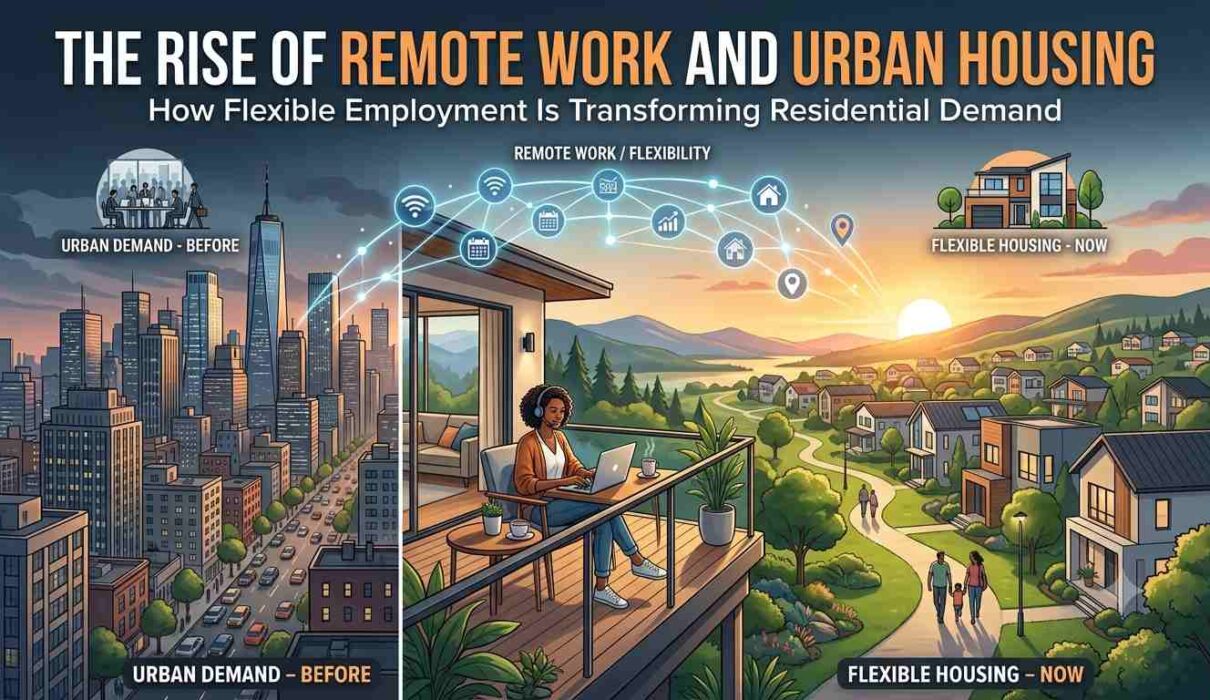
Remote work has moved from being a temporary workplace arrangement to a long-term feature of modern employment. As businesses increasingly adopt remote and hybrid work models, employees are gaining greater freedom to choose where they live and how they use their homes. This shift is having a significant impact on urban housing demand, residential preferences, property development, and the broader real estate market.
For decades, proximity to the workplace was one of the most important factors influencing where people chose to live. Employees often preferred homes close to offices, business districts, and public transportation because daily commuting was unavoidable. Today, flexible employment is changing that relationship. When working from home becomes possible, people can consider larger homes, quieter neighborhoods, better amenities, and even locations farther away from traditional employment centers.
This transformation creates both opportunities and challenges for homeowners, property developers, investors, landlords, and city planners. Understanding the relationship between remote work and real estate is therefore becoming increasingly important for anyone interested in the future of urban housing.
How Remote Work Is Changing Housing Demand
The most visible impact of remote work is the changing definition of an ideal home. A property is no longer viewed only as a place to relax after work. For many remote and hybrid employees, the home has also become an office, meeting space, study area, and productivity environment.
This has increased demand for homes that offer dedicated workspaces, better internet connectivity, natural light, comfortable layouts, and additional privacy. A small apartment that was suitable for a traditional office worker may feel less practical when two household members need to work from home simultaneously.
As a result, housing demand is increasingly influenced by functionality rather than location alone.
Buyers and renters may now prioritize:
- Dedicated home office spaces
- Additional bedrooms that can be converted into workspaces
- Larger living areas
- Reliable high-speed internet
- Quiet residential surroundings
- Access to parks and recreational areas
- Balconies, terraces, or outdoor spaces
- Community amenities
- Flexible and multi-purpose floor plans
This shift is encouraging developers to rethink residential design and create properties that support both professional and personal lifestyles.
The Declining Importance of Daily Commuting
Commuting has historically played a major role in urban housing decisions. People often accepted smaller homes or higher property prices in central locations because living near the workplace saved time and transportation costs.
Remote work changes this equation.
When employees only need to visit an office occasionally, living within a short distance of the workplace may no longer be essential. A person who previously needed to live 5 or 10 kilometers from an office may now be comfortable living considerably farther away if commuting is required only once or twice a week.
This can create new residential demand in suburban and peripheral areas.
Neighborhoods that were previously considered too far from major employment centers may become more attractive because they can offer larger homes, lower housing costs, greener surroundings, and a quieter lifestyle.
However, this does not necessarily mean that cities will lose their importance. Major urban centers continue to offer employment opportunities, education, healthcare, entertainment, cultural attractions, and social connections. Instead, remote work may create a more balanced relationship between central urban areas, suburbs, and emerging residential communities.
Growing Demand for Home Office Spaces
One of the biggest changes in residential preferences is the growing importance of the home office.
Before remote work became widespread, a spare bedroom or small corner of a living room might have been considered sufficient for occasional computer use. Today, many professionals want a dedicated and comfortable workspace.
This is influencing both new construction and existing property renovations.
Developers may incorporate flexible rooms into apartment layouts that can serve as offices, guest rooms, study areas, or creative spaces. Homeowners are also modifying existing rooms to create productive work environments.
For real estate professionals, highlighting the availability of a home office can therefore become an important part of property marketing.
A property listing that emphasizes “work-from-home space,” “dedicated study,” “high-speed internet connectivity,” or “flexible floor plan” may appeal strongly to modern buyers and renters.
Remote Work and the Rise of Suburban Housing
Another major effect of flexible employment is the increasing attractiveness of suburban housing.
Urban centers traditionally provide convenience, but central properties can also be expensive and limited in size. Suburban areas often provide more space at comparatively accessible prices.
For remote workers, the trade-off becomes more attractive because commuting is no longer required every day.
Families may prefer suburban locations where they can find larger homes, gardens, parking, schools, and recreational facilities. Young professionals may also consider smaller cities or outer urban neighborhoods if they can maintain employment with companies located elsewhere.
This creates opportunities for developers to invest in well-connected residential communities outside traditional business districts.
The key factor is connectivity. Remote workers may not need to live next to their offices, but they still value access to transportation, reliable internet, healthcare, education, shopping, and entertainment.
Urban Housing Is Becoming More Flexible
The concept of a traditional residential floor plan is also changing.
Modern households increasingly want spaces that can perform multiple functions. A room may serve as a home office during working hours and a study room or guest room at other times.
This is encouraging architects and developers to focus on flexible residential design.
Open-plan layouts, movable partitions, built-in storage, multipurpose rooms, acoustic improvements, and adaptable furniture can make homes more suitable for changing lifestyles.
For apartment developers, this creates an opportunity to differentiate properties in competitive markets. Instead of simply focusing on the number of bedrooms or square footage, developers can promote how effectively a property supports modern living and working.
Impact on Property Prices
Remote work can influence property prices in different ways depending on the location and type of housing.
Properties in highly desirable central business districts may experience changing demand if fewer employees need to commute every day. At the same time, homes in suburban and emerging neighborhoods may become more attractive if they provide additional space and better value.
However, property prices are influenced by many factors, including employment, infrastructure, interest rates, population growth, supply, local regulations, and economic conditions. Remote work is therefore one factor within a much larger real estate system.
The strongest demand is likely to develop in locations that combine affordability, quality housing, reliable connectivity, and convenient amenities.
This means that previously overlooked neighborhoods can potentially become more competitive when they offer the right combination of lifestyle and infrastructure.
The Role of Technology in Residential Real Estate
Technology is at the center of the remote work revolution. Reliable broadband, video conferencing, cloud-based applications, smart devices, and digital collaboration tools allow employees to work effectively from locations outside traditional offices.
As a result, internet connectivity has become an important residential amenity.
For remote workers, poor internet service can directly affect productivity and professional performance. Consequently, residential communities with strong digital infrastructure may have an advantage over locations where connectivity is unreliable.
Smart home technology can also enhance the remote working experience. Automated lighting, temperature controls, security systems, energy management, and connected appliances can make homes more comfortable and efficient.
The future of housing is therefore likely to combine physical space with digital infrastructure.
What Remote Work Means for Real Estate Developers
Real estate developers need to respond to changing consumer expectations. Traditional residential projects designed primarily around location and basic amenities may no longer be enough to attract every segment of the market.
Developers can consider incorporating:
- Dedicated coworking areas
- Private work pods
- High-speed internet infrastructure
- Flexible apartment layouts
- Quiet zones
- Outdoor workspaces
- Meeting rooms
- Community lounges
- Fitness and wellness facilities
- Smart home features
These amenities can help create residential communities designed specifically for flexible lifestyles.
Importantly, developers should avoid treating remote work as a temporary trend. The more significant opportunity lies in designing homes that can adapt to different lifestyles, whether residents work remotely, follow a hybrid schedule, study from home, or simply want additional personal space.
Changing Priorities for Homebuyers and Renters
The priorities of homebuyers and renters are also evolving.
Location remains important, but its meaning is changing. Instead of asking only, “How close is this home to my office?” people may ask, “How well does this neighborhood support my overall lifestyle?”
This can include questions such as:
- Is the home suitable for working remotely?
- Is the neighborhood peaceful?
- Is high-speed internet available?
- Are schools and healthcare facilities nearby?
- Are parks and recreational spaces accessible?
- Can the property accommodate future lifestyle changes?
- Is public transportation still convenient?
- Does the neighborhood provide social and community amenities?
These considerations demonstrate how remote work is contributing to a broader shift from commute-centered housing decisions to lifestyle-centered housing decisions.
The Impact on Rental Housing
The rental market is also being affected by flexible employment.
Remote workers may be more willing to rent outside expensive city centers if they can enjoy larger homes and lower living costs. At the same time, some renters may continue choosing centrally located apartments because they value restaurants, entertainment, networking opportunities, and urban convenience.
This creates a more diverse rental market.
Landlords can respond by offering practical features such as strong internet connectivity, flexible living spaces, desks, additional storage, and quiet environments. Rental properties that support both work and personal life may become more competitive.
For investors, understanding the specific needs of different tenant groups will be increasingly important.
Will Cities Become Less Important?
Despite predictions that remote work could eliminate the need for cities, urban areas remain highly valuable.
Cities provide dense networks of businesses, universities, hospitals, cultural institutions, transportation systems, and social opportunities. Human interaction also remains important for collaboration, creativity, networking, and community building.
Instead of eliminating cities, remote work may change how people use them.
Some employees may visit offices fewer days per week while spending more time in their neighborhoods. This could encourage the development of mixed-use communities where residents can work, shop, exercise, socialize, and access essential services closer to home.
The result could be a more decentralized model of urban living.
The Future of Remote Work and Urban Housing
The relationship between remote work and housing demand is likely to continue evolving as companies and employees settle into long-term working patterns.
Hybrid employment may become particularly influential because it combines the advantages of remote work with periodic in-person collaboration. Employees may not need to live directly beside their workplaces, but they may still want reasonable access to offices and transportation networks.
This could increase demand for strategically located suburban and peripheral communities that offer a balance between accessibility and quality of life.
For the real estate industry, flexibility will likely become one of the defining themes of future residential development.
Homes may increasingly be designed to accommodate changing professional and personal requirements. Instead of building spaces for one fixed purpose, architects may focus on adaptable environments that can evolve with residents.
Conclusion
The rise of remote work is transforming the relationship between employment and housing. As flexible employment reduces the need for daily commuting, residential decisions are becoming less focused on proximity to offices and more focused on space, comfort, connectivity, affordability, and lifestyle.
From growing demand for home offices to the increasing attractiveness of suburban communities, the effects of remote work can already be seen across the residential real estate market. Developers, investors, landlords, and homebuyers who understand these changing preferences can make better decisions in an increasingly flexible housing environment.
The future of urban housing and real estate will not simply be about where people work. It will be about how homes, neighborhoods, technology, and communities work together to support modern lifestyles.
Remote work has opened the door to a new way of thinking about residential demand. As flexible employment continues to evolve, the most successful housing markets are likely to be those that offer not only a place to live, but also the space, connectivity, flexibility, and quality of life that modern residents increasingly expect.