
 By
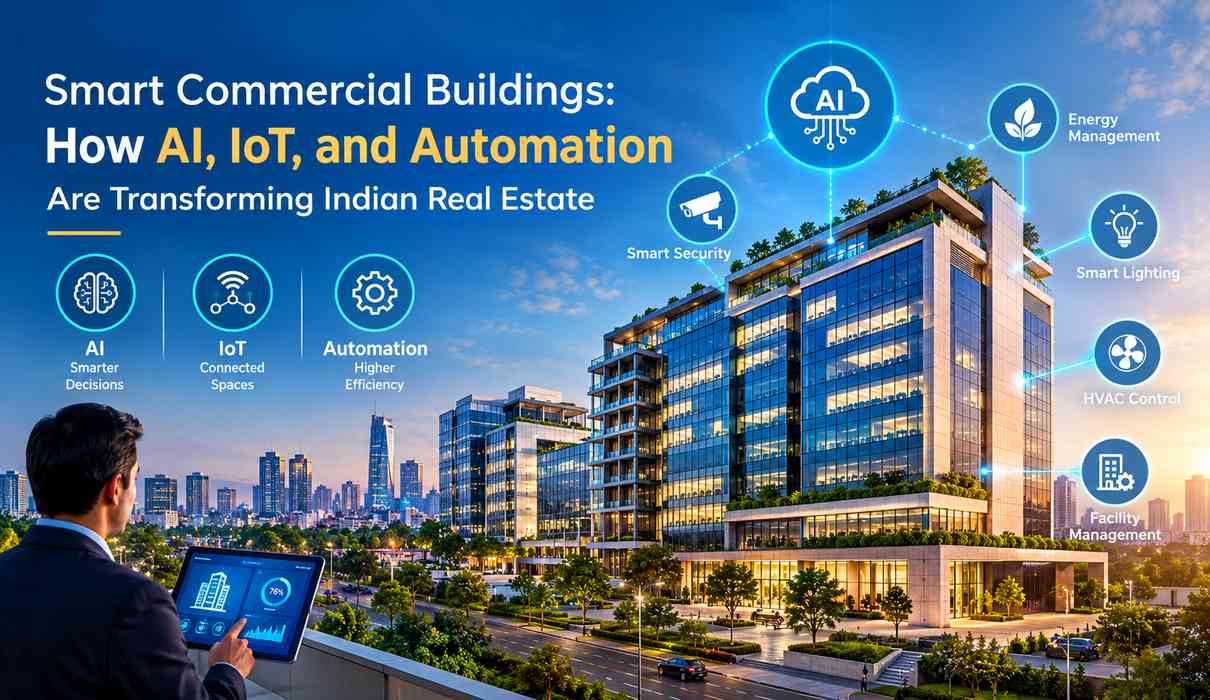
Smart Commercial Buildings: How AI, IoT, and Automation Are Transforming Indian Real Estate
India’s commercial real estate sector is entering a new era of technological innovation. Traditional office buildings, shopping complexes, business parks, and commercial properties are gradually evolving into intelligent spaces powered by artificial intelligence (AI), the Internet of Things (IoT), and advanced automation systems.
As businesses increasingly prioritize operational efficiency, sustainability, security, and employee comfort, smart commercial buildings are emerging as an important part of modern real estate development.
From automated lighting and intelligent climate control to predictive maintenance and AI-powered security systems, smart building technologies are changing how commercial properties operate.
Major Indian cities such as Bengaluru, Mumbai, Hyderabad, Pune, Chennai, and Delhi NCR are important markets for technology-enabled commercial developments.
For developers, investors, architects, and property managers, understanding these innovations is essential for planning future-ready commercial spaces.
This article explores how AI, IoT, and building automation are transforming Indian commercial real estate, their benefits, challenges, and future opportunities.
What Are Smart Commercial Buildings?
Smart commercial buildings are properties that use connected technologies, sensors, software, and automated systems to monitor and optimize building operations.
Unlike conventional buildings, which often rely on manual monitoring and isolated equipment, intelligent buildings integrate multiple systems through centralized digital platforms.
These systems can manage:
- Heating, ventilation, and air conditioning (HVAC).
- Lighting and electricity consumption.
- Security and access control.
- Fire detection and safety monitoring.
- Water consumption and leak detection.
- Equipment maintenance.
- Indoor environmental conditions.
- Occupancy and space utilization.
The primary objective of smart building technology is to improve operational efficiency while creating safer, more comfortable, and sustainable commercial environments.
The Growing Importance of Smart Buildings in India
India’s commercial real estate market is evolving as organizations seek modern workspaces with advanced infrastructure.
Businesses increasingly consider energy efficiency, digital connectivity, employee well-being, and operational flexibility when selecting commercial properties.
Smart buildings address many of these requirements through intelligent monitoring and automation.
Key Factors Driving Adoption
1. Rising operational costs: Automated energy management can help businesses identify unnecessary electricity consumption.
2. Sustainability requirements: Developers are increasingly exploring green building certifications and energy-efficient construction practices.
3. Digital transformation: Businesses require commercial spaces capable of supporting connected technologies and modern workplace systems.
4. Employee experience: Better lighting, ventilation, and temperature management can improve workplace comfort.
5. Property management efficiency: Centralized monitoring allows facility teams to manage complex building operations more effectively.
Together, these factors are encouraging developers to consider intelligent infrastructure during both new construction and property modernization.
1. Artificial Intelligence Is Revolutionizing Building Management
Artificial intelligence is becoming an important technology in modern commercial property management.
AI-powered platforms analyze information collected from building systems and identify patterns that may be difficult to detect through manual monitoring.
For example, an intelligent building management system can analyze electricity usage, occupancy levels, and outdoor weather conditions.
Based on these inputs, it can recommend adjustments to cooling and lighting systems.
Applications of AI in Commercial Buildings
- Predictive maintenance of mechanical equipment.
- Intelligent energy optimization.
- Automated temperature adjustments.
- Occupancy forecasting.
- Equipment performance analysis.
- Detection of unusual operating conditions.
AI can also help facility managers identify inefficient equipment before problems become expensive.
However, automated recommendations require accurate data, suitable controls, and human oversight.
When implemented properly, AI in commercial real estate can support more informed property management decisions.
2. IoT Technology Connects Building Infrastructure
The Internet of Things refers to physical devices equipped with sensors and communication capabilities that allow them to exchange information.
In smart commercial buildings, IoT sensors continuously monitor environmental and operational conditions.
For example, occupancy sensors can detect whether meeting rooms are being used.
Temperature sensors can provide information to HVAC systems, while smart meters track electricity consumption.
Common IoT Applications
Smart lighting: Sensors adjust lighting according to occupancy and available daylight.
Environmental monitoring: Connected devices measure temperature, humidity, and indoor air quality.
Water management: Smart meters and leak sensors help identify unusual water consumption.
Equipment monitoring: Sensors collect performance information from pumps, motors, and cooling systems.
Space utilization: Occupancy data helps property managers understand how different areas are used.
By connecting building infrastructure, IoT in smart buildings creates opportunities for better coordination and operational visibility.
3. Building Automation Systems Improve Operational Efficiency
Building automation systems, commonly known as BAS, provide centralized control over essential building services.
A building management system, or BMS, may integrate HVAC equipment, lighting, electrical infrastructure, and other compatible systems.
Automation reduces the need for repetitive manual adjustments.
For example, office lighting can automatically switch to an energy-saving mode after working hours.
Similarly, cooling systems can adjust their operation according to scheduled occupancy.
Benefits of Building Automation
- Centralized equipment monitoring.
- Reduced manual intervention.
- Improved energy management.
- Faster identification of operational problems.
- Consistent indoor environmental conditions.
- Better maintenance scheduling.
Automation does not eliminate the need for skilled facility managers.
Instead, it provides tools that help teams supervise complex commercial infrastructure more effectively.
4. Smart Energy Management Supports Sustainable Buildings
Energy consumption represents a major operating expense for many commercial properties.
Air conditioning, lighting, elevators, office equipment, and electrical infrastructure contribute to overall electricity demand.
Smart energy management systems help property owners monitor consumption and identify opportunities for improvement.
AI-enabled platforms can analyze historical energy data alongside weather forecasts and occupancy patterns.
This information can support better cooling schedules and equipment operation.
Energy-Saving Technologies
- Smart electricity meters.
- Occupancy-based lighting.
- Automated HVAC controls.
- Daylight-responsive lighting.
- Energy monitoring dashboards.
- Demand management systems.
Some buildings also integrate rooftop solar systems and battery storage where technically and financially suitable.
Actual energy savings depend on building design, equipment condition, operating schedules, and system configuration.
Smart technology is most effective when combined with efficient architecture and properly maintained equipment.
5. AI-Powered Security Enhances Commercial Property Protection
Security is an essential consideration for office towers, shopping malls, business parks, and other commercial properties.
Modern smart buildings use connected security systems to improve monitoring and access management.
These may include smart cameras, digital visitor registration, electronic access cards, and automated alerts.
AI-assisted video analytics can help security teams identify unusual activity or potential safety concerns.
Smart Security Features
- Digital visitor management.
- Electronic access control.
- Automated security notifications.
- Remote monitoring dashboards.
- Smart parking access.
- Integrated emergency communication.
Security systems should be designed with appropriate privacy protections.
Property managers must consider data retention, cybersecurity, access permissions, and applicable Indian privacy requirements.
AI-generated alerts should also be reviewed by trained personnel rather than treated as automatically conclusive.
6. Predictive Maintenance Reduces Unexpected Equipment Failures
Traditional maintenance often follows fixed schedules or begins after equipment develops problems.
Predictive maintenance uses sensor data and analytical software to identify potential equipment issues earlier.
For example, connected sensors can monitor vibration, temperature, and operating conditions in mechanical equipment.
When unusual patterns appear, maintenance teams can investigate before a serious breakdown occurs.
Equipment That Can Benefit
- Air-conditioning systems.
- Water pumps.
- Ventilation equipment.
- Electrical distribution systems.
- Elevators and escalators.
- Backup power infrastructure.
Predictive maintenance may reduce unexpected downtime and improve maintenance planning.
It can also help property owners understand equipment performance over time.
However, reliable results require suitable sensors, accurate information, and regular system calibration.
7. Smart Buildings Improve Workplace Comfort and Productivity
Modern commercial buildings are increasingly designed around the needs of occupants.
Comfortable indoor environments can support employee satisfaction and create more pleasant workplaces.
Smart building systems monitor temperature, ventilation, lighting, and occupancy conditions.
For example, automated blinds can help manage sunlight and glare.
Connected ventilation systems can respond to selected indoor air quality indicators.
Occupancy information can also help organizations understand meeting room demand.
Employee-Focused Smart Features
- Adjustable lighting systems.
- Intelligent temperature controls.
- Indoor air quality monitoring.
- Smart meeting room booking.
- Contactless access systems.
- Digital workplace applications.
These technologies can improve the experience of using commercial spaces.
Nevertheless, workplace comfort also depends on architectural design, acoustics, furniture, accessibility, and organizational practices.
8. Smart Parking Systems Improve Commercial Accessibility
Parking management is a significant challenge for commercial properties in busy Indian cities.
Large office complexes and shopping centers often experience congestion during peak hours.
Smart parking systems use sensors, cameras, and software to monitor available parking spaces.
Digital displays can guide drivers toward available areas.
Some systems also support electronic payments and authorized vehicle access.
Benefits of Smart Parking
- Improved parking space utilization.
- Reduced time spent searching for parking.
- Better vehicle movement.
- Simplified payment management.
- More organized visitor access.
Smart parking technology is particularly useful for large commercial campuses with substantial vehicle traffic.
Its effectiveness depends on accurate detection systems and appropriate traffic planning.
9. Digital Twins Are Changing Commercial Building Operations
Digital twin technology is an emerging innovation in intelligent building management.
A digital twin is a virtual representation of a physical building or selected building systems.
It can combine design information, equipment records, and operational data to support analysis.
Facility managers may use digital twins to understand equipment performance, evaluate operating scenarios, or plan maintenance activities.
For example, a digital model can help teams examine how changes to cooling schedules might affect energy consumption.
Potential Applications
- Building performance monitoring.
- Equipment maintenance planning.
- Energy optimization.
- Space management.
- Renovation planning.
- Operational scenario analysis.
Digital twins can be valuable for complex commercial developments.
However, implementation requires reliable data integration, specialized expertise, and ongoing maintenance of the digital model.
10. Smart Commercial Buildings Support Green Real Estate Development
Sustainability is becoming an increasingly important consideration in Indian commercial architecture.
Developers are exploring strategies to reduce energy consumption, conserve water, and improve building performance.
Smart technologies support these objectives by providing detailed operational information.
For example, connected water meters can help identify leaks.
Automated lighting controls can reduce unnecessary electricity usage.
Energy dashboards can support performance monitoring and sustainability reporting.
Smart building systems may also contribute to meeting selected requirements under recognized green building certification frameworks.
However, installing smart devices alone does not make a property environmentally sustainable.
Building orientation, insulation, materials, efficient equipment, and responsible operations remain essential.
11. Challenges of Smart Building Adoption in India
Despite their potential benefits, intelligent commercial buildings face several implementation challenges.
High Initial Investment
Sensors, automation controllers, software platforms, and network infrastructure can require substantial upfront expenditure.
Developers should evaluate long-term operating benefits against installation and maintenance costs.
Cybersecurity Risks
Connected systems can introduce vulnerabilities if networks and devices are not properly secured.
Regular updates, access controls, network segmentation, and security monitoring are important safeguards.
Integration With Existing Buildings
Older commercial properties may contain equipment that cannot easily communicate with modern automation platforms.
Retrofitting may require additional hardware and technical modifications.
Skilled Workforce Requirements
Smart buildings require professionals who understand automation, data analysis, cybersecurity, and mechanical systems.
Training facility management teams is therefore essential.
Data Privacy Concerns
Occupancy monitoring, visitor management, and connected security systems may collect personal information.
Organizations should establish appropriate data governance practices and comply with applicable legal requirements.
12. Future of Smart Commercial Buildings in India
The future of commercial real estate is likely to involve greater integration between intelligent software, connected infrastructure, and sustainable architecture.
Several developments could influence the next generation of Indian commercial properties.
AI-assisted building operations: Advanced analytical platforms may provide more accurate operational recommendations.
Greater system interoperability: Open communication standards could simplify integration between equipment from different manufacturers.
Occupant-focused automation: Commercial spaces may offer more personalized environmental controls.
Advanced energy management: Smart buildings may increasingly coordinate electricity consumption with renewable energy and storage systems.
Digital property management: Integrated platforms could simplify maintenance, reporting, and tenant communication.
Adoption will depend on technology costs, regulatory requirements, infrastructure readiness, and demonstrated financial benefits.
How Smart Buildings Benefit Commercial Real Estate Investors
For commercial property investors, intelligent building technology can influence long-term asset performance.
Efficient systems may help control operating expenses and improve maintenance planning.
Modern digital infrastructure can also make properties more attractive to certain corporate tenants.
Potential investor benefits include:
- Better visibility into operating costs.
- Improved equipment maintenance.
- Greater flexibility for tenant requirements.
- More detailed building performance information.
- Opportunities for energy efficiency improvements.
- Stronger long-term asset management.
However, smart technology does not guarantee higher rental income, occupancy, or property appreciation.
Location, construction quality, tenant demand, financing costs, and overall market conditions remain major determinants of investment performance.
Investors should assess implementation costs and measurable operating results before assigning additional value to smart building features.
Frequently Asked Questions About Smart Commercial Buildings
1. What is a smart commercial building?
A smart commercial building uses connected sensors, automation software, and intelligent management systems to monitor and optimize operations such as lighting, cooling, security, and energy consumption.
2. How is AI used in commercial buildings?
AI can analyze building data to support predictive maintenance, energy optimization, occupancy forecasting, and equipment performance monitoring.
3. What is the role of IoT in smart buildings?
IoT connects physical devices and sensors, allowing building operators to collect information about environmental conditions, equipment, and resource consumption.
4. Are smart commercial buildings energy efficient?
Smart technologies can improve energy efficiency by reducing unnecessary equipment operation. Actual savings depend on system design, building conditions, and operational practices.
5. What is the future of smart commercial buildings in India?
Future developments may include greater AI integration, advanced automation, digital twins, connected energy systems, and more occupant-focused building management.
Conclusion
Smart commercial buildings are transforming Indian real estate by combining artificial intelligence, IoT connectivity, and building automation with modern architectural practices.
These technologies offer opportunities to improve energy management, equipment maintenance, security, operational efficiency, and occupant comfort.
For developers and property owners, intelligent infrastructure can support more adaptable commercial spaces.
For investors, smart building capabilities may contribute to long-term operational performance when supported by sound financial planning and effective management.
As India’s commercial property sector continues to evolve, the integration of technology and sustainable design will remain an important area of innovation.
The future of commercial real estate is not simply about constructing modern buildings. It is about creating intelligent, efficient, and adaptable spaces that respond to the changing needs of businesses and occupants.